
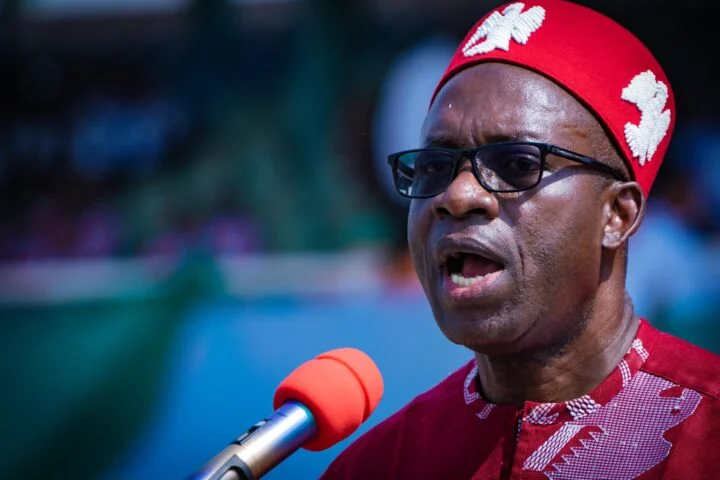
The political fight between former Anambra Governor Peter Obi and the government of his successor’s successor, Governor Chukwuma Soludo, has suddenly become a forensic argument over ledgers, loan agreements and what, precisely, it means to leave a government “debt-free.”
While on the face of it, it appears to be all about debts, many see political machinations to undermine Obi’s presidential ambitions for 2027 to serve Soludo’s planned vice presidential ambition for 2031.
At the centre of the dispute is a number that has now entered Nigeria’s 2027 political conversation: ₦127.37 billion.

The Soludo administration says that is the naira value, at the official exchange rate, of the outstanding balance as of June 30, 2026, on eight external loan facilities associated with projects contracted during Peter Obi’s administration.
Obi says he left Anambra without unpaid salaries, pensions, gratuities or liabilities to contractors whose work had been executed and certified. He has challenged the government to produce evidence and said he would abandon his presidential campaign if anybody can establish that he left an unpaid obligation of the sort he described.
On Wednesday, the Anambra government responded with a detailed statement from Commissioner for Information and Value Reorientation Law Mefor, listing eight external facilities and arguing that Obi’s “debt-free” narrative is false.
But a closer examination of the available records reveals an important distinction that has been largely lost in the political exchange: A loan being signed during an administration is not necessarily the same thing as the full amount being disbursed during that administration. And the balance of a loan in 2026 is not the same thing as the debt balance inherited in March 2014.
The distinction could determine whether the present controversy is a straightforward exposure of a misleading political claim or an incomplete presentation of an otherwise legitimate debt history.
The first thing the records establish: Anambra was not literally debt-free
This is the easiest part of the dispute to verify.
The Debt Management Office’s historical records show that as of December 31, 2013, less than three months before Obi handed over power on March 17, 2014, Anambra had:
▪︎ US$30.323 million in external debt
▪︎ ₦3.026 billion in domestic debt
Those are DMO figures.
The DMO’s own subsequent publication shows Anambra’s external debt at US$41.46 million as of June 30, 2014, and US$45.15 million by December 31, 2014.
That creates a fundamental problem for any blanket interpretation of “I left the state debt-free.”
If “debt-free” means that Anambra had no formal public debt obligations whatsoever, the available DMO evidence does not support that proposition.
A 2025 Guardian fact-check reached essentially the same conclusion, finding that Obi’s broad statement that he left Anambra without debt was misleading when measured against the DMO’s formal debt records.
But there is an equally important caveat.
The DMO records do not, by themselves, establish that Obi left unpaid salaries, unpaid contractors or unpaid pensions.
Those are separate categories of liabilities.
And this is where the current dispute becomes considerably more complicated.
“No contractor debt” is not the same claim as “no public debt”
Obi’s recent statements have concentrated heavily on salaries, pensions, gratuities and contractors.
He says his administration liquidated more than ₦35 billion in historical gratuity and arrears and that, on the day of handover, there were no outstanding salaries, pensions or gratuities that the state was obliged to pay. He also says no contractor whose work had been duly executed and certified was owed money.
The DMO, meanwhile, records formal public debt.
Those are not interchangeable accounting categories.
A government can have:
an external development loan;
cash and investments in its accounts;
no unpaid salary bill;
no certified contractor invoice awaiting payment;
all at the same time.
That means the argument “Obi left money in the bank, therefore he left no debt” does not follow automatically.
Conversely, the existence of a DMO-recorded loan does not prove that Obi left unpaid contractors or pensioners.
The most defensible interpretation of the evidence therefore requires the two questions to be separated.
Question one: Did Anambra have formal public debt when Obi left?
The evidence says yes.
Question two: Did Obi leave the state with unpaid salaries, pensions, gratuities and certified contractor obligations?
That remains a separate factual dispute requiring documentary evidence beyond the DMO debt tables.
Orire School Abduction: Victim Describes 56 Days of Torture, Hunger in Captivity
Then comes the ₦127.4 billion question
The Anambra government says Obi’s administration contracted US$123.77 million across eight external facilities.
It says the loans were associated with projects including malaria control, Fadama, health-system development, education, community development, erosion and watershed management, and agricultural value-chain development.
It further says US$92.35 million remained outstanding as of June 30, 2026, which it converts to approximately ₦127.37 billion.
There is an important correction here.
An earlier version of the government’s statement reportedly contained a vastly different figure, including an erroneous reference to “US$127.77 billion.” The government subsequently clarified that the correct aggregate original loan amount was US$123.77 million, not billion.
The correction is important because the difference between millions and billions is not a minor typographical detail in a political argument about public debt.
The government’s corrected figure is therefore the one that should be examined.
But the government’s ₦127.4bn figure is a 2026 balance – not necessarily a 2014 handover balance
This is the central unresolved issue.
The government’s table, as reported, aggregates the original amounts of eight facilities signed between 2007 and 2013 and then gives their outstanding balances in 2026.
That establishes that these facilities exist and that they have outstanding balances.
It does not yet establish, from the documents publicly examined for this report, exactly how much had been drawn down by March 17, 2014.
This is crucial.
Suppose a state signs a US$48 million development facility in 2013, but only US$15 million is disbursed before the governor leaves office. If another US$20 million is disbursed under a successor, it would be misleading to describe the entire US$48 million as money borrowed and spent by the first administration.
The legal commitment, the amount disbursed and the amount outstanding are three different accounting concepts.
An independent analysis of the dispute has highlighted precisely this issue: the US$123.77 million in the Anambra government’s new publication appears to represent the aggregate original amounts of the facilities, whereas what is required to establish the March 2014 liability is the amount actually disbursed and outstanding at handover.
That is the missing bridge in the government’s argument.
The DMO’s historical numbers make that gap impossible to ignore
The DMO recorded Anambra’s external debt at only US$30.32 million at the end of 2013.
Six months later, in June 2014, the DMO recorded US$41.46 million.
By December 2014, it was US$45.15 million.
The progression is relevant.
If the eight facilities listed by the Soludo administration totalled US$123.77 million in original commitments, the public record still needs to answer: How much of those facilities had actually been disbursed by March 17, 2014? And: How much of the post-2014 increase in Anambra’s external debt resulted from subsequent drawdowns rather than debt inherited in cash terms on the day Obi left?
Without those figures, the ₦127.4 billion number cannot be treated as synonymous with “₦127.4 billion debt left by Peter Obi in 2014.”
It is a 2026 outstanding balance on facilities the state associates with his administration.
Those are not necessarily the same proposition.
There is another problem: the DMO’s public website does not presently show a June 30, 2026 subnational external-debt publication
This is one of the most significant findings from checking the government’s source.
The Anambra government says it summarised the latest DMO report on the state’s debt position as of June 30, 2026.
However, the DMO’s publicly accessible Sub-National Debts archive currently lists:
domestic debt data through March 31, 2026;
external debt data through December 31, 2025.
The DMO’s listed subnational external-debt publication for December 31, 2025 was published in April 2026. There is no June 30, 2026 subnational external-debt publication visible in that public archive at the time of this investigation.
That does not prove that the Anambra government’s June 2026 figures are false.
The state may have access to a more recent DMO dataset, correspondence or debt-service schedule that has not yet appeared on the public website.
But it means the crucial source should be published.
For a controversy involving ₦127 billion, the public should not have to reconstruct the underlying data from a political statement.
What the latest publicly accessible DMO data show
DMO data for December 31, 2025, as analysed by Nairametrics, put Anambra’s total external debt at approximately US$102.58 million. The figure had fallen from about US$103.69 million in 2024.
That is remarkably close to, but not identical with, the Anambra government’s later figure of US$92.35 million for the specific eight facilities it attributes to Obi.
This tells us something important: Anambra unquestionably has substantial external debt today.
But it does not tell us how much of today’s debt should legally or politically be attributed to Obi, because the state’s current external-debt stock includes obligations accumulated across successive administrations.
Attribution requires a facility-by-facility reconstruction.
The 2014 handover note: powerful evidence, but not the complete ledger
Obi’s camp has now published a handover document dated March 17, 2014, showing a positive financial position of more than ₦86 billion, with the figure built from cash, investments and other balances.
A similar figure – approximately ₦86.666 billion – was reported in an investigation published in 2014, which said it had examined the statutory handover note and supporting financial documents.
The handover figure is important evidence.
But it has a limitation.
The financial summary does not, by itself, constitute a complete debt schedule.
It shows assets and balances. It does not automatically extinguish liabilities appearing elsewhere in government accounts.
An analysis published amid the current dispute makes this point: the circulated financial summary lists investments, cash and estimated liabilities, but does not provide a detailed schedule showing every external facility, outstanding principal, undisbursed commitment or contingent liability.
Therefore, the handover note can establish that Obi’s government claimed to be transferring a substantial positive financial position.
It cannot, without the underlying debt schedules, establish that Anambra had no formal public debt.
The old ₦75bn versus ₦185bn argument has returned from the grave
This is not the first time Anambra’s political class has fought over Obi’s financial legacy.
In 2015, the Willie Obiano administration disputed Obi’s claim that he had left about ₦75 billion for his successor.
Obiano’s government said it inherited roughly ₦9 billion in cash and ₦26 billion in near-cash assets, alongside about ₦185.1 billion in project/contract liabilities.
Obi’s representatives disputed that account.
Independent fact-checking later noted that the ₦75 billion figure involved cash, local investments, foreign-currency investments and certified balances, and that the competing descriptions of what constituted “cash,” “investment” and “liability” made the dispute difficult to resolve conclusively from publicly available information.
This historical argument is relevant because it demonstrates a recurring feature of Anambra’s fiscal politics: The two camps have repeatedly used different definitions of “what was inherited.”
One side tends to count cash and investments.
The other counts contracts, commitments and liabilities.
Both can produce dramatically different numbers without necessarily describing the same accounting category.
The ecological fund is a separate controversy
Obi has also claimed that approximately ₦2.13 billion remained in a First Bank account at the Nnamdi Azikiwe University branch when he left office.
He says the money was released by the Federal Government for a specific erosion-control project and that he deliberately left it untouched for his successor.
The Anambra government disputes this.
Law Mefor says the state obtained a certified statement of the account and determined that the account was an internally generated revenue/consolidated-revenue account rather than an ecological-fund account.
This allegation should be relatively easy to settle.
The government has identified the account.
Obi has identified the account.
The documentary test is straightforward: Produce the complete certified bank statement covering the relevant period.
Identify the Federal Government remittance into the account.
Identify the originating agency and purpose of the payment.
Establish the balance on March 17, 2014.
Establish subsequent withdrawals and transfers.
Produce the relevant erosion-control approval or project documentation.
Until those records are placed side by side, this remains an allegation-and-denial contest.
The pension and salary allegations also require documentary proof
The Soludo administration says Obi left verified salary, gratuity and pension obligations involving retired teachers and workers of the defunct Water Corporation. It also says subsequent governments have continued to deal with inherited arrears.
Obi says the opposite and maintains that historical arrears exceeding ₦35 billion were liquidated under his administration.
Here again, neither a political statement nor a handover speech is enough.
The decisive documents would be: payroll arrears schedules as at March 17, 2014;
pension verification lists;
gratuity payment vouchers;
court judgments and settlement agreements;
Water Corporation staff liability schedules;
Treasury payment records;
certificates showing the periods for which arrears were paid.
The government should publish the list of beneficiaries it says were owed.
Obi’s camp should publish the corresponding payment schedules it says cleared them.
That would turn the argument from politics into an auditable investigation.
What the evidence currently supports – and what it does not
After examining the available evidence, five conclusions stand out.
1. The claim that Anambra had absolutely no formal debt when Obi left office is not supported by DMO records.
The DMO recorded US$30.32 million in external debt and about ₦3.03 billion in domestic debt at December 31, 2013.
2. The Anambra government’s claim that eight external facilities associated with the Obi years exist is substantially supported by the published reporting and its disclosed project list.
The facilities cover recognised development areas including health, education, malaria control, erosion, agriculture and community development.
3. The ₦127.37 billion figure should not automatically be described as “the debt Obi left behind in 2014.”
That figure represents the government’s stated June 30, 2026 outstanding balance on the specified facilities.
The missing evidence is the facility-by-facility amount actually disbursed and outstanding on March 17, 2014.
4. The current DMO public archive does not independently reproduce the June 30, 2026 figure cited by Anambra.
Its publicly accessible subnational external-debt series currently goes through December 31, 2025.
The state should therefore release the underlying DMO schedule it relied upon.
5. Obi’s ₦86 billion handover figure does not, by itself, prove that Anambra had no debt.
A government can possess substantial cash and investments while simultaneously carrying formal debt obligations.
The real question is the net fiscal position, including both assets and liabilities, on March 17, 2014.
There is a simple way to end much of the argument.
The Anambra government should publish details for every one of the eight facilities.
Obi’s camp, for its part, should publish the complete March 17, 2014 financial statement rather than only the summary page, including all debt schedules, contingent liabilities and loan commitments.
The controversy is being fought as though there are only two possible stories.
Either Peter Obi left Anambra completely debt-free and solvent, or he left behind a massive debt burden.
The documentary record does not support such a simple binary.
The evidence shows that Anambra had formal public debt near the end of Obi’s tenure.
It also shows that Obi’s government had substantial financial assets and that his administration claims to have cleared significant historical arrears.
It shows that the state continued to carry external obligations after 2014.
It does not yet publicly establish, from the evidence independently accessible in the DMO archive, that US$92.35 million – or ₦127.37 billion at today’s exchange rate – was the amount actually outstanding when Obi handed over on March 17, 2014.
That is the critical distinction.
The Soludo administration has produced a list of loan facilities and a 2026 balance.
Obi has produced a handover statement showing substantial positive assets.
Neither document, standing alone, resolves the complete March 2014 balance sheet.
And that is why the most important document in this dispute has not yet appeared in public: the audited, facility-by-facility debt position of Anambra State on March 17, 2014.
Until that ledger is produced, the political argument will continue to generate headlines while the accounting question remains open.
In a contest increasingly centred on claims of transparency and accountability, the decisive evidence should not be another speech from Awka to independently validate the stronger claim that the entire ₦127.37 billion now cited by the Soludo administration represents debt that Obi personally left outstanding at the moment of handover. The DMO’s historical figures are strong evidence against a literal “zero formal debt” claim, but the government’s ₦127.4bn figure needs a loan-by-loan disbursement and handover reconciliation.
It should be the books.
The available evidence is sufficient to reject the simplistic proposition that Anambra had no formal debt when Peter Obi left office. It is not yet sufficient to independently validate the stronger claim that the entire ₦127.37 billion now cited by the Soludo administration represents debt that Obi personally left outstanding at the moment of handover. The two claims require different evidence – and the public deserves to see that evidence separately.