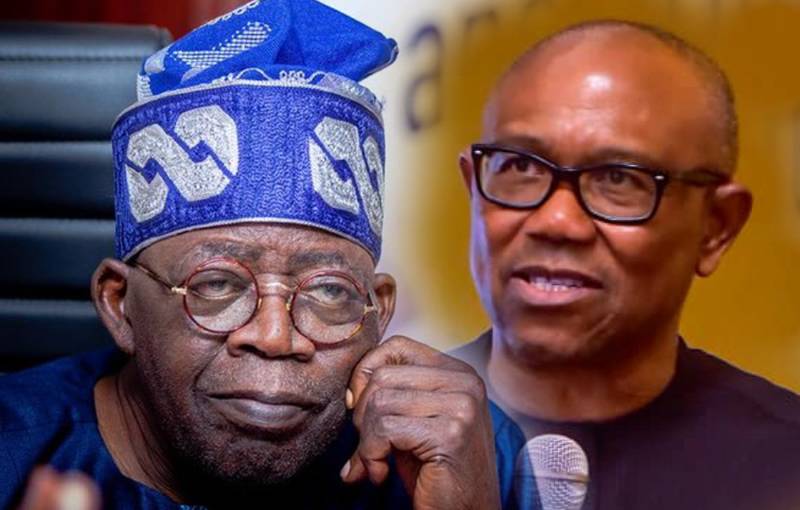
The political battle lines are sharpening ahead of Nigeria’s next presidential contest, with the Peter Obi Media Office firing back at critics who have dismissed the former Anambra State governor’s growing political profile as nothing more than hype.
In a statement issued on Sunday, September 13, the media office declared that Peter Obi’s presidential credentials are rooted in his performance record, not political patronage, challenging supporters and surrogates of President Bola Ahmed Tinubu to put the records of both men side by side.
The statement, signed by Idris Zekeri Jnr, argues that Obi’s case for the presidency goes beyond popularity ratings and campaign rhetoric.
Its central message is blunt: Obi has already run a government – and Nigerians can judge him by what he did with public resources.
According to the media office, Obi governed Anambra State from 2006 to 2014, surviving political and legal battles before winning re-election in 2010 and completing his tenure.
The statement highlights what it describes as Obi’s record of fiscal discipline, pointing to savings and investments accumulated during his administration. It cites figures contained in Obi’s 2023 manifesto, including approximately $500 million in investments and savings, among them $156 million in dollar-denominated bonds.
For Obi’s camp, the argument is simple: while governments are often judged by how much they spend, Obi’s record, it argues, should also be judged by what he saved and invested for the future.
Education, healthcare and human capital
The media office also puts education at the centre of Obi’s governance record.
It says his administration returned mission schools to their original owners and worked with them to improve educational outcomes. The statement further cites Obi’s manifesto, which claims that Anambra rose from 24th position to first in WAEC/NECO performance for three consecutive years.
Healthcare is another major plank of the argument.
The statement says more than a dozen health institutions in Anambra, including two hospitals, secured accreditation during Obi’s tenure, compared with none at the beginning of his administration.
Beyond physical infrastructure, the Obi camp points to scholarships, healthcare spending, poverty mapping and other human-capital programmes as evidence of a governance philosophy centred on building people and institutions.
The media office also cites Obi’s reported engagements with international development organisations, including the World Bank, UNDP, DFID and the European Union.
It says his administration employed data, poverty mapping and planning tools while developing the Anambra Integrated Development Strategy (ANIDS).
And then comes what the statement describes as perhaps Obi’s strongest selling point: his experience outside politics.
Before becoming governor, Obi worked in business and banking, including senior positions in the financial sector. His supporters argue that this combination of private-sector experience, financial management and executive governance gives him a different profile from a politician whose experience is built primarily around political office.
“He is not asking Nigerians to let him learn”
The Obi Media Office’s political argument ultimately boils down to one powerful proposition: Peter Obi is not asking Nigerians to make him president so he can learn how government works.
Rather, it says, he is asking Nigerians to entrust him with the country after what his supporters regard as a demonstrable record of managing public finances, investing in human capital, strengthening institutions and planning for the long term.
But the statement does not stop there.
It launches a broadside against the Tinubu administration, listing what it describes as ten failures Nigerians cannot ignore.
Tinubu administration under fire
At the top of the list is the cost-of-living crisis.
The Obi Media Office argues that the removal of the petrol subsidy and other economic reforms have been accompanied by steep increases in food, transportation and other essential costs.
It also points to inflation, declining purchasing power and the naira’s depreciation, arguing that Nigerians now need substantially more money to purchase the same goods and services.
Fuel prices, rising poverty and hardship, limited employment opportunities and persistent security challenges also feature prominently in the indictment.
The statement cites continuing concerns over banditry, terrorism, kidnapping and communal violence, arguing that the security situation remains a major test for the federal government.
It also raises questions about transparency and public trust, pointing to controversies around government spending, appointments, procurement and the management of public resources.
Another criticism is political: Obi’s media office accuses the administration of appearing more concerned with political consolidation and the 2027 calculations than with building strong institutions.
The statement’s final charge is perhaps its broadest – that there remains a troubling gap between government promises and Nigerians’ lived experience.
The big political question
The Obi camp acknowledges that President Tinubu inherited a difficult economic and security environment.
But it insists that this cannot be the end of the argument.
Its challenge to the administration is straightforward: After the difficult decisions, are Nigerians better off?
The Peter Obi Media Office says the answer is an emphatic no.
Whether that verdict resonates with the wider electorate will be one of the defining political questions as Nigeria moves toward another fiercely contested presidential cycle.
For now, however, Obi’s camp has made its position unmistakable: Popularity, it says, is not the foundation of Peter Obi’s presidential ambition. Performance is.
And with the political temperature rising, the battle over whose record deserves Nigeria’s trust has already begun.