
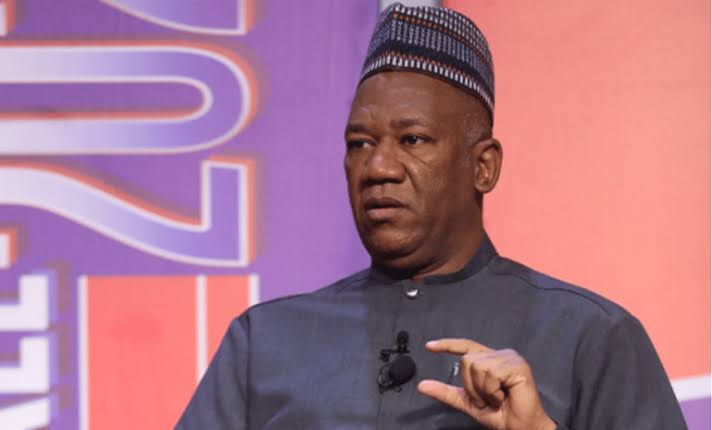
From Mauritania to Zaria, a family history of Islamic scholarship, migration and education resurfaces
A fresh revelation by former presidential candidate and politician Yusuf Datti Baba-Ahmed about his family’s ancestry has ignited interest in a remarkable chapter of Nigeria’s religious, intellectual and migration history.
Speaking during an interview with journalist Seun Okinbaloye on the Mic On Podcast, Baba-Ahmed said his family descended from what he described as “jihadists” who were Qur’an memorizers and established schools across the region.
He also disclosed that his father, originally from the territories of present-day Mauritania, Algeria and Morocco, settled in Nigeria in 1925.
“Our dad of blessed memory settled in Nigeria in 1925,” Baba-Ahmed said, describing a family tradition deeply rooted in Islamic learning and education.
The disclosure has since generated attention because of one particularly charged word: jihadists.
But beneath the provocative headline lies a far more complicated historical story.
From the Sahara to Zaria
Long before Baba-Ahmed became a politician, senator, educationist and the running mate to Peter Obi in the 2023 presidential election, his family had already established deep roots in northern Nigeria.
Historical profiles published years before the latest revelation document his father’s origins in Mauritania and his eventual settlement in Zaria, Kaduna State.
A detailed 2018 Daily Trust account described Baba-Ahmed’s father as a Mauritanian cattle trader who was attracted to Zaria because of the city’s reputation as a centre of Islamic scholarship. He subsequently became prominent as an Islamic scholar and authority on Islamic jurisprudence.
The family eventually became one of Zaria’s prominent intellectual and professional families.
The patriarch reportedly had 33 children, many of whom received both Islamic and Western education—a combination that would become one of the defining characteristics of the Baba-Ahmed family.
According to the family’s own history, the father was sufficiently respected for his Islamic knowledge to advise traditional authorities in the Zazzau emirate on Sharia and Islamic jurisprudence.
This background is significant.
It suggests that the family story was not simply one of migration from North Africa to Nigeria, but of the transplantation of an Islamic scholarly tradition into northern Nigerian society.
But what did Baba-Ahmed mean by “jihadists”?
This is where the story requires careful handling.
In today’s international media vocabulary, the word jihadist commonly evokes violent extremist organisations such as Boko Haram, al-Qaeda or Islamic State.
But the word has a much older historical meaning.
Across West African history, “jihad” was also used to describe Islamic reform movements, religious struggles and political movements that emerged centuries before today’s jihadist organisations.
The famous nineteenth-century jihads associated with Shehu Usman dan Fodio transformed the political and intellectual landscape of northern Nigeria and the wider western Sudan.
They also produced a powerful tradition of Qur’anic education, scholarship, writing and religious instruction.
It is therefore misleading to automatically translate Baba-Ahmed’s reference to ancestral “jihadists” into a claim that his family descended from modern terrorists.
Indeed, the statement attributed to him specifically links his ancestors’ jihadist identity with Qur’an memorisation and the establishment of schools.
The context is crucial.
There is currently no credible evidence that Baba-Ahmed was claiming that his father or immediate family members belonged to Boko Haram or any contemporary terrorist organisation.
Nor is there evidence that the Baba-Ahmed family itself constituted a modern extremist network.
A family built around scholarship
The older record of the family points overwhelmingly toward scholarship, education, public service and commerce.
The patriarch’s decision to settle in Zaria was reportedly influenced by the city’s reputation as a centre of Islamic learning.
The family’s children were encouraged to pursue Western education even as Islamic learning remained central to their upbringing.
The dual educational philosophy produced an unusual family legacy: Islamic scholarship on one side, and professional, political and academic achievement on the other.
Datti Baba-Ahmed himself eventually became an economist, entrepreneur and founder of Baze University in Abuja.
His brother, Hakeem Baba-Ahmed, has also occupied prominent positions in Nigerian public life.
In 2023, Hakeem wrote that their father came from Mauritania to Nigeria around 1920, and described him as passionate about spreading Islamic knowledge and serving the public.
The account differs slightly from Datti’s latest recollection of 1925, but both place the family’s migration in the same broad period – the early decades of the twentieth century.
The 1925 journey
The migration story itself opens a fascinating window into Nigeria’s history.
By the early twentieth century, northern Nigeria was connected to a vast network of trade, scholarship and migration stretching across the Sahara and Sahel.
People, books, religious ideas, livestock and commercial goods moved across territories that today are divided among several countries.
A scholar or trader from Mauritania could therefore establish himself in northern Nigeria without abandoning his intellectual and religious identity.
For the Baba-Ahmed family, Zaria became the destination.
And there, according to the family’s history, the migrant trader gradually became an Islamic scholar and community figure.
The result was a Nigerian dynasty whose roots reached across the Sahara.
From cattle trader to Islamic authority
Perhaps the most striking part of the family’s history is the transformation of Baba-Ahmed’s father.
He arrived in Nigeria as a Mauritanian cattle trader but became increasingly immersed in Islamic scholarship.
The Daily Trust account says he eventually gained recognition for his knowledge of Islamic jurisprudence and served as a counsellor to Zazzau’s traditional authorities on matters of Sharia.
He was also associated with Barewa College, one of northern Nigeria’s historic educational institutions.
Thus, the family’s legacy became inseparable from education.
The same family that traced its ancestry to Islamic reformers produced children who went through Nigeria’s modern educational system and eventually entered politics, business, law, academia and public administration.
The historical shadow of jihad
Yet Baba-Ahmed’s use of the word “jihadist” inevitably raises a larger historical question.
Who exactly were the ancestors he was referring to?
At present, that question remains unanswered.
His interview does not provide a genealogical chain identifying a particular nineteenth-century jihad leader or commander from whom the family directly descends.
There is also no independently published genealogy presently available that conclusively establishes such a connection.
What can be established is the family’s Mauritanian origin and long association with Islamic scholarship.
The more specific claim – that the clan descended from historical jihadists – comes from Baba-Ahmed’s own account and would require further genealogical documentation before it can be independently verified in detail.
Nigeria’s history is full of religious movements whose meanings have changed dramatically over time.
The word “jihad” itself cannot simply be stripped from its historical context and equated with twenty-first-century terrorism.
Doing so risks collapsing two very different eras into one.
A nineteenth-century Islamic reformer who participated in a jihad and an individual who belongs to a modern terrorist organisation may both be described using the same word, but they belong to radically different historical contexts.
The distinction is particularly important in the case of Baba-Ahmed because the publicly available history of his family points strongly toward religious scholarship and education, rather than evidence of contemporary violent extremism.
The Boko Haram question
There is another reason the issue demands precision.
Baba-Ahmed’s family history has previously intersected with Nigeria’s troubled debate over Islamist militancy.
His father was a prominent Muslim figure who was involved in discussions concerning Boko Haram during the insurgency.
But attempts to establish dialogue with an armed group are not themselves evidence of membership of that group.
The historical episode should therefore not be confused with Baba-Ahmed’s newly discussed ancestral history.
A story bigger than one politician
Ultimately, the revelation is about more than Datti Baba-Ahmed.
It is a story about how Mauritanian migration, Islamic scholarship, trans-Saharan commerce and northern Nigerian society intersected over generations.
It is also a reminder that some of Nigeria’s most prominent families possess histories that stretch far beyond the borders of the modern Nigerian state.
Baba-Ahmed’s family journey – from the Islamic scholarly world of the western Sahel to colonial-era Zaria, and from traditional Islamic learning to modern universities and national politics – is a remarkable illustration of that history.
The question now is not simply whether Baba-Ahmed’s ancestors were “jihadists.”
The more interesting question is: Which jihadists, in which historical movement, and what precisely was their connection to the Baba-Ahmed lineage?
Until that genealogy is produced, the safest conclusion is that Baba-Ahmed has publicly identified his ancestry with a historical Islamic tradition that he associates with Qur’anic scholarship and education.
The available evidence does not establish a connection between his family and modern jihadist terrorism.
What it does establish is the extraordinary journey of a Mauritanian family that crossed the Sahara, settled in Zaria and built a Nigerian legacy around faith, scholarship, education, commerce and public life.
And that, perhaps, is the more fascinating story.