By Alifa Daniel, who was in Ibadan & Lagos
In a country where citizens routinely worry about kidnappers, bandits, terrorists, rising food prices and the cost of getting to work, Nigeria’s latest political drama has produced an unusual security assignment: protecting campaign posters.
As President Bola Ahmed Tinubu prepares to flag off the All Progressives Congress (APC) presidential campaign for the 2027 election in Kaduna on Saturday, October 24, security personnel have reportedly been deployed to protect his campaign billboards and posters against possible vandalism.
The development has triggered a wave of mockery, anger and political commentary online, with critics asking whether Nigeria has finally discovered a new category of VIP requiring round-the-clock protection: the presidential photograph.
The controversy has also handed opposition politicians a ready-made campaign talking point, served up an internet feast of political sarcasm and revived an old question about the gap between the security enjoyed by those in power and the insecurity endured by ordinary Nigerians.
According to Daily Trust, personnel of the Kaduna State Traffic Law Enforcement Authority (KASTLEA) and the Nigeria Security and Civil Defence Corps (NSCDC) were among those assigned to guard Tinubu’s campaign materials, particularly along major roads leading to the Kaduna Township Stadium.
A security operative reportedly told the newspaper that the assignment was intended to prevent vandalism, especially at night, when youths might attempt to damage the materials.

The guards were said to be stationed along the route from the stadium towards Kawo, while police officers and plain-clothes operatives maintained a visible presence around major roads and roundabouts.
Thus, as the President prepares to meet supporters in Kaduna, his campaign photographs have acquired something many Nigerians would dearly love for themselves: dedicated security attention.
Former Vice-President Atiku Abubakar wasted little time exploiting the optics.
In a post on X on Friday, the African Democratic Congress (ADC) presidential candidate questioned why a president who claims to enjoy widespread public support should require security personnel to protect his campaign billboards.
“Bola, you claim Nigerians love you, yet your billboards in Kaduna require security guards,” Atiku wrote.
He contrasted the reported protection of the posters with the plight of communities facing attacks by bandits and terrorists.
“Your posters enjoy protection that millions of Nigerians can only dream of,” he added, describing the situation as a tragic statement about the administration’s priorities.
His punchline was direct: “Bola, please protect Nigerians with the same urgency you protect your image!”
The criticism quickly gained traction in news reports and online discussions. Social media users seized on the apparent irony, although the reactions themselves do not establish whether Tinubu is broadly unpopular in Kaduna or across the North.
Among the comments reported by Nigerian media, @AndrewOkere wrote: “This is laughable. Imagine security operatives guarding Tinubu’s billboard instead of citizens? Nigeria MUST be OK”.
Another user, @McFobiz, interpreted the arrangement as a sign of political rejection, while @HAHayatu argued that the reported deployment suggested the administration was concerned about the President’s popularity.
Those are political interpretations, not independently established facts. But they capture the central problem facing the APC’s campaign managers: a measure intended to protect campaign property has become an opportunity for opponents to question the government’s priorities.
The social media verdict, at least among the critics whose comments were published, was less about the durability of billboard materials than about the durability of public trust.
FG Records 653 Terrorism Convictions as 11th Mass Trial Phase Continues in Abuja
State Police Amendment Clears Hurdle as 24 Assemblies Approve Bill – Gbajabiamila
October Bloodshed: Sokoto Passenger Attack, 15 Borno Farmers Killed, 113 Deaths Reported in Benue
Kaduna government: It is routine security, not billboard panic
But before the internet could formally appoint the posters as the most protected political personalities in Nigeria, a counterargument emerged from Kaduna State.
In a response reported by Trust Radio, Abdullah Yunus Abdullah, a senior aide to Governor Uba Sani on new media, dismissed claims that security personnel had been specifically deployed to shield Tinubu’s campaign materials because of widespread hostility towards the President.
He said security deployments were routine whenever a high-profile visitor arrived, with officers assigned to strategic locations such as markets, roundabouts, flyovers and places of worship.
He also cited similar arrangements during the administration of former President Muhammadu Buhari.
His argument was straightforward: the presence of security personnel around campaign routes should not automatically be interpreted as proof that the President is unpopular.
He may be right. Securing a presidential visit, managing crowds and preventing vandalism are normal considerations during major political events.
Nevertheless, the reported account from a security operative specifically described an assignment to protect campaign posters and billboards. That detail is what gave the controversy its unusual political flavour.
The government’s explanation may account for the security presence, but it has not erased the optics of personnel reportedly tasked with protecting campaign materials.
In politics, as the saying goes, perception can sometimes run faster than an official statement.
The stadium is ready; the voters have questions
Meanwhile, Kaduna has been preparing for a major political spectacle.
The Kaduna Township Stadium, an approximately 8,000-capacity venue, has been repainted and decorated with APC flags and campaign materials bearing the images of Tinubu, Vice-President Kashim Shettima and Governor Uba Sani.
The surrounding roads have also received their share of campaign decoration. Police patrol vehicles and armed officers have been seen around the stadium and other strategic locations.
Deputy Governor Hadiza Balarabe, who chairs the rally’s Local Organising Committee, expressed satisfaction with preparations after inspecting the venue. She said the facilities were ready, with arrangements also being made for security screening and the reception of visitors.
The state’s Commissioner for Information and Culture, Ahmed Maiyaki, said mobilisation was continuing and hotels and serviced apartments across Kaduna metropolis had been fully booked.
The APC expects a substantial turnout, with governors from the seven North-West states and other party leaders expected to attend.
But outside the stadium, the mood is not entirely captured by the flags, fresh paint and carefully positioned photographs.
But online newspaper, Premium Times, in a report on Thursday October 22 found residents raising concerns about food and transport costs, insecurity, unemployment and the difficulty of sustaining household budgets.
Commercial bus driver Dan Kundi said it was not enough to organise rallies and make promises; people wanted improvements in their lives.
Other residents interviewed by the newspaper similarly urged the President to explain how his policies would address their daily struggles.
The contrast is striking. Inside the campaign arena, organisers are preparing for a celebration of political support. Outside it, many citizens are asking when political promises will translate into affordable food, jobs and safer communities.
A billboard can be repainted in a day. Restoring public confidence is a considerably longer project.
Lagos: APC everywhere, opposition somewhere
If Kaduna has turned campaign security into a national talking point, Lagos has offered another lesson in the politics of visibility.
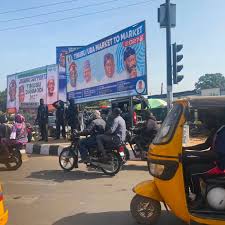
Across much of Lagos, the campaign landscape has been overwhelmingly dominated by the ruling APC. More than 99 per cent of visible billboards and posters, according to observations belonged to the party, while materials belonging to other parties had frequently been removed or torn down.
The result is a visual environment in which the ruling party appears to have purchased not merely advertising space but a substantial share of the city’s political scenery.
Yet the apparent dominance comes with an important qualification: the ability to occupy public space is not necessarily a direct measurement of popular support.
Money matters. Access matters. Regulation matters.
Opposition politicians in Lagos have complained about high signage and outdoor advertising fees, arguing that the charges make it difficult for less-funded candidates and smaller parties to compete.
A report by Trust Radio in August noted that billboard advertising costs depended on the location, size and duration of the advert, with some locations attracting charges running into millions of naira. The report also highlighted a non-refundable application fee for certain large outdoor advertisements.
In other words, some candidates may have to overcome a formidable financial hurdle before their message can even reach the roadside.
The irony is hard to miss: democracy promises voters a choice, but the cost of making that choice visible can be prohibitive for the politicians seeking their votes.
Lagos is believed to be particularly sensitive following President Bola Tinubu’s loss of the presidential ballot there three years ago. It was especially painful for his supporters who took it for granted that his legacy as a two-term governor was enough. He was beaten there by the then Labour Party candidate, Mr. Peter Obi.
A lot of the perceived persecution suffered by persons and businesses of Igbo extraction since then has been attributed to that defeat. The atmosphere in Lagos is thick with that perception. When an Igbo trader in one of the popular busstops on the outskirts of Lagos was asked why he intermittently shouted, ‘Power Must Change Hands’ last week Friday, he smiled mockingly and said it was a refrain from the Pentecostal fold of the Christian faith.
An airport taxi driver had pointed out that posters of other political parties under the bridge at the taxi stand where he picked the reporter were torn down overnight. He however, offered a small exception to the APC-dominated landscape in Lagos. He pointed towards opposition posters near the entrance to the local wing of Murtala Muhammed Airport, suggesting that their proximity to a police station might have helped them survive.
It was an observation, not proof of why the posters remained standing. Still, it provided an irresistible image: in Lagos, a political poster might need a good location, a generous budget and, if the driver’s theory is correct, a conveniently nearby police station.
The joke practically writes itself.
Ibadan: Makinde’s colours, opposition still in the picture
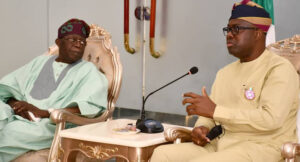
In Ibadan, the Oyo State capital, the visual contest appeared more varied.
Many of the posters sighted belonged to the Allied Peoples Movement (APM), the party associated with Oyo State Governor Seyi Makinde, who is its presidential candidate.
The opposition APC also had some billboards and posters still standing, alongside materials from other political parties.
The election there promises to be interesting as most respondents there say the contest for the Oyo gubernatorial seat is a proxy slug-out between him and a prominent traditional ruler backing the the APC candidate.
Compared with the overwhelming APC presence described in Lagos, Ibadan offered a more visibly competitive political landscape.
That does not automatically mean the APM enjoys greater electoral support than its rivals. Posters can reflect the organisation, funding and enthusiasm of campaign teams as much as the preferences of voters. This is more so in Lagos where many respondents appear to be seething under over the economic hardship and bullying tactics of the ruling party.
Nevertheless, the difference between the two cities highlights an important feature of Nigeria’s electoral politics: the battle for attention is fought not only at rallies and on television but also on walls, bridges, roadsides and every available advertising surface.
In one city, the ruling party seems to have won much of the billboard war. In another, a governor’s party has made its presence conspicuous. And in Kaduna, the argument has shifted from who owns the most posters to who is assigned to protect them.
The real campaign is about more than posters
The controversy arrives at a sensitive moment for the APC, which is seeking another presidential mandate in 2027.
A rally can demonstrate organisational strength. A crowded stadium, a long convoy, decorated roads and supporters dancing beneath party flags can all communicate momentum.
But none of these, on its own, settles the question of how voters will behave when they enter the polling booth.
Nor does the protection of campaign materials prove that a candidate is unpopular. Posters may be guarded to prevent deliberate vandalism, preserve expensive property or maintain order around a major event.
The more substantial question is why the episode has proved so politically combustible.
It has done so because the reported deployment has collided with a much wider public concern: the persistent difficulty of keeping communities safe while households struggle with the cost of living and young people search for employment.
Atiku has turned that contrast into an attack on Tinubu. Online critics have turned it into satire. Kaduna officials have argued that security measures should not be misrepresented as evidence of political rejection.
All three developments form part of the same contest over the meaning of a campaign image.
For the APC, the Kaduna rally is an opportunity to project unity, strength and a commanding presence in the North-West.
For the opposition, the guarded posters are an opportunity to challenge the administration’s claim to public affection.
For citizens concerned about insecurity and economic hardship, the controversy raises a more practical question: will the promises made from the rally podium produce results beyond the campaign season?
Tomorrow’s rally, today’s unanswered questions
As Kaduna prepares to welcome Tinubu and visiting governors, the campaign machinery is in motion. The stadium is decorated, roads are lined with political messages, security arrangements are in place and party supporters are mobilising.
But the campaign has acquired an unexpected subplot.
The President’s photographs are attracting attention not simply because they are everywhere, but because reports say some of them require protection.
That is a gift to political satirists, although it is not, by itself, a reliable poll of public opinion.
The larger test will come when the flags are taken down, the stadium returns to ordinary use and campaign vehicles leave the city.
Will voters remember the speeches, or will they remember the cost of food? Will promises of security translate into safer journeys and communities? Will young people hear credible plans for employment? And will the political parties compete on the strength of their ideas as well as their ability to occupy public space?
For now, Nigeria’s campaign season has supplied a memorable tableau: in Lagos, the billboards are overwhelmingly APC; in Ibadan, the political colours are a little more mixed; and in Kaduna, security personnel have reportedly been assigned to protect the President’s campaign materials.
The posters may survive the night. The argument over what they represent is likely to last much longer.
And if the campaign is meant to convince Nigerians that the President enjoys their affection, the most useful security detail may ultimately be one that no police officer can provide: a credible record of results that makes voters want to keep the posters standing.■