
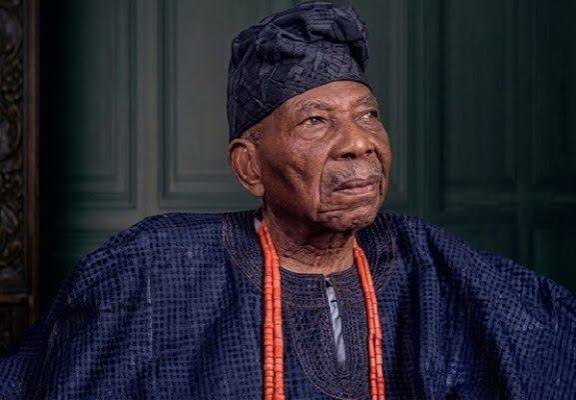
The Yoruba elder statesman was an educationist, former Ondo State Commissioner for Finance and a prominent disciple of Chief Obafemi Awolowo.
Pa Reuben Famuyide Fasoranti, a respected Yoruba elder statesman, educationist and national leader of the pan-Yoruba socio-political organisation, Afenifere, has died at the age of 100.
His death was announced on Tuesday, October 20, 2026, by Ondo State Governor Lucky Aiyedatiwa in a statement issued in Akure, the state capital.
The governor described the late Afenifere leader as a revered elder statesman whose life was defined by wisdom, integrity and selfless service to Ondo State, the Yoruba people and Nigeria.
“With a heavy heart but with total submission to the will of God, I announce the passing of our revered elder statesman, Pa Reuben Famuyide Fasoranti, who departed this world at the glorious age of 100,” Aiyedatiwa said.
The governor added that Fasoranti’s counsel, fatherly guidance and principled positions on justice and good governance would be sorely missed.
He extended condolences to the Fasoranti family, the people of Akure Kingdom and residents of Ondo State, praying for the peaceful repose of the deceased’s soul.
President Bola Tinubu also mourned the elder statesman, describing him as one of the foremost custodians of Awolowo’s progressive political tradition. He highlighted Fasoranti’s contributions to education, public administration, democracy and the advancement of the Yoruba people.
Fasoranti’s biography: Early life and education
Pa Reuben Famuyide Fasoranti was born on May 11, 1926, in Uso, a community in present-day Ondo State, southwestern Nigeria. He celebrated his 100th birthday on May 11, 2026, making him one of the prominent Nigerian political figures whose lives spanned the colonial era, independence, military rule and the return to civilian democracy.
Fasoranti began his education at a village school in Uso before proceeding to Owo for further studies. He attended Ondo Boys’ High School and Yaba Higher College in Lagos before gaining admission to the University College, Ibadan, now the University of Ibadan, where he studied English and Geography.
He subsequently obtained a postgraduate qualification in education from the University of Hull in the United Kingdom and a master’s degree in Education Administration and School Management from Macquarie University in Sydney, Australia.
His educational background shaped a career that combined teaching, school administration, institution-building and public service.
Career as a teacher and educationist
Fasoranti began his teaching career at Ondo Boys’ High School and later served in several educational institutions, including Oyemekun Grammar School in Akure.
In 1957, he became the founding principal of Anglican Grammar School, Iju-Itaogbolu, where he spent about 14 years helping to establish and develop the school. The institution opened with only 30 pupils.
He later worked in Iwo, Oyo and Ado Ekiti, including serving as principal of Christ’s School, Ado Ekiti, before retiring from public education.
His commitment to education continued after retirement. He established Omolere Nursery and Primary School and Akure High School, contributing to the expansion of educational opportunities in Ondo State. He also established St Frances’ Academy in Igoba, Akure, in memory of his late wife.
Fasoranti’s educational philosophy aligned with the progressive ideals of expanding access to education and improving the welfare of ordinary Nigerians.
Political career and Awolowo’s influence
Fasoranti’s political convictions were strongly influenced by Chief Obafemi Awolowo, the late Nigerian nationalist and former premier of the Western Region.
He joined Awolowo’s Action Group and subsequently became associated with the Unity Party of Nigeria (UPN), which was founded by Awolowo and his political associates ahead of the 1979 general elections.
His political activities reflected his commitment to Awolowo’s progressive philosophy, which emphasised free education, accessible healthcare, employment opportunities, rural development and social welfare.
Following the UPN’s victory in the 1979 Ondo State governorship election, Governor Michael Ajasin appointed Fasoranti Commissioner for Finance in the old Ondo State.
He served in the position from 1979 to 1983, when the military coup that ended Nigeria’s Second Republic brought the civilian administration to an end.
His years in public office reinforced his reputation as an advocate of public accountability, responsible governance and policies aimed at improving citizens’ welfare.
Role in the pro-democracy struggle
Fasoranti was also associated with Nigeria’s pro-democracy movement, particularly the campaign against military rule following the annulment of the June 12, 1993 presidential election.
He became involved with the National Democratic Coalition (NADECO), a pro-democracy movement established in 1994 to press for the restoration of democratic governance.
The struggle exposed activists to intimidation, threats and other forms of persecution under the military regime of the late General Sani Abacha. Accounts of Fasoranti’s life also recount an assassination attempt during that period.
His political legacy therefore extended beyond Yoruba affairs to the broader struggle for democratic government, constitutionalism and political accountability in Nigeria.
Afenifere leadership and Yoruba affairs
Fasoranti became one of the leading figures in Afenifere, a pan-Yoruba socio-political organisation associated with Awolowo’s political tradition.
Following the death of Pa Abraham Adesanya in 2008, Fasoranti emerged as a principal leader of the organisation and became a prominent voice in discussions concerning Yoruba interests, national restructuring, federalism and governance.
Under his leadership, Afenifere continued to participate in national debates on constitutional reform, regional autonomy, social justice and the future of Nigeria’s political system.
In March 2021, Fasoranti stepped aside from the organisation’s day-to-day leadership, citing his advanced age. Pa Ayo Adebanjo subsequently became acting leader, although Fasoranti remained an influential elder within the movement.
His later years also witnessed disagreements within Afenifere over political alliances and the organisation’s position ahead of the 2023 presidential election. Fasoranti endorsed Bola Tinubu, while Adebanjo and his supporters backed Labour Party candidate Peter Obi.
Despite the disagreements, Fasoranti remained a significant figure in Yoruba political discourse and a link between the generation of Awolowo and contemporary Nigerian politics.
Family and personal life
Fasoranti’s personal life was marked by family devotion and profound loss. His wife died in 1991, and he did not remarry.
One of his daughters, Funke Olakunrin, was killed in July 2019 when gunmen attacked her vehicle on the Ore–Benin road in Ondo State. Her death attracted national attention and renewed concerns about insecurity on Nigerian highways.
Despite these personal tragedies, Fasoranti continued to be recognised for his dedication to public service, education and the political development of the Yoruba people.
A legacy of service
Fasoranti’s death marks the end of a century-long life that encompassed major turning points in Nigeria’s history, from colonial rule and independence to military dictatorship and democratic government.
His contributions as a teacher, school administrator, finance commissioner, pro-democracy activist and Afenifere leader earned him a place among the influential figures in southwestern Nigeria’s political history.
In his condolence message, Aiyedatiwa described the late elder statesman’s legacy as one of honour, integrity and service, saying his guidance and principled positions on justice and good governance would continue to inspire future generations.
Tinubu similarly praised Fasoranti’s discipline, commitment to social justice and unwavering dedication to the Yoruba people and Nigeria.
As tributes continue to emerge, the late elder statesman will be remembered for his commitment to education, his association with Awolowo’s progressive ideals and his decades of involvement in the struggle for democratic governance and the advancement of the Yoruba people.