● Former Kaduna governor tells Abuja court he neither intercepted NSA’s calls nor instructed anyone to do so as he opens defence in DSS prosecution
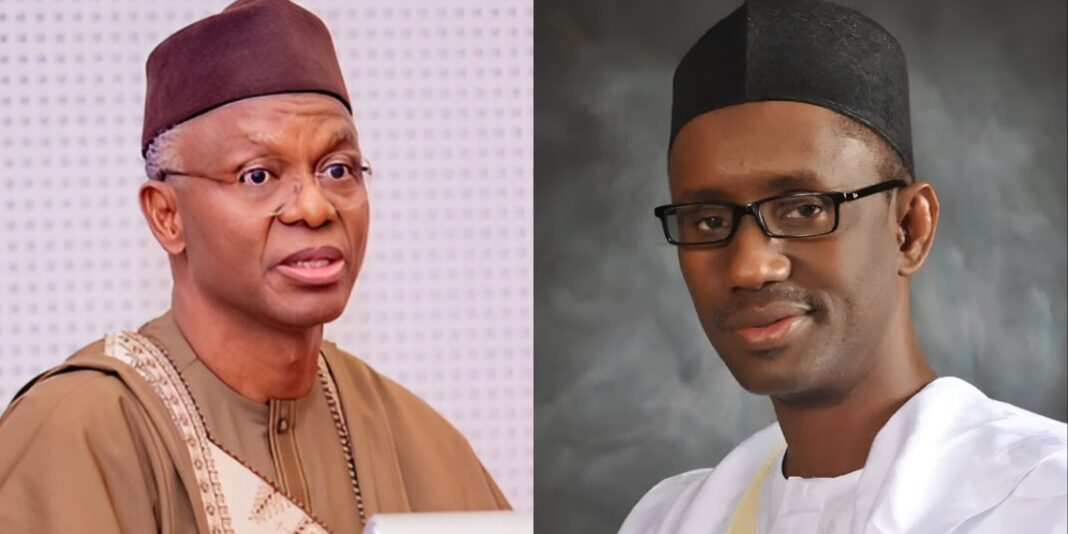
Former Kaduna State Governor Nasir El-Rufai has denied allegations that he unlawfully intercepted the telephone communications of National Security Adviser (NSA), Nuhu Ribadu, insisting that his controversial comments during a television interview earlier this year were political rhetoric rather than an admission of wrongdoing.
El-Rufai made the denial on Wednesday while opening his defence before Justice Joyce Abdulmalik of the Federal High Court in Abuja, where he is facing a five-count amended charge instituted by the Department of State Services (DSS) over the alleged unlawful interception of Ribadu’s telephone communications.
Testifying in his own defence, the former governor said he had never owned equipment capable of intercepting telephone conversations and possessed no technical knowledge of how such operations were carried out.
Led in evidence by his counsel, Paul Erokoro, SAN, El-Rufai also denied having access to Ribadu’s communication networks or devices. He further maintained that he neither intercepted the NSA’s telephone conversations nor instructed anyone to carry out such an operation on his behalf.
Explaining the statement that triggered the controversy, El-Rufai said his use of the word “we” during an interview on Arise Television in February referred to opposition politicians rather than a group of people involved in telephone interception.
He described his reference to phone tapping as an exaggeration intended to communicate his political frustration with the Federal Government.
“I used ‘we’ to refer to opposition politicians.
“When I said ‘tapped’, it was an embellishment intended to make the government feel the pain we are feeling.
“It was rhetorical and exaggerated. My objective was to engage in political retort and linguistic flourish,” he told the court.
HOW THE CONTROVERSY STARTED
The case originated from an interview El-Rufai granted Arise Television’s Prime Time programme on February 13, 2026, following a reported attempt by security operatives to arrest him at the Nnamdi Azikiwe International Airport, Abuja, upon his return from Cairo, Egypt.
During the interview, the former governor alleged that he had listened to a telephone conversation involving Ribadu in which the NSA allegedly instructed security operatives to arrest him.
His remarks generated widespread controversy, particularly after the programme’s anchor raised concerns about the legality of telephone interception.
The comments subsequently attracted the attention of the Federal Government and formed the basis of the DSS prosecution.
The prosecution argued that El-Rufai’s statements suggested knowledge of, and possible involvement in, the unlawful interception of the NSA’s communications.
The DSS also alleged that the circumstances surrounding the interception raised concerns about national security and the unauthorised use of technical equipment to access protected communications.
COURT REJECTS EL-RUFAI’S NO-CASE SUBMISSION
Wednesday’s proceedings followed an earlier decision by Justice Abdulmalik, who, on October 26, 2026, dismissed a no-case submission filed by the former governor.
El-Rufai had approached the court seeking to be discharged and acquitted, arguing through his legal team that the prosecution had failed to establish sufficient evidence to require him to enter a defence.
However, the DSS opposed the application, maintaining that the evidence presented during the trial established a prima facie case against the defendant.
In dismissing the application, Justice Abdulmalik held that the prosecution had presented sufficient evidence to warrant calling on El-Rufai to respond to the allegations.
The judge subsequently directed him to open his defence and adjourned the proceedings until November 25.
The prosecution had closed its case after presenting two witnesses, including a DSS operative and lawyer Deji Adeyanju, who testified in connection with the former governor’s controversial television interview.
During the prosecution’s case, the court reportedly examined the television interview, which the DSS relied upon as part of its evidence.
The prosecution also maintained that the interview contained statements relevant to the allegations against El-Rufai.
FIVE-COUNT CHARGE AND THE LEGAL BATTLE
The former governor is standing trial on a five-count amended charge filed by the DSS over allegations bordering on the unlawful interception of telephone communications, failure to report alleged unlawful interception and actions said to have implications for public safety and national security.
El-Rufai has denied the allegations.
The dispute has attracted considerable public attention because of the prominent positions occupied by both El-Rufai and Ribadu in Nigeria’s political and security landscape.
El-Rufai governed Kaduna State from 2015 to 2023, while Ribadu currently serves as National Security Adviser, a position that places him at the centre of the Federal Government’s national security coordination.
The latest development marks the beginning of the defence stage in the trial, with El-Rufai now seeking to challenge the prosecution’s allegations and explain the circumstances surrounding the statements that triggered the case.
The court is expected to continue hearing evidence from the defence as the proceedings unfold.