
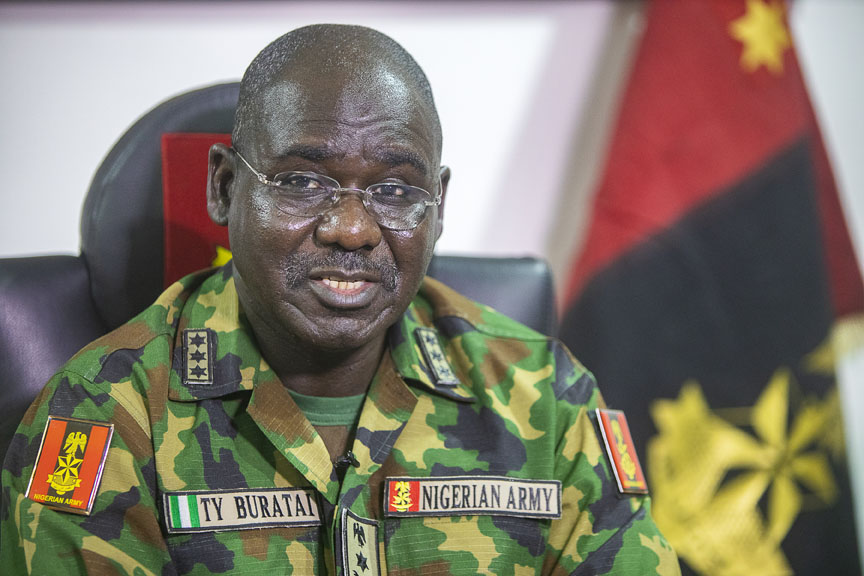
● Former Army Chief denies handling funds, urges ministry to publish defence contracts and expenditure records
Former Chief of Army Staff (COAS), Lieutenant General Tukur Buratai (retd.), has denied any personal involvement in the management or disbursement of the $1 billion special arms procurement fund approved in 2018, insisting that the money was released to the Federal Ministry of Defence rather than the headquarters of the Nigerian Army, Navy or Air Force.
Buratai made the clarification on Monday while speaking at a conference organised by the Defence Correspondents Association of Nigeria (DECAN) in Abuja, themed “Beyond Kinetic Warfare: Harnessing Technology and Intelligence-Led Operations for Nigeria’s National Security.”
He described allegations surrounding the fund as “political and malicious,” arguing that the controversy had unfairly damaged the reputations of service chiefs who, according to him, were not directly responsible for managing the money.
“The $1 billion was approved by the National Economic Council for defence procurement. Not a single dollar of that fund passed through my hands or through the accounts of the Nigerian Army, Navy or Air Force. The funds were released to the Ministry of Defence, and the entire procurement process was handled by that ministry,” he said.
The retired general maintained that accountability for the expenditure should rest primarily with the institution responsible for administering the procurement process.
Background to the $1bn arms fund
In 2018, the administration of former President Muhammadu Buhari approved the withdrawal of $1 billion from the Excess Crude Account (ECA) to finance the procurement of military equipment and arms amid escalating security challenges, including the Boko Haram insurgency and other forms of insecurity.
The decision generated public debate over the management of the funds, the procurement process and the extent to which the expenditure strengthened Nigeria’s military capabilities.
One of the major defence purchases around that period was the acquisition of 12 A-29 Super Tucano aircraft from the United States. On April 24, 2018, Buhari informed the House of Representatives that he had authorised an anticipatory payment of $496.37 million to the United States government for the aircraft, while seeking legislative approval for the expenditure.
The transaction was subsequently documented in proceedings of the National Assembly. Contemporary media reports also identified other releases for military equipment, including procurement intended for the Army, Navy and Defence Intelligence Agency. These transactions formed part of the debate over the utilisation of funds approved for national security.
Buratai faults Defence Ministry over accountability
Buratai traced the allegations of possible diversion of the $1 billion to the 2019 general election period, when opposition figures reportedly accused the Federal Government of diverting the money for political purposes.
He said the government had publicly rejected the allegations at the time but regretted that the controversy continued to cast a shadow over the service chiefs, while the ministry he identified as the fund administrator had not adequately explained the disbursements and contract awards.
“The ministry then, on its own, had not publicly explained how funds were disbursed or contracts awarded. Accountability must be properly located,” he said.
The former army chief argued that the absence of sustained public disclosure had allowed questions about the fund to persist, stressing that institutions responsible for public expenditure should be prepared to explain how appropriated or approved resources are utilised.
His remarks renew attention on the need for verifiable procurement records, including details of contracts awarded, the entities responsible for executing them, delivery schedules and evidence that equipment purchased was supplied in accordance with contractual terms.
However, Buratai’s account represents his position on the controversy; determining the complete financial trail and the status of individual contracts would require examination of official disbursement records, procurement documents and independent audit findings.
Proposes defence procurement transparency portal
As part of his recommendations for improving public confidence in the Armed Forces, Buratai called for the establishment of a Defence Procurement Transparency Portal through which the Ministry of Defence could publish relevant information on military contracts without compromising classified operational details.
He said the platform should provide information on broad categories of contracts, contracting entities and delivery timelines, subject to legitimate national security restrictions.
“The Ministry of Defence must own procurement records. The $1 billion arms procurement controversy festered because the institution that managed the funds, the Ministry of Defence, remained silent while Service Chiefs absorbed criticism,” he said.
He added that questions about the destination of public funds should be answered by the institutions that managed the expenditure, rather than by military officers who, according to him, did not directly handle the money.
“When the media asks where the money went, the answer should come from the ministry that spent it, not from military officers who never touched it,” he said.
Buratai also proposed the publication of quarterly accountability bulletins summarising the outcomes of court-martial proceedings involving allegations of human rights violations and operational misconduct.
He said such disclosures should be carefully managed to protect the rights of accused personnel, preserve the integrity of ongoing proceedings and prevent the release of information that could compromise military operations.
Calls for credible investigations into rights violations
Addressing allegations of human rights abuses by members of Nigeria’s security forces, the former army chief said credible complaints should be investigated and prosecuted where the evidence supports criminal charges.
“I have always maintained that where credible allegations exist, they must be investigated and, where substantiated, prosecuted. The military is not above the law,” he said.
He acknowledged that the military must demonstrate that its disciplinary mechanisms are credible, transparent and capable of addressing misconduct at every level of the command structure.
His position underscores the importance of ensuring that allegations against security personnel are assessed through established investigative and judicial processes, with due regard for the rights of complainants and accused persons.
Buratai further advocated stronger communication between the Armed Forces, the Ministry of Defence and the media, arguing that timely access to accurate information would help address public concerns and provide a fuller context for reporting on military operations.
Government calls for intelligence-led security operations
Earlier, the Minister of Information and National Orientation, Mohammed Idris, represented at the conference by the Director-General of the Voice of Nigeria, Jibrin Ndace, said Nigeria’s security challenges required a combination of military action, reliable intelligence, modern technology and stronger collaboration among security agencies and local communities.
Idris noted that military operations remained necessary but could not, on their own, address all the factors enabling insurgents, bandits and other criminal groups to recruit members and threaten citizens.
“This conference’s theme is particularly relevant because today’s security threats cannot be addressed by force alone. Military operations remain necessary, but they must be supported by reliable intelligence, modern technology, effective coordination among security agencies and cooperation with communities,” he said.
He said President Bola Ahmed Tinubu had placed national security at the centre of the administration’s development priorities, with ongoing efforts to modernise the Armed Forces, strengthen surveillance capabilities and improve coordination among security and intelligence agencies.
The minister also highlighted the President’s approval of salary increases ranging from 30 to 80 per cent for Armed Forces personnel, effective September 1, 2026.
The pay adjustment, announced in August, is expected to benefit approximately 250,000 military personnel. Under the approved structure, junior personnel from private to staff sergeant are to receive an 80 per cent increase, while personnel from warrant officer to colonel are to receive 50 per cent and officers above the rank of colonel are to receive 30 per cent.
The Federal Government has presented the increase as part of efforts to improve military welfare and morale amid continuing security challenges across the country.
Idris, however, stressed that security policies should be measured by their practical impact on citizens, including safer communities and roads, protection for farmers and businesses, and improved access to education without fear of attacks.
Idris urges responsible reporting without shielding authorities
The minister also highlighted the media’s role in shaping public understanding of security developments, urging journalists to verify information, report accurately and avoid amplifying rumours that could generate panic or undermine military operations.
He said responsible journalism should not be confused with shielding government institutions or security agencies from public scrutiny.
“This does not mean shielding the government or the security agencies from scrutiny. Journalists must keep asking difficult questions and hold institutions accountable, while respecting legitimate operational sensitivities,” he said.
The conference highlighted the relationship between national security, institutional accountability and public communication, with speakers emphasising the need for more effective intelligence gathering, technological innovation and cooperation between security agencies and the communities they serve.