
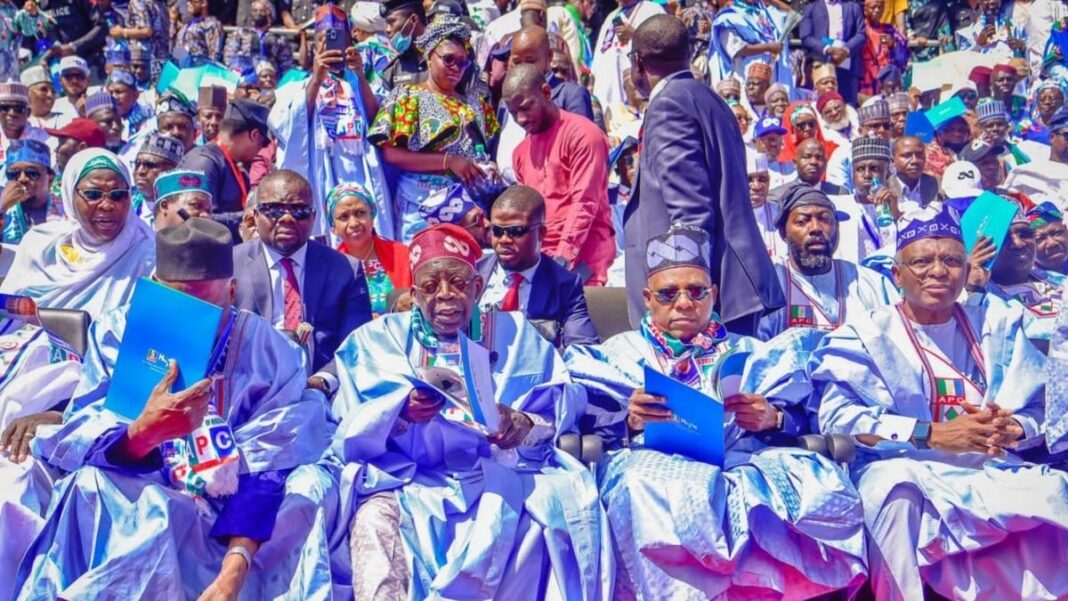
President Bola Ahmed Tinubu on Saturday, formally launched the All Progressives Congress (APC) presidential campaign for the 2027 general election in Kaduna State, calling on Nigerians to renew his mandate and give his administration more time to sustain economic reforms, infrastructure development and efforts to improve national prosperity.
The rally, which drew a mammoth crowd of APC supporters and party leaders from across the country, particularly the North-West, served as both a show of party organisation and a platform for the President to defend his record in office. It also provided an opportunity for the ruling party to highlight federal road construction, including the inauguration of an 81-kilometre section of the Abuja–Kaduna highway.
Yet, beneath the large turnout, political speeches and infrastructure announcements, the rally brought into focus the central questions likely to shape the 2027 election: whether Nigerians are experiencing tangible economic relief, how much progress has been made on public projects, and whether the administration can adequately address the challenges that remain.
President Tinubu thanked Nigerians for electing him in 2023 and argued that a second term would enable his government to consolidate ongoing reforms and development projects.
He promised continued economic recovery, prosperity and national development, while attributing much of the hunger and poverty criticised by opposition parties to problems inherited from previous administrations.
The President also cited regular salary payments, efforts to combat corruption and fuel smuggling, and measures to stabilise the economy as evidence of his government’s commitment to improving the country.
He urged eligible Nigerians to obtain their Permanent Voter Cards (PVCs) and participate in the 2027 general election.
The APC’s choice of Kaduna was politically significant. The North-West is an important electoral region, and the mobilisation of supporters from across the zone offered the party an opportunity to demonstrate organisational strength ahead of the election.
Major streets in Kaduna were occupied by party supporters, with hundreds travelling into the city in the days preceding the event.
The good: Infrastructure, connectivity and economic reform arguments
1. Abuja–Kaduna highway section inaugurated
One of the most significant developments associated with the Kaduna campaign was the inauguration of an 81-kilometre section of the Abuja–Kaduna highway.
Works Minister David Umahi said the completed stretch formed part of the first 118-kilometre section of the wider Abuja–Kaduna–Zaria–Kano corridor. He attributed the pace of construction to the administration’s funding decisions and its adoption of continuously reinforced concrete pavement.
According to the minister, more than 144 kilometres of the second section, covering 164 kilometres, had also been completed, with the remaining 20 kilometres expected to be finished by the end of November 2026. He said solar-powered streetlights were planned along the 375-kilometre corridor.
This durable, well-maintained highway can reduce vehicle operating costs, improve passenger travel and facilitate the movement of agricultural produce and commercial goods. Streetlighting may also improve visibility at night.
However, the project’s full economic and safety benefits will depend on maintenance, lighting coverage, road-user behaviour and security conditions.
2. Federal road programme in the North-West
Umahi reported the following figures at the rally:
348 km
Road projects reportedly completed in the North-West.
1,800 km
Roads described as partially completed.
4,083 km
Ongoing federal road projects cited for the region.
These are figures attributed to the Minister of Works, not an independent audit of completed infrastructure.
Many think the government should publish project-by-project records showing locations, contract values, commencement dates, physical completion, payments and outstanding work.
3. Economic stabilisation and investor confidence
There is a substantive argument behind the administration’s defence of its reforms.
The International Monetary Fund reported in June 2026 that Nigeria’s reforms had improved macroeconomic outcomes and strengthened economic resilience. It estimated economic growth at 4% in 2025 and projected 4.1% growth for 2026.
Reuters also reported that the government’s removal of the petrol subsidy and changes to the foreign-exchange regime had improved public finances, supported foreign reserves and attracted investment.
These developments provide context for Tinubu’s claim that the reforms are intended to establish a more stable economy.
The outstanding question is whether those gains will translate into higher real incomes, more jobs, cheaper essential goods and better living standards for ordinary Nigerians.
4. Political organisation and voter participation
The rally demonstrated the APC’s ability to assemble supporters and political leaders for a nationwide campaign launch. The presentation of flags to the party’s seven North-West governorship candidates also connected the presidential campaign to the party’s regional political organisation.
Tinubu’s call for eligible citizens to obtain their PVCs and participate in the election was another significant element of the event.
Voter participation is important, although the credibility of an election also depends on peaceful campaigning, freedom of political expression, transparent electoral administration and respect for the final results.
The bad: Economic hardship and the gap between reforms and household welfare
1. Falling inflation does not mean falling prices
The central economic challenge confronting the campaign is the gap between improved macroeconomic indicators and the financial pressures experienced by households.
Reuters reported on October 15, 2026, that Nigeria’s headline inflation rate eased to 14.63% in September from 15.39% in August. However, food inflation remained high at 19.59%, compared with 19.57% in August.
For families already struggling with food, transport, rent, electricity and school expenses, a lower inflation rate may offer little immediate relief if earnings remain insufficient.
Reuters’ reporting on the cost-of-living crisis has also documented households cutting consumption and struggling to make their incomes cover basic expenses.
The central question for the campaign: What specific, measurable improvements in purchasing power will Nigerians experience if Tinubu wins another term?
2. Blaming previous administrations leaves questions unanswered
At the rally, Tinubu attributed hunger and poverty criticised by opposition parties partly to problems inherited from previous governments.
Historical context is relevant. Nigeria’s economic challenges predate Tinubu’s presidency, and some of the reforms introduced since 2023 were designed to address longstanding fiscal and foreign-exchange problems.
But the President’s defence must also be assessed against the effects of decisions taken during his own administration.
The removal of petrol subsidies and changes to the foreign-exchange regime were intended to improve public finances and economic efficiency. They also contributed to a sharp increase in living costs, placing pressure on households and businesses.
Consequently, assigning responsibility to previous administrations does not resolve the question of how effectively the current government has protected vulnerable citizens or delivered relief.
The relevant test is not simply whether the reforms were necessary, but whether their benefits are reaching the population and whether the government has adequately addressed their social costs.
3. Regular salaries are important, but not a complete measure of welfare
Tinubu cited regular salary payments as evidence of his administration’s commitment.
Reliable salary payments matter to workers and their families. Nevertheless, the value of those payments depends on what they can buy.
If wages rise more slowly than food, housing, transport and electricity costs, workers can become poorer in real terms even when they receive their salaries on time.
A more comprehensive assessment would examine:
▪︎Real wage growth after inflation.
▪︎Employment creation and the quality of available jobs.
▪︎Household poverty and food insecurity.
▪︎The reach and effectiveness of cash transfers and other social protection programmes.
▪︎Access to affordable electricity, transport, education and healthcare.
These indicators would help determine whether the administration’s economic recovery is improving everyday life rather than merely strengthening aggregate economic figures.
4. Infrastructure claims require transparent verification
The road announcements are potentially significant, but the reported figures raise questions about accountability.
For instance, the claim that 348 kilometres of roads have been completed should be accompanied by a clear list of the roads concerned, their locations, costs and dates of completion. Similar documentation should be provided for the 1,800 kilometres reportedly partially completed.
The same scrutiny should apply to the Abuja–Kaduna–Zaria–Kano project. Citizens need clarity on what portions are fully usable, what work remains, how much has been spent and whether the stated deadlines are being met.
The government has reported substantial progress, but the figures cited at a campaign event should not be treated as a substitute for independent engineering inspections and public expenditure audits.
The ugly: Insecurity, vulnerability and the risk of political messaging overtaking public accountability
1. Insecurity remains a major test for the government
The North-West continues to face serious security challenges, including banditry, kidnapping and attacks on rural communities.
The security problem is particularly relevant to the Kaduna rally because improved roads alone cannot guarantee safe movement. Travellers, traders, farmers and residents also need effective policing, intelligence-led operations and protection against criminal attacks.
In August 2026, the Inspector-General of Police called for a coordinated regional response to insecurity in the North-West, highlighting the need for intelligence-sharing, cooperation between states and stronger community engagement.
This raises an important question for the President’s re-election campaign: what measurable security improvements will the administration deliver, and how will it assess success?
2. The risk of promises without measurable targets
Promises of prosperity, recovery and development are familiar features of political campaigns. Their public value depends on whether voters can later measure their delivery.
A credible programme for another term should identify specific objectives, deadlines, funding arrangements and indicators for assessing progress.
For example, the administration could publish measurable targets for:
▪︎Reducing food insecurity and the number of households unable to afford basic necessities.
▪︎Increasing real household incomes and productive employment.
▪︎Completing outstanding road projects within published budgets and deadlines.
▪︎Improving security in communities affected by kidnapping and banditry.
▪︎Publishing independently verifiable results for social assistance programmes.
Without such benchmarks, broad campaign promises are difficult to evaluate after the election.
3. A large rally cannot substitute for accountability
The Kaduna turnout may demonstrate the APC’s capacity to mobilise supporters. It cannot, on its own, establish that the administration’s policies have succeeded across the country.
The same principle applies in reverse: criticism from opposition parties does not, by itself, prove that every government policy has failed.
The appropriate standard is evidence. Citizens need comparable data, transparent public spending records and independent assessments of outcomes.
The rally is therefore best understood as the opening of a political contest in which the government is presenting its achievements and asking for more time, while the public has reason to examine both the results already delivered and the costs that remain.