
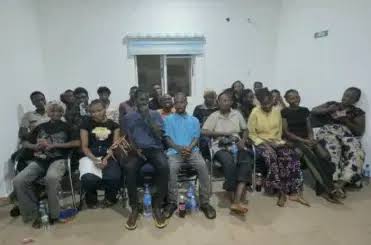
Families say they raised millions of naira, borrowed money and sent representatives to deliver ransom to kidnappers holding their children. The police say sustained security pressure forced the abductors to release their victims. Both accounts have emerged from the same ordeal, but a crucial question remains unanswered: what ultimately secured the freedom of the 20 prospective corps members and another abducted traveller?
For the families of the 20 prospective members of the National Youth Service Corps (NYSC) abducted in Imo State, October 7, 2026, was supposed to be the day the nightmare ended.
After nearly a week of uncertainty, fear and desperate attempts to secure their children’s freedom, the news finally came: the captives were free.
But almost immediately, another story began to unfold.
Some parents said they had paid millions of naira to the kidnappers. One family reportedly raised ₦6 million after struggling to meet a series of changing demands. Another parent said she paid ₦3 million to secure her child’s freedom.
The police, however, offered a different explanation. According to Imo State Commissioner of Police Audu Bosso, the kidnappers released the victims because security operatives had intensified their search and applied sustained pressure on their hideout.
The disagreement has turned what should have been an uncomplicated rescue story into a controversy over ransom payments, security operations and the unanswered details of how the victims regained their freedom.
So, what actually happened?
The available reports establish the abduction, the security operation and the eventual release. They also document families’ claims that ransom was paid. What remains unclear is whether the payments directly secured the victims’ release, whether security pressure independently forced the kidnappers to surrender them, or whether both developments played a part.
The journey that ended in captivity
The ordeal began on October 1, 2026, when gunmen attacked travellers along the Owerri-Onitsha Road in Imo State.
The prospective corps members were travelling from Ibadan, Oyo State, towards their NYSC orientation camps in Abia and Akwa Ibom states. Reports said the attack took place near Umunoha in Mbaitoli Local Government Area, at about 6:30 a.m., with the victims travelling in two buses.
The journey was meant to mark the beginning of a new chapter for the young graduates. Instead, it ended in an encounter that left families scrambling for information about their whereabouts and safety.
According to reports some passengers were initially rescued, while other victims remained in captivity.
The police subsequently launched search-and-rescue efforts with other security agencies.
For the families, however, the immediate concern was not the details of the operation. It was whether their children would return alive.
As the days passed, the fear intensified. A parent appealed to President Bola Tinubu and the Inspector-General of Police to intervene in securing the captives’ release.
The kidnappers were reported to have demanded ₦50 million per victim, an amount that would have placed the cost of securing all 20 prospective corps members far beyond the reach of most ordinary families.
The families now faced two frightening possibilities: find a way to meet the kidnappers’ demands or wait for a security operation whose outcome they could not predict.
The police located the hideout, but the rescue was not immediate
As the search intensified, the police announced a significant development: operatives had located the suspected kidnappers’ camp.
A report three days after the attack quoted Bosso as saying drone surveillance had helped security operatives identify the location where the victims were believed to be held.
But finding the hideout did not immediately translate into a rescue.
The police said the location was reportedly protected by improvised explosive devices (IEDs), complicating efforts to enter the area and reach the captives safely.
According to the police, security agencies continued to apply pressure, deploying additional operational resources as efforts to reach the victims intensified.
On October 7, the authorities announced that the remaining captives had regained their freedom.
The release involved 20 prospective corps members and another person who had also been abducted. The victims were taken to a Department of State Services (DSS) facility in Owerri for medical assessment and attention.
The police attributed the outcome to coordinated action involving security agencies, including the police, military and DSS.
On the face of it, the official account was straightforward: the security operation succeeded, and the captives were released.
But the families’ accounts would complicate that explanation.
Inside the ransom negotiations: From ₦50 million to ₦6 million
One of the most detailed accounts came from Alirat Wahab, the mother of a prospective corps member, whose family’s experience was reported following an interview with News Central Television.
According to Wahab, the kidnappers initially demanded ₦50 million for her son.
The family pleaded with them to accept a smaller amount, reportedly offering ₦500,000. The abductors rejected the offer.
Wahab said the demand later fell to ₦15 million, but the family continued negotiating because it could not raise that amount.
Eventually, according to her account, the kidnappers insisted on ₦6 million after the family said it could raise only ₦5.5 million.
The family said it paid the ₦6 million.
Wahab also described how her husband and elder son became involved in arranging delivery of the money. Family representatives were reportedly instructed to meet in Ibadan before travelling to Imo State, where the ransom was to be handed over.
The account included another significant detail: the family said it was instructed to transfer the money into an account and convert it to dollars after arriving in Imo State.
Wahab said her elder son eventually delivered the money and later informed the family that his brother had been released.
This is more than a general allegation that ransom was paid. It is a specific account describing the initial demand, subsequent negotiations, the final amount, the movement of family representatives and the reported handover.
Nevertheless, the account remains a family’s testimony as reported by the media. Publicly available reports have not established an independently verified payment trail or presented a response from the alleged recipients of the money.
This, however, does not invalidate the family’s account.
Another mother says she paid ₦3 million
Wahab’s account was not the only report of a family paying money during the crisis.
Another mother, speaking to News Central Television, said she struggled to raise ₦3 million while fearing for her child’s safety.
“I paid as much as N3 million as ransom while I was hoping that nothing happened to my child,” she said.
She described running from one person to another to raise the money before arranging for someone to take it to Imo State for delivery.
Another father said his family raised ₦6 million, partly through borrowing and contributions from relatives.
According to his account, family members gathered in Ibadan to pool their resources. Some reportedly converted their contributions into dollars before arranging delivery to Imo State.
The father was relieved that his son had returned, but the financial consequences of the ordeal remained.
“I am excited that my son is coming back. However, how do I repay the N6 million I borrowed? I’m just a farmer,” he lamented.
His question captures the second crisis facing some of the families: survival after the kidnapping.
The return of their children ended the immediate fear of losing them, but it did not automatically erase the debts incurred to secure their freedom.
These accounts also require a careful distinction. The reports of ₦3 million and ₦6 million describe payments or fundraising by particular families. They do not establish that every family paid ransom, that all the money went to the same recipients, or that a single payment arrangement covered all the victims.
Nor do the accounts, by themselves, establish whether the reported payments were the decisive reason the captives were released.
Then came the police denial
On Thursday, October 8, Bosso addressed the ransom controversy in an interview with Channels Television.
His position was that he was not aware of any ransom payment.
“I am not aware of any ransom paid,” he said, explaining that the pressure from security agencies combing the forest had mounted until the kidnappers succumbed.
The commissioner said the victims were receiving attention at the DSS facility in Owerri.
His account was not that the families had publicly demonstrated that no money changed hands. Rather, he said he was unaware of any ransom payment and attributed the release to security pressure.
There is a difference between saying that the police are unaware of a payment, saying that investigators have found no evidence of a payment, and establishing that no payment occurred.
The commissioner’s reported statement supports the first proposition. It does not, on its own, settle the other two.
Similarly, the parents’ accounts provide specific allegations that money was raised and delivered. But those accounts do not independently establish that the payment of ransom was the sole or decisive cause of the release.
The two accounts therefore do not necessarily describe mutually exclusive events.
Security operatives could have intensified pressure on the kidnappers while families were negotiating with them. Money could have changed hands before, during or around the period of the operation. Alternatively, the captives could have been released because of security pressure even as some families believed their payments had secured their children’s freedom.
These are possibilities, not established findings.
Available reports do not provide enough evidence to determine which sequence occurred.
Was it a rescue, a ransom release, or both?
This is the central question of the saga.
The official narrative emphasises the security operation: surveillance located the suspected hideout, reported explosive devices complicated access, and sustained pressure preceded the release.
The families’ narrative emphasises a different set of events: negotiations, changing ransom demands, emergency fundraising, borrowing, money transfers and the delivery of cash or foreign currency.
Both sets of accounts describe events surrounding the same release. The difficulty is that the public has not been given a sufficiently detailed, independently corroborated timeline to connect them.
To establish what happened, investigators and authorities would need to clarify several issues.
First, when exactly were the reported ransom payments made? Were they delivered before the security operation reached its decisive stage, during the operation, or shortly before the captives were released?
Second, did the payments concern individual victims or groups of captives? Were different families negotiating separately, or was there a coordinated arrangement involving representatives of several families?
Third, what information did security agencies possess about the negotiations? Were they aware that families were communicating with the kidnappers or arranging payments? If so, how did that information affect the operation?
Fourth, what did the rescued victims tell investigators about the circumstances of their release? Their accounts, considered alongside those of the families and security operatives, could help establish whether the kidnappers abandoned the captives, deliberately released them following negotiations, or responded to a combination of pressure and payment.
Finally, have investigators identified the alleged ransom recipients, traced any transfers or obtained other evidence that could independently confirm the families’ accounts?
These questions are not allegations of wrongdoing against the police or any other agency. They are the questions that arise when families provide detailed accounts of payments while the authorities publicly attribute the release to security operations.
A fuller account would require evidence that connects the two narratives.
Beyond the dispute over what secured the captives’ release lies a more difficult question about the burden placed on ordinary Nigerians by kidnapping.
For the family that reportedly paid ₦6 million, the crisis did not end when its son returned. The money had been raised through contributions and borrowing, leaving the family to confront the problem of repayment.
For the mother who said she raised ₦3 million, the financial scramble was inseparable from the fear of what might happen to her child.
These are not merely competing accounts of a security operation. They are accounts of families making urgent decisions under extreme pressure, with little certainty about what would guarantee their loved ones’ safety.
The wider context is troubling. The ICIR, citing a recent analysis based on data from SBM Intelligence and the ninth Nigeria Sustainable Development Goals 16 Shadow Report, reported that at least 7,825 people were abducted in 1,713 incidents across Nigeria between July 2025 and June 2026. The analysis also estimated that kidnappers demanded about ₦22.9 billion in ransom and received approximately ₦7.78 billion during the period.
Those figures are national estimates, not measurements of the ransom paid in the NYSC case. But they illustrate why the circumstances surrounding this incident matter beyond the affected families.
Where ransom payments are made, families face immediate financial losses, while payments can potentially provide criminal groups with funds to continue their activities. Where authorities successfully rescue victims through security operations, the public needs a clear account of what the operation achieved and how.
The challenge is to establish the facts without dismissing the families’ experiences or treating unverified claims as proven findings.
What government still needs to explain
Governor Hope Uzodimma commended the security agencies following the release, while acknowledging cooperation between the Imo and Oyo state governments.
That cooperation and the return of all 20 prospective corps members and the additional traveller were significant developments.
But the successful return of the captives does not remove the need to establish the circumstances surrounding their freedom.
The police and other relevant agencies can help resolve the controversy by providing a fuller account of the operation, explaining the basis for attributing the release to security pressure and clarifying whether investigators are examining the families’ allegations of ransom payments.
They should also provide information, where operationally appropriate, about efforts to identify and apprehend those responsible for the abduction.
The families, meanwhile, deserve to have their accounts taken seriously and assessed fairly. They should not have to choose between being grateful that their children are alive and seeking answers about the money they say they paid.
Most importantly, the investigation should establish the fate of the kidnappers. The reported release of the captives is one outcome; identifying and prosecuting those responsible is a separate task.