
President Bola Ahmed Tinubu has used this year’s Workers’ Day to cast a steady but unambiguous light on Nigeria’s most persistent strains, describing insecurity and poverty as twin emergencies shaping the country’s economic and social reality.
But the country’s labour force marked Workers’ Day under a cloud of deepening hardship, as the Civil Society Legislative Advocacy Centre (CISLAC) sounded a sharp warning: the system meant to protect workers is failing them. In a statement released Thursday, Executive Director Auwal Musa Rafsanjani painted a blunt picture of a workforce squeezed by soaring living costs and policies that continue to widen inequality. For millions, he said, the celebration rang hollow – another reminder that those who keep the country running are themselves struggling to survive.
Rafsanjani traced the crisis to entrenched structural flaws, arguing that public service systems and welfare schemes have become disconnected from the realities of ordinary workers. Subsidies meant to cushion hardship rarely reach their targets, while short-term policymaking has steadily eroded long-term social protection. The result, CISLAC warned, is a workforce trapped in persistent poverty, with the dignity of labour steadily diminished. Welfare, Rafsanjani stressed, must be treated not as a favour handed down, but as a fundamental right owed to every worker.
The group pushed for immediate and practical reforms: prompt payment of salaries, consistent promotions, and serious investment in training and skills development. It flagged a glaring gap in capacity building, noting that many workers are left without the tools to grow or adapt in a changing economy. At the same time, CISLAC challenged workers themselves to uphold standards – calling for an end to absenteeism, fraud, and complacency, and urging a renewed commitment to professionalism and accountability across sectors.
Even amid its critique, CISLAC struck a note of recognition, paying tribute to uniformed personnel, civil servants, private-sector employees, and development workers who continue to sustain national life under pressure.
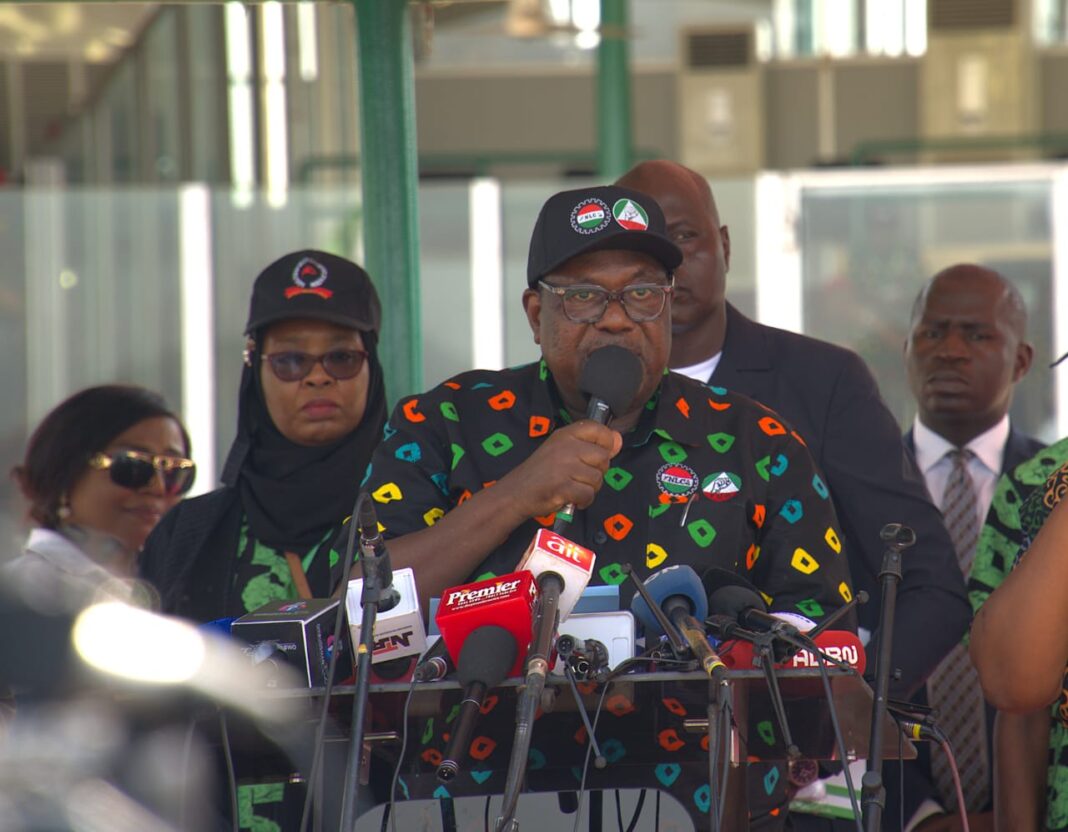
Speaking to thousands gathered at Eagle Square in Abuja through the Secretary to the Government of the Federation, Senator George Akume – the President linked the condition of workers directly to the wider climate of safety and survival. Employment, he suggested, loses its meaning where fear is constant and wages fall short of basic needs.
His remarks echoed the global Decent Work Agenda, but were grounded in local urgency. The administration, he said, recognises that without stability, neither productivity nor national confidence can take firm root.
Even so, the tone was not without resolve. Tinubu pointed to a series of ongoing interventions, presenting them as signs of a government attempting to respond in layers rather than slogans. The Community Protection Guards Initiative, for instance, has drawn tens of thousands of young Nigerians into community-based security roles – an effort that blends job creation with local vigilance.
Beyond security, the administration outlined its social and economic outreach. Expanded cash transfer programmes now extend to millions of vulnerable households, with officials estimating measurable movement out of extreme poverty. Meanwhile, major infrastructure projects, including the Lagos-Calabar Coastal Highway and the Ajaokuta-Kaduna-Kano Gas Pipeline, were cited as engines of employment, together accounting for hundreds of thousands of jobs.
For workers themselves, the message was one of incremental relief. A new national minimum wage has been introduced, pension arrears addressed, and gratuity payments restored as of January 2026. In quieter but notable steps, informal sector workers are being drawn into micro-pension schemes, while small businesses continue to receive support through a substantial funding pool.
Yet the President did not present these measures as a conclusion. Insecurity and poverty, he acknowledged, remain deeply rooted obstacles – ones that challenge not only economic ambitions but the simple expectation that citizens should live without fear.
His appeal to organised labour, including the Nigeria Labour Congress and the Trade Union Congress, carried a familiar caution: that dialogue should prevail over disruption, and that strikes, though legitimate, ought to remain a final recourse rather than an opening move.
There was also recognition of the human cost behind the statistics. Security personnel, he noted, continue to bear the burden of enforcement, often at great personal risk, forming the unseen backbone of the country’s fragile stability.
Framing the path forward, Tinubu described an approach that leans on agriculture, small enterprise development, infrastructure, and skills acquisition—sectors intended to widen opportunity and steady growth over time.
By the close of the address, the message settled into a quiet promise rather than a dramatic flourish: that Nigeria’s current difficulties, however entrenched, are not beyond reversal, and that the idea of decent work – secure, fair, and accessible – remains the standard the government claims to be working toward.