
Nigeria’s political landscape may be heading toward a major realignment ahead of the 2027 general elections, as a broad coalition of opposition parties has agreed to work toward presenting a single presidential candidate to challenge the ruling All Progressives Congress (APC).
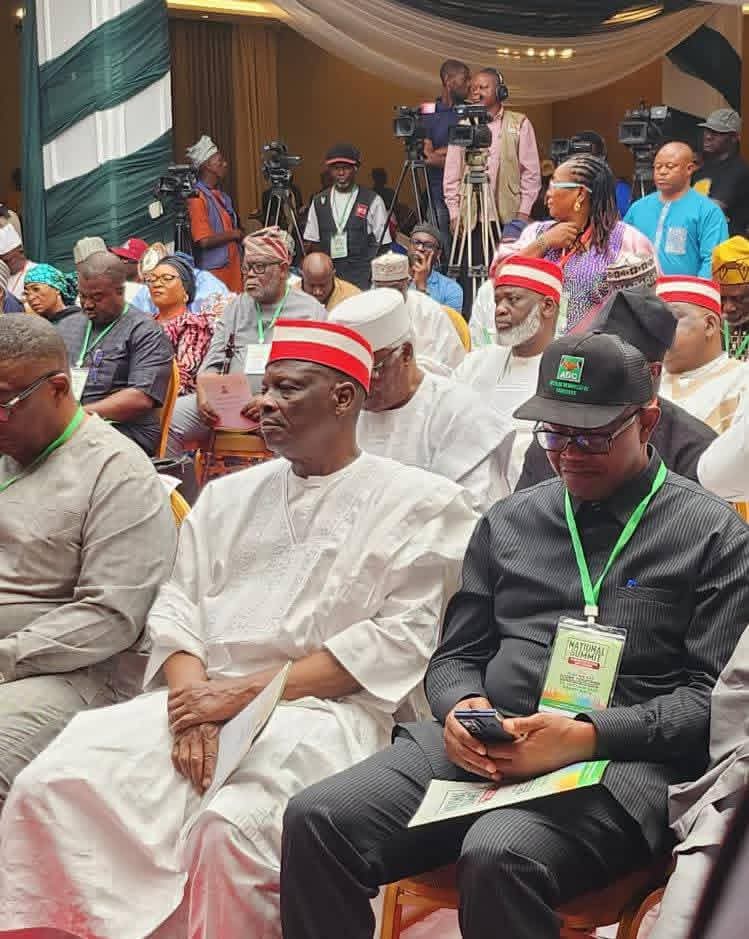
The decision was reached at a National Summit of Opposition Political Parties held in Ibadan, Oyo State, where prominent political figures and party leaders gathered to forge a unified strategy against the incumbent government.
The “Ibadan Declaration”
At the end of the summit, the coalition issued a communiqué – now widely referred to as the “Ibadan Declaration”—outlining a series of resolutions aimed at consolidating opposition strength.
Central to the declaration is the plan to field a consensus presidential candidate:
“We shall work towards fielding one presidential candidate… agreed and supported by all participating opposition parties.”
The move is widely seen as an attempt to avoid the vote fragmentation that weakened opposition chances in previous elections.
The parties also reaffirmed their intention to actively contest the 2027 elections, rejecting any suggestion of a predetermined outcome or uncontested candidacy.
Strong Warning Against “One-Party State”
A recurring theme throughout the summit was concern over what opposition leaders described as a drift toward one-party dominance.
The coalition accused the APC of attempting to consolidate power and warned that such a trajectory could undermine Nigeria’s democratic system:
• They pledged to “resist all machinations” toward a one-party state
• Emphasized the need to preserve multi-party democracy
• Described the 2027 election as a critical turning point for the country
Call for INEC Chairman’s Removal
In one of the most controversial resolutions, the coalition issued a vote of no confidence in the Chairman of the Independent National Electoral Commission (INEC), Professor Joash Amupitan.
They accused him of bias and partisanship in favor of the ruling party and called for his removal ahead of the 2027 elections.
The demand is linked to broader concerns about electoral integrity, with opposition leaders warning that:
• Public confidence in INEC leadership has eroded
• His continued tenure could undermine the credibility of the 2027 polls
• Failure to act may risk political instability
Push for Electoral Reforms
The summit also highlighted deep dissatisfaction with Nigeria’s current electoral framework.
Demands include:
• Urgent review of the Electoral Act 2026 to address perceived loopholes
• Removal of provisions seen as threatening election integrity
• Extension of deadlines for party primaries to July 2026
• Reversal of what the opposition described as restrictive INEC guidelines
Call for Release of Political Detainees
The coalition further called for the immediate release of politicians allegedly detained or harassed over bailable offences, arguing that such actions:
• Undermine democratic participation
• Limit political inclusivity
• Create an uneven playing field ahead of elections
Heavyweight Political Presence
The Ibadan summit drew several influential political figures, signaling the seriousness of the emerging coalition. Attendees reportedly included:
• Atiku Abubakar
• Peter Obi
• Rabiu Kwankwaso
• Rotimi Amaechi
• Rauf Aregbesola
• Seyi Makinde
Their presence underscores the growing momentum for a unified opposition front, although many note that agreeing on a single candidate could prove politically complex.
The coalition’s strategy is widely interpreted as a direct response to the expected re-election bid of incumbent President Bola Ahmed Tinubu.
Opposition leaders argue that only a united front can effectively challenge the ruling party’s dominance, particularly given:
• Internal divisions within opposition parties in past elections
• The APC’s strong national structure
• Ongoing debates over electoral transparency
While the agreement marks a significant step, several major questions remain:
• Who will emerge as the consensus candidate?
• Can historically rival politicians set aside differences?
• Will electoral reforms be implemented before 2027?
Governor Seyi Makinde emphasized that the initiative is not about targeting individuals but about strengthening democratic competition.
The Ibadan summit signals the most coordinated opposition effort in years and could reshape Nigeria’s political dynamics ahead of 2027.
If the coalition succeeds in maintaining unity and selecting a viable candidate, the next presidential election may become one of the most competitive in Nigeria’s recent history.
The Likely Contenders for a Unified Ticket
1. Atiku Abubakar
A perennial contender and former Vice President, Atiku remains one of the most experienced figures in Nigerian politics.
Strengths:
• Deep political network across all regions
• Strong backing in the North
• Established campaign structure
Challenges:
• Multiple previous presidential runs may create “fatigue” among voters
• Resistance from younger voters seeking a generational shift
• Trust deficit among some southern blocs
However, he is still a heavyweight—but not a consensus figure without concessions.
2. Peter Obi
The 2023 Labour Party candidate transformed into a mass-movement figure, especially among urban youth.
Strengths:
• Strong grassroots enthusiasm (“Obidient” movement)
• Appeal among young and middle-class voters
• Perceived personal integrity
Challenges:
• Weaker traditional political structure
• Limited control over entrenched party machinery
• Skepticism from older political elites
In summary, he is popular with voters, but may face resistance from political insiders.
3. Rabiu Kwankwaso
Leader of the Kwankwasiyya movement and former Kano governor.
Strengths:
• Massive following in Kano and parts of the North
• Strong grassroots political machine
• Loyal base
Challenges:
• Regional concentration of support
• Difficult coalition partner historically
• Limited southern appeal
He is a kingmaker – or spoiler – if not fully integrated.
4. Rotimi Amaechi
Former Rivers governor and ex-minister with deep ties across party lines.
Strengths:
• Elite political connections
• Experience in governance and federal politics
• Acceptable to some northern blocs
Challenges:
• Less grassroots enthusiasm nationally
• Perception as establishment politician
He is more viable as a compromise candidate than a frontrunner.
5. Seyi Makinde
A rising southern figure and host of the Ibadan summit.
Strengths:
• Incumbent governor with governance track record
• Seen as pragmatic and less polarizing
• Growing national profile
Challenges:
• Still building nationwide recognition
• Limited northern base
He is a potential dark horse if bigger names deadlock.
The Power Blocs That Will Decide Everything
Northern Political Establishment
• Historically decisive in presidential elections
• Likely to push for a northern candidate or at least strong influence
Southern Coalition
• Particularly the South-East and South-South blocs
• More inclined toward candidates like Obi or Makinde
Party Structures (PDP, LP, NNPP, ADC)
• Control delegates, funding, and legal frameworks
• Often clash with grassroots sentiment
Youth & Urban Voters
• Increasingly influential
• Strongly aligned with reform-oriented candidates
Now The Core Problem: Who Steps Down?
This is the real obstacle.
For a single candidate to emerge:
• At least 2–3 major contenders must step aside
• Or accept roles like vice president or coalition appointments
Historically, Nigerian politicians rarely yield power voluntarily – which makes this plan fragile.
Possible (Coalition) Scenarios
Scenario 1: Obi + Northern Running Mate
• Obi as presidential candidate
• Northern heavyweight as VP
● Energizes youth + balances region
● May face elite resistance
Scenario 2: Atiku Returns with Broad Coalition
• Atiku as consensus candidate
• Southern VP (possibly Obi-aligned figure)
● Strong structure
● Risks voter fatigue
Scenario 3: Compromise Candidate Emerges
Someone like Amaechi or Makinde becomes the “neutral option”
● Reduces rivalry
● May lack strong voter enthusiasm
Scenario 4: Coalition Collapses
• Multiple candidates run separately
This would likely benefit the ruling APC, especially since Bola Ahmed Tinubu seeks re-election.
Factors That Will Decide the Outcome
• Zoning (North vs South)
Still one of the most powerful informal rules in Nigerian politics
• Ego Management
Personal ambition could derail the coalition
• Electoral Reforms & INEC Trust
The controversy around Independent National Electoral Commission will shape credibility
• Economic Conditions
Voters’ dissatisfaction could boost opposition chances
Now The Reality Check
A single opposition candidate is strategically smart – but politically difficult.
• It requires unprecedented cooperation
• It challenges entrenched interests
• And it depends heavily on who is willing to sacrifice ambition
The Final Take
Right now:
• Peter Obi – strongest grassroots energy
• Atiku Abubakar – strongest political machine
• Kwankwaso – regional kingmaker
• Makinde/Amaechi – potential compromise options
The coalition’s success will hinge on whether it can turn ambition into alignment – something opposition politics has struggled to achieve in the past.