
By Sabastine Abu
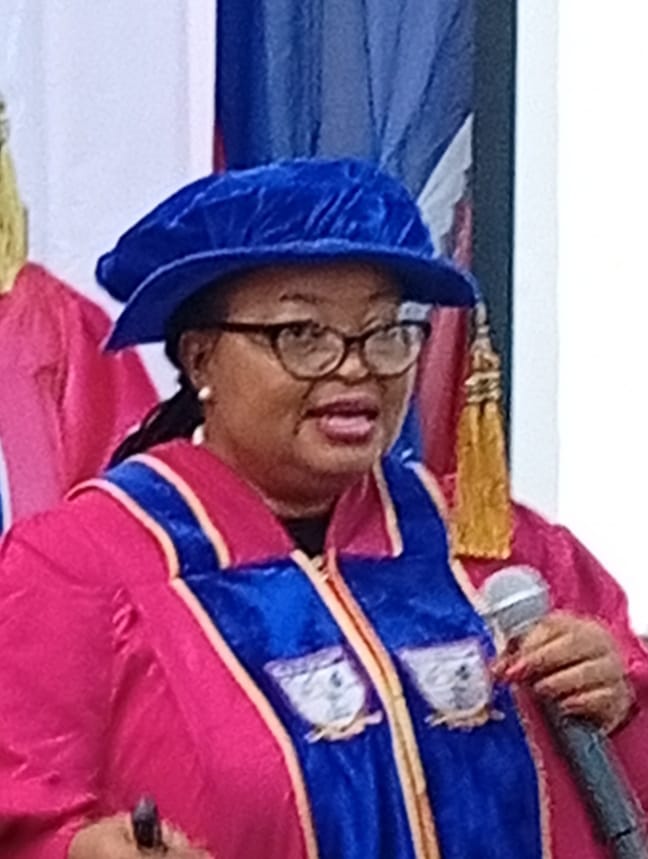
In a democracy, elections are the bedrock of legitimate governance, yet the integrity of that foundation rests precariously on the mechanisms available to challenge electoral malfeasance. It was this profound intersection of law, democracy, and justice that formed the intellectual core of the 13th inaugural lecture delivered by Prof. Magdalyne Mbadzendan Dura, Dean of the Faculty of Law at Bingham University, Karu.
Her lecture, titled “Unbundling the Burden of Proof in Election Cases: Law, Democracy and the Search for Electoral Justice,” offered a timely and rigorous examination of one of the most contentious procedural questions in contemporary electoral jurisprudence: who bears the burden of proof when election outcomes are contested, and what standard must they meet?
Prof. Dura is no stranger to the intersections of law, governance, and advocacy. Beyond her academic role as Dean of the Faculty of Law at Bingham University, she has served as Special Adviser to the Benue State Governor on Sustainable Development Goals and NEPAD, and as Chairperson of the International Federation of Women Lawyers (FIDA), Benue State chapter. Her scholarly output spans child protection law, international commercial arbitration, and the enforcement of collective agreements, a breadth that lends her insights on electoral justice a rare interdisciplinary weight.
The inaugural lecture itself is a cherished academic tradition at Bingham University, described by the institution as “a rare opportunity for scholars to present the essence of their intellectual journey, bringing together years of research, teaching and reflection into a coherent public narrative”. Prof. Dura’s lecture thus represented not merely a ceremonial address, but a distillation of scholarly rigour applied to a matter of urgent national concern.
In unbundling the burden, the core argument advanced in Prof. Dura’s lecture lies a deceptively simple question: in an election petition, upon whom does the law place the obligation to prove that the election was invalid? The answer, as she reportedly unpacked, is far from straightforward.
In most legal contexts, the burden of proof rests with the party making the allegation. For election challenges, this generally means the petitioner, the candidate or party challenging the outcome, bears the legal burden of proving their case.
However, Prof. Dura’s lecture appears to have critically examined the nuances that complicate this principle: the distinction between the legal burden (the obligation to prove a fact in issue) and the evidential burden (the duty to adduce sufficient evidence to raise an issue for consideration). As one authority puts it, “an evidential burden is not a burden of proof. It is a burden of raising, on the evidence in the case, an issue as to the matter in question fit for consideration by the tribunal of fact”.
The lecture likely traced how this distinction plays out in election petitions, where the legal burden remains on the petitioner, but the evidential burden can shift depending on how effectively the petitioner discharges their initial obligation. This “shifting” is not merely academic, it has profound practical consequences for the accessibility of electoral justice.
In addressing the issues in democracy and the search for justice, Prof. Dura went beyond technical legal exposition by anchoring her points on democratic theory. She posited that the outcome of election petitions, as courts have recognised, “implicates the ‘governance of a nation and the deployment of constitutional authority'”. When the burden of proof is set too high, or when its allocation systematically favours incumbents and state institutions, the right to challenge electoral fraud becomes a hollow entitlement.
This concern resonates powerfully with ongoing debates in Nigeria. In October 2025, Senior Advocate of Nigeria J.B. Daudu urged the National Assembly not to tamper with the burden of proof provision in election cases, warning that shifting the burden from petitioners to the Independent National Electoral Commission (INEC) could “permanently damage the avowed neutrality” of the electoral body. Yet others have argued precisely for such a shift, proposing that INEC should bear the burden of proving that elections were conducted properly.
Prof. Dura’s lecture appears to have navigated this contested terrain with scholarly nuance, “unbundling” the burden of proof to reveal not a single, monolithic obligation but a complex web of legal, evidential, and institutional responsibilities.
By framing the inquiry within the broader search for “electoral justice,” she reminded her audience that procedural rules are not neutral technicalities, but that they are expressions of democratic values.
For legal practitioners, the lecture offered a timely refresher on the shifting nature of evidential burdens in election petitions. For policymakers, it provided a scholarly foundation for evaluating proposed electoral reforms. And for the broader public, it demystified a legal doctrine that too often remains the preserve of specialists.
The lecture also underscored the vital role of universities in nurturing democratic culture. As Bingham University’s Vice-Chancellor, Prof. Haruna Kuje Ayuba noted in his welcome remarks, inaugural lectures “reinforce values such as scholarship, research, excellence, interdisciplinary dialogue, and knowledge sharing within the university system”. Prof. Dura’s contribution to this tradition was both intellectually rigorous and publicly engaged, a model of what legal scholarship can offer to a democracy in search of justice.
“Unbundling the Burden of Proof in Election Cases” as delivered in this lecture series, was more than an academic exercise. It was a call to examine the procedural architecture of electoral justice with the seriousness it deserves. In an era of contested elections and debates over electoral reform, Prof. Dura’s lecture reminds us that the burden of proof is not merely a legal technicality—it is a measure of how much we trust citizens to hold their leaders accountable, and how much we are willing to invest in making that accountability real.
● Abu, PhD., mni is the Deputy President of Nigerian Guild of Editors