
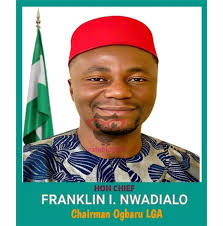
An international fraud case has culminated in the sentencing of a serving local government chairman to five years in a United States federal prison, after prosecutors proved he orchestrated a sophisticated online romance scam that swindled vulnerable victims out of more than $3.5 million over a period spanning more than a decade.
The convicted official, Francis Ikechukwu Nwadialo, who serves as Chairman of Ogbaru Local Government in Anambra State, was sentenced by the U.S. District Court in Tacoma, Washington, after pleading guilty to charges linked to a long-running romance fraud operation that targeted mostly elderly and emotionally vulnerable Americans.
American authorities identified him in court records as Franklin Ikechukwu Nwadialo, a 42-year-old Nigerian who frequently travelled between Nigeria and the United States. He was arrested at an airport in Texas shortly after arriving in America in 2024 and was later prosecuted in the Western District of Washington.
The sentencing marks the culmination of a federal investigation led by the Federal Bureau of Investigation, which described Nwadialo as a serial fraudster who spent years cultivating fake online identities to deceive lonely and grieving victims searching for companionship on dating websites.
According to prosecutors, Nwadialo operated under various aliases, most notably the name “Giovanni.” Using fabricated photographs and invented personal histories, he allegedly posed as a military officer deployed overseas, a successful businessman, and even a humanitarian working with autistic children.
Investigators said he established relationships with victims through popular dating platforms including Match, Zoosk and Christian Café before gradually manipulating them into sending large sums of money.
His stories were carefully crafted and emotionally charged.
In one instance, he convinced a victim that he had been punished by the military for revealing his location and urgently needed $150,000 to pay a supposed fine. In another, he claimed he needed help accessing family funds following his father’s death. Other victims were told he required money for funeral expenses, his son’s education, business investments, or emergency financial crises.
Federal investigators estimated that at least eight victims lost more than $3.5 million collectively.
Court documents revealed that some victims remained trapped in the fraudulent relationships for years before discovering the truth. One woman reportedly spent three years believing she was in a genuine romantic relationship before being informed by FBI agents that the man she loved did not exist. Another widow, who believed she had found companionship after the death of her husband, liquidated assets and exhausted her savings to support the fictitious “Giovanni,” ultimately losing her home and financial security.
During sentencing, U.S. District Judge Tiffany M. Cartwright described the scheme as “devastating,” emphasizing that the damage extended far beyond financial losses.
The court noted that victims suffered profound emotional trauma, including depression, shame, social isolation, and fractured family relationships.
Federal prosecutors argued that the defendant deliberately preyed upon individuals already coping with loneliness, bereavement, divorce, or emotional vulnerability.
“This defendant preyed on those already suffering from the loss of loved ones or other heartbreak,” prosecutors told the court, adding that he manipulated victims for more than fifteen years through a web of lies designed to gain trust and extract money.
The conviction comes amid an intensified global crackdown on transnational romance fraud networks, many of which operate across multiple jurisdictions and exploit the anonymity of digital communication.
American law enforcement agencies have increasingly pursued suspects who travel internationally, taking advantage of opportunities to arrest individuals once they enter countries with extradition arrangements or direct U.S. jurisdiction. Similar prosecutions in recent years have resulted in convictions of Nigerians linked to romance scams, business email compromise schemes, money laundering operations, and cyber-enabled fraud targeting elderly Americans.
Authorities say romance scams remain among the most emotionally destructive forms of cybercrime because victims are manipulated not only financially but psychologically. Fraudsters often spend months or even years building trust before requesting money.
The sentencing is likely to generate political shockwaves in Anambra State, where Nwadialo currently holds one of the most visible grassroots political positions in the state.
While U.S. court proceedings focused exclusively on criminal fraud allegations, the conviction raises questions about his future in public office and whether authorities or political stakeholders will initiate separate administrative or legal actions.
As of press time, there had been no official public response from the council regarding the sentence.
Cybercrime experts say the case highlights the continuing dangers of online romance fraud. Common warning signs include individuals who avoid face-to-face meetings, claim to be working overseas, request financial assistance for emergencies, or repeatedly invent crises requiring urgent transfers.
The FBI has repeatedly warned that romance scammers often target widowed, divorced, or elderly individuals and can spend months establishing emotional bonds before asking for money.
For the victims in the Nwadialo case, prosecutors said the consequences will likely endure long after the prison sentence has been served.
For the convicted politician, the five-year term represents a fall from public office to a federal prison cell – an outcome U.S. authorities say demonstrates that cybercriminals operating across international borders can still be tracked, arrested, and brought to justice.