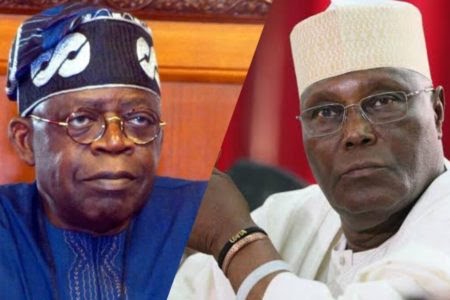
Former Vice-President and presidential candidate of the African Democratic Congress, Atiku Abubakar, has opened a fresh legal front against President Bola Ahmed Tinubu, asking the Federal High Court in Abuja to disqualify the President from the 2027 presidential election over an alleged forged National Youth Service Corps discharge certificate.
The suit, filed on Friday, August 14, by Atiku and the ADC, names Tinubu, the All Progressives Congress and the Independent National Electoral Commission as defendants. Atiku personally appeared at the court registry to depose to an affidavit in support of the action, signalling the political and constitutional weight the opposition candidate attaches to the case.
The case centres on an NYSC discharge certificate which Atiku alleges was submitted to INEC in connection with Tinubu’s presidential candidacy and bears the name “Tinubu Bola Adekunle”, rather than “Bola Ahmed Tinubu.” The plaintiffs further allege that the certificate was not obtained by Tinubu.
Those allegations remain claims in a newly filed lawsuit. No court has, in the present proceedings, found Tinubu guilty of forging the document, and the existence of a discrepancy in a name does not, by itself, establish forgery. The Federal High Court will have to determine what the document is, to whom it belongs and what legal consequences, if any, flow from its presentation to the electoral commission.
At the heart of Atiku’s case is Section 137(1)(j) of the 1999 Constitution, which provides that a person is not qualified for election as President if he has presented a forged certificate to INEC. The constitutional provision has long been one of the most consequential rules invoked in Nigerian election litigation involving disputed credentials.
Atiku and the ADC are also relying on Sections 139(1)(a)(i) and 285(14)(c) of the Constitution, alongside provisions of the newly enacted Electoral Act 2026. They argue, in effect, that ordinary legislation cannot remove or neutralise a constitutional standard governing eligibility for the presidency.
The plaintiffs are asking the court to determine whether the disputed NYSC document constitutes a forged certificate and, if so, whether Tinubu and the APC should be barred from participating in the 2027 presidential election.
They are also seeking an order compelling INEC to produce Tinubu’s Form CF001 and related nomination records submitted in connection with the 2023 and 2027 presidential election processes. Atiku says he had requested certified copies of the relevant records from INEC before filing the case but had not received them.
The request for the INEC documents could prove central to the proceedings because the constitutional prohibition is concerned not simply with whether a disputed document exists, but with whether a candidate presented a forged certificate to the electoral commission.
Atiku said his decision to personally swear to the affidavit was deliberate.
He argued that the question was too important to be left to political exchanges or social-media arguments and should instead be resolved through documentary evidence and judicial scrutiny.
“We are not asking Nigerians to decide this matter on social media,” Atiku said, according to a statement issued by his media team. “We are asking the institution holding the records to produce them and the judiciary to examine the evidence and pronounce on it.”
The timing of the lawsuit is significant because Nigeria is approaching the 2027 general elections under a substantially revised electoral framework.
The National Assembly’s Electoral Act 2026 has changed the treatment of candidate-qualification disputes. The Policy and Legal Advocacy Centre says the new law shifts the principal battleground for qualification disputes from post-election litigation to the pre-election period.
Under the 2026 Act, qualification is no longer one of the principal grounds for challenging an election after the votes have been cast. Section 138 narrows election-petition grounds, while Section 29 provides a pre-election mechanism for challenging false information concerning constitutional qualifications in nomination documents.
That legislative change could make the Abuja case particularly consequential.
Atiku and the ADC are challenging aspects of the new framework, arguing that an Act of the National Assembly cannot be interpreted in a way that effectively prevents enforcement of an express constitutional disqualification.
Their argument raises a constitutional question: Can an electoral statute restrict access to the courts in a way that undermines a disqualification expressly contained in the Constitution?
The answer will be important beyond the immediate contest between Atiku and Tinubu because it could determine how future disputes over presidential eligibility are litigated.
The latest case is a revival of one of the most persistent controversies from the 2023 presidential election litigation.
During the proceedings before the Presidential Election Petition Court in June 2023, Atiku and the Peoples Democratic Party tendered certified documents relating to Tinubu’s academic and professional records.
Among them was an NYSC discharge certificate bearing the name “Tinubu Bola Adekunle.” The petitioners also tendered a Chicago State University certificate and other records. Lawyers representing Tinubu, APC and INEC objected to the admission of the documents, but the court admitted them as evidence.
The documents became part of a much wider dispute over Tinubu’s educational history, including records obtained from Chicago State University in the United States.
Atiku subsequently pursued discovery proceedings in the United States to obtain additional records from the university. A US federal court ordered Chicago State University to produce relevant, non-privileged documents for use in the Nigerian proceedings. The records and subsequent deposition became the basis of Atiku’s attempt to introduce fresh evidence before Nigeria’s Supreme Court.
But an important distinction remains between evidence being admitted and an allegation being proved.
The admission of the NYSC document into evidence in 2023 did not amount to a judicial declaration that the document was forged.
The certificate controversy eventually reached the Supreme Court, but not in the manner Atiku had hoped.
After the Presidential Election Petition Court dismissed his challenge to Tinubu’s victory in September 2023, Atiku obtained additional material from the Chicago litigation and sought permission to introduce it as fresh evidence in his appeal.
The Supreme Court rejected that request in October 2023.
Justice Inyang Okoro, delivering the ruling, held that the constitutionally prescribed period for hearing the presidential election petition had expired. The court said the Supreme Court could not admit evidence when the lower court had already lost jurisdiction because the 180-day period for determining the presidential petition had elapsed. The court also noted that the forgery issue sought to be established through the new evidence was not properly pleaded in the petition in a manner that could support the proposed evidence at the appellate stage.
The seven-member Supreme Court subsequently dismissed Atiku’s appeal and affirmed Tinubu’s electoral victory.
That history is crucial to understanding the new litigation.
The Supreme Court’s 2023 ruling did not constitute a finding that every disputed certificate allegation was authentic or that every allegation surrounding Tinubu’s records had been factually established. Rather, the court rejected Atiku’s attempt to introduce particular fresh evidence at the appellate stage and ultimately affirmed the 2023 election result. The current lawsuit therefore seeks to place the eligibility question before the courts in the context of the 2027 election and the legal framework now in force.
The governing APC has already dismissed the fresh suit.
National Secretary Ajibola Basiru described the action as an exercise in futility and argued that Tinubu remains qualified to contest the 2027 election.
Basiru also pointed to the Supreme Court’s 2023 judgment, telling Saturday PUNCH that the matter had been settled and urging Atiku to prepare for the political contest rather than pursue what he described as a shortcut to power.
The APC’s position effectively frames the dispute as an attempt to reopen issues that were already litigated around the 2023 presidential election.
Atiku’s side, however, is presenting the new action differently: not as a social-media campaign or an attempt to overturn the 2023 result, but as a constitutional eligibility challenge relating to the forthcoming 2027 election.
That distinction is likely to become one of the first major legal questions in the proceedings.
The Abuja suit is not the only fresh legal initiative concerning Tinubu’s credentials.
Earlier in June, the Centre for Reform and Public Advocacy, a civil-society organisation, petitioned INEC over questions surrounding Tinubu’s academic credentials and NYSC certificate. The group said it wanted the electoral commission to clarify its position before the 2027 election.
The organisation subsequently filed a separate suit at the Federal High Court in Kano, marked FHC/K/CS/312/2026, seeking Tinubu’s disqualification from the 2027 presidential election over alleged certificate forgery. Tinubu, INEC and Chicago State University were listed as defendants.
That development means the certificate controversy is no longer confined to the political statements of Atiku’s camp. It has generated multiple legal and institutional processes ahead of the next presidential election.
The controversy also moved beyond Nigeria on Friday.
Kalu Agu, an ADC chieftain and lawyer, submitted a petition to the European Commission in Brussels concerning allegations about Tinubu’s certificates and documents submitted to INEC.
Agu alleged that Tinubu presented false academic credentials and failed to disclose some of the schools he attended in documents submitted to the electoral commission. He urged European institutions to intervene over what he characterised as a threat to Nigeria’s constitutional order.
Daniel Bwala, Special Adviser to the President on Policy Communications, described the opposition’s action in Europe as a “wild goose chase” and challenged the opposition to focus instead on what it would do differently from the Tinubu administration.
For all the political significance surrounding the case, the central issue before the court is narrower than the rhetoric surrounding it.
The plaintiffs will have to establish, through admissible evidence, what the disputed NYSC certificate actually represents, whether it was presented to INEC by Tinubu, whether it was genuinely issued to him, and whether its alleged discrepancies amount in law to a forged certificate.
A different ordering of names — “Tinubu Bola Adekunle” rather than “Bola Ahmed Tinubu” — is an allegation requiring explanation, but it is not automatically proof of forgery.
That distinction will matter because Section 137(1)(j) does not merely prohibit questionable paperwork; it specifically addresses the presentation of a forged certificate to INEC. The constitutional consequence is potentially severe, but the factual foundation for invoking it must first be established.
The 2017 Supreme Court decision in Saleh v. Abah is likely to feature prominently in arguments over the legal consequences of certificate forgery. In that case, the Supreme Court discussed the constitutional consequences of presenting a forged certificate and emphasised the seriousness with which such conduct is treated under Nigeria’s electoral law. Atiku’s lawyers previously relied heavily on that jurisprudence during the 2023 litigation.
The immediate consequence of the lawsuit, regardless of its eventual outcome, is that the 2027 presidential contest has acquired an important judicial dimension more than a year before the election.
The case could force INEC to disclose records that have remained at the centre of political controversy, while requiring a Federal High Court to examine the relationship between constitutional presidential qualifications and the Electoral Act 2026.
It could also test the limits of the new pre-election litigation regime.
The 2026 electoral law was designed, in part, to move disputes about candidate qualification away from the post-election stage. PLAC’s analysis says the reform means that qualification questions are expected to be resolved before voting rather than after an election has produced a winner.
That makes the present litigation potentially more significant than the same controversy was in 2023.
If Atiku succeeds in obtaining the records he seeks and establishes his allegations, the consequences could extend beyond a political embarrassment for the President and directly affect his eligibility to appear on the 2027 ballot.
If he fails, the case could nevertheless produce an important judicial interpretation of the 2026 electoral framework and clarify the extent to which old allegations surrounding a candidate’s credentials can be revived in a new election cycle.
For now, however, the legal position is straightforward: Tinubu has not been judicially found to have forged the disputed NYSC certificate in the new case. Atiku has made the allegation under oath, the APC has rejected it, and the courts are being asked to determine what the evidence establishes.
The next stage will therefore be less about political accusation and more about documents — particularly the records held by INEC and the evidentiary trail surrounding the disputed NYSC certificate.
With the 2027 presidential contest already taking shape, the courtroom may once again become one of the principal arenas in which the battle between Atiku and Tinubu is fought.