
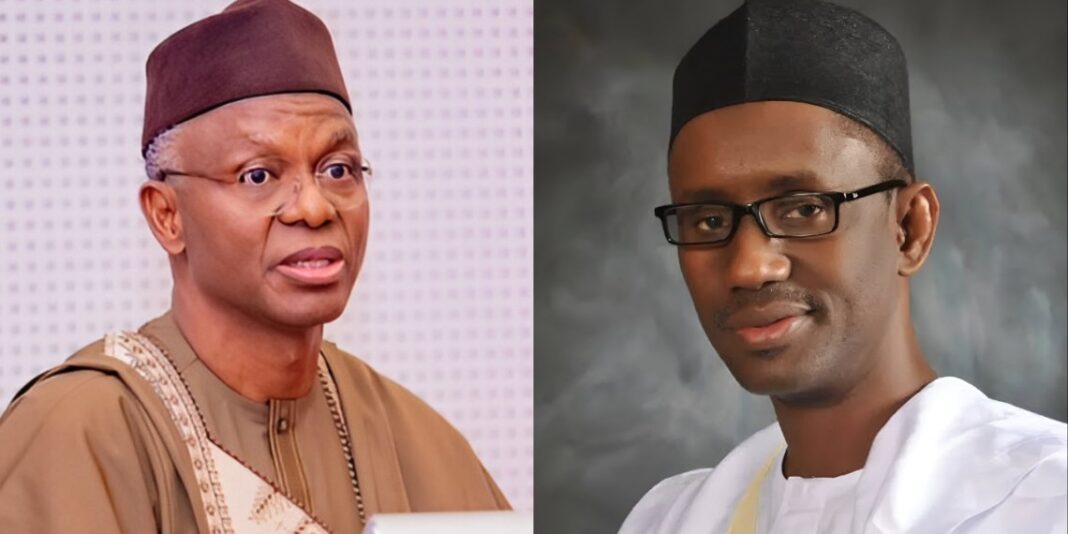
The legal battle between former Kaduna State governor, Nasir El-Rufai, and Nigeria’s domestic intelligence agency entered a crucial phase on Tuesday as the Department of State Services (DSS) formally closed its case in the alleged unlawful phone interception trial against the former governor.
Following the close of the prosecution’s case before Justice Joyce Abdulmalik of the Federal High Court in Abuja, El-Rufai’s legal team announced plans to file a no-case submission, arguing that the DSS had failed to establish sufficient evidence linking their client to the offences alleged in the five-count charge.
The development came after DSS counsel, Oluwole Aladedoye (SAN), informed the court that the prosecution would not be calling any additional witnesses, maintaining that the evidence already presented was adequate to sustain the charges against the former governor.
Responding, El-Rufai’s lead counsel, Paul Erokoro (SAN), told the court that the defence would challenge the prosecution’s case through a no-case submission, a legal procedure through which a defendant asks the court to dismiss charges on the grounds that the prosecution has failed to establish a prima facie case.
Justice Abdulmalik granted the parties two weeks each to file and respond to the application and adjourned proceedings until September 22.
Bid to Relax Bail Conditions Rejected
At Tuesday’s sitting, the former governor also sought a review of his bail conditions, describing them as excessively stringent and difficult to fulfil.
Erokoro argued that requirements mandating sureties who are Level 17 civil servants owning property in Abuja’s Maitama or Asokoro districts, alongside verification letters from traditional authorities in Kaduna State, imposed an unnecessary burden on his client.
The prosecution opposed the request, insisting that qualified individuals capable of meeting the conditions existed.
In her ruling, Justice Abdulmalik declined to vary the bail terms, holding that the conditions remained reasonable and enforceable.
The DSS filed charges against El-Rufai after remarks he made during an interview on Arise Television in February.
During the interview, the former governor claimed he became aware of an alleged directive by National Security Adviser (NSA), Nuhu Ribadu, to arrest him after information from what he described as an intercepted telephone conversation reached him.
El-Rufai linked the alleged directive to an encounter with security operatives at the Nnamdi Azikiwe International Airport in Abuja shortly after returning from Cairo, Egypt.
The DSS subsequently accused him of unlawfully accessing or intercepting a telephone conversation involving the NSA and, after initially filing a three-count charge, expanded the case to five counts before arraigning him in April. El-Rufai pleaded not guilty to all charges.
Adeyanju’s Testimony and Courtroom Video Evidence
A key moment in the prosecution’s case came during Monday’s proceedings when Abuja-based lawyer and activist Deji Adeyanju testified as the second prosecution witness.
Adeyanju told the court that he was present at Arise Television on February 13, the day El-Rufai granted the interview that triggered the criminal charges.
During the hearing, prosecutors replayed the interview recording in open court. After watching the footage, Adeyanju confirmed that the video accurately reflected what he witnessed during the programme.
According to the witness, El-Rufai discussed how information about an alleged arrest plan reached him and referred to the interception of a telephone conversation involving the National Security Adviser.
The prosecution also tendered a recording of Adeyanju’s own television appearance on the same programme, alongside a certificate of compliance. Both were admitted as exhibits without objection from the defence.
In the recorded interview, Adeyanju challenged El-Rufai’s allegations, arguing that if security agencies truly intended to arrest him, they could have done so at the airport. He further suggested that any investigations involving the former governor should follow due legal process.
The witness also confirmed that he later provided a written statement to the DSS regarding the television interview and the claims made by El-Rufai.
Under cross-examination, the defence sought to distinguish between hearing information from a conversation and illegally intercepting a phone call.
Erokoro repeatedly questioned whether El-Rufai had expressly stated during the interview that he personally tapped or hacked the NSA’s phone.
Adeyanju responded that his understanding was that El-Rufai said information from a monitored conversation had reached him.
The defence further suggested scenarios in which a conversation might be overheard without any unlawful interception, such as where a call was placed on speakerphone. The witness maintained that he could not comment on how the information was obtained and was merely recounting what he heard during the television programme.
High-Profile Political Fallout
The trial has attracted widespread attention because of El-Rufai’s prominent role in politics and his deteriorating relationship with President Bola Tinubu’s administration.
Once one of Tinubu’s strongest allies during the 2023 presidential campaign, El-Rufai later emerged as a vocal critic of the administration after his ministerial nomination failed to secure Senate confirmation amid concerns raised by security agencies.
Beyond the DSS prosecution, the former governor is also facing separate legal challenges relating to alleged abuse of office, fraud and financial misconduct during his tenure as Kaduna State governor, allegations he has consistently denied. Recent proceedings in those cases have also experienced delays following the absence of some co-defendants.
The immediate focus of the trial now shifts to El-Rufai’s no-case submission.
If the court agrees with the defence that the prosecution failed to establish a prima facie case, the charges could be dismissed without El-Rufai being required to open his defence.
However, if Justice Abdulmalik rules that sufficient evidence exists for the case to proceed, the former governor will be required to enter his defence and respond formally to the allegations of unlawful interception of communications involving the National Security Adviser.
The court is expected to consider the defence application when proceedings resume in September.