

● As artificial intelligence, digital platforms and global commercial interests make indigenous knowledge and cultural expressions easier to reproduce and monetise, experts are warning that Nigeria must do more to protect the communities behind its cultural heritage.
A young Nigerian searching online for the history of an artefact from the ancient Benin Kingdom might find photographs displayed by foreign museums, replicas advertised on commercial platforms and AI-generated images presented as authentic cultural works. Yet finding reliable accounts of the people who created the object, its cultural significance and the circumstances under which it left its place of origin may prove considerably more difficult.
That scenario, presented by intellectual property expert Dr Jimson Olufuye, captures a growing dilemma confronting Nigeria and other culturally rich societies: in an increasingly digital world, the people who create, preserve and understand cultural heritage may have the least control over how it is represented, accessed and commercially exploited.
The challenge goes beyond the physical ownership of traditional objects. It extends to photographs, digital scans, indigenous designs, oral histories, traditional performances, recorded voices and the knowledge embedded in cultural practices. As artificial intelligence expands the possibilities for reproducing and commercialising such materials, questions of ownership, consent, attribution and economic benefit are becoming increasingly urgent.
This was the central concern at a webinar organised by the Intellectual Property Institute Nigeria in partnership with Law & Society Magazine on Monday, November 23, 2026, under the theme, “Reclaiming Heritage: Protecting Traditional Knowledge & Artifacts in the Digital Economy.”
The discussions brought together two resource persons from complementary legal and professional perspectives: Hon. Ehusani Abel Simpa, Judge of the Federal Capital Territory Customary Court, and Olufuye, Principal Consultant at Kontemporary Consulting Ltd.
While Simpa examined the importance of customary law and indigenous knowledge systems in preserving cultural identity, Olufuye focused on the legal, institutional and commercial safeguards required to prevent digital technologies from becoming instruments of cultural appropriation.
Heritage beyond objects and monuments
Opening the discussion, Lillian Okenwa, Editor-in-Chief and Publisher of Law & Society Magazine, challenged the perception of heritage as merely a collection of historical objects, customs and stories.
“A people’s heritage is more than a collection of old objects, customs and stories. It is the record of who they are, the knowledge they have accumulated, the creativity they have nurtured and the identity they pass from one generation to another,” she said.
She warned that digital technology had dramatically changed the accessibility and commercial possibilities of traditional knowledge and indigenous creations. Materials that once required physical access to communities or cultural institutions could now be reproduced, distributed and monetised globally, often without the meaningful involvement of their originating communities.
For Okenwa, this raises a fundamental question: how can technological advancement be reconciled with the rights of communities to determine how their heritage is represented and used?
She maintained that cultural protection was not simply an intellectual property issue. It was equally about identity, ownership, economic justice, cultural preservation and the right of communities to benefit from knowledge and creativity sustained across generations.
Her concern was that innovation must not come at the expense of cultural ownership and dignity. Legal and institutional frameworks, she argued, must evolve to address the new challenges created by digital access and commercial exploitation.
Customary law and the intelligence of indigenous communities
In his presentation, “Customary Law and Traditional Heritage: The Peculiarities of Core Values and Global Identity,” Simpa argued that Nigeria’s cultural preservation efforts must begin with a proper appreciation of indigenous knowledge systems and the customs through which communities express their identity.
A particularly significant aspect of his presentation was the relationship between artificial intelligence and what he described as “native intelligence”.
He questioned the tendency to measure knowledge primarily through conventional written records, English-language expression and information available on the internet.
According to him, the credibility of online information depends on the authenticity of its sources, while artificial intelligence can only produce meaningful results within the limits of the information available to it and the accuracy of the prompts and instructions supplied.
“Native intelligence speaks to intellectual capacity that is not tied to English Language or the conventional means of expression,” he explained.
To illustrate his argument, Simpa referred to the Yoruba Bata dance and the Agidibo slit drum associated with Ebira-Okene culture. These, he explained, represent forms of indigenous knowledge communicated through rhythm, sound, movement, performance and established cultural practices.
Such knowledge may not always be captured in books, formal databases or digital archives, but its absence from those platforms does not diminish its intellectual or cultural value.
His argument was that indigenous knowledge systems must not be marginalised simply because they do not conform to the conventional formats through which modern technology organises and processes information.
Simpa also examined the legal status of customary law in Nigeria, describing it as an important source of law and an expression of the accepted practices of a community.
Citing Okechukwu v. Otukokwu (1998) 8 NWLR (Pt. 562) 405, he recalled judicial recognition of customary law as a source of law no less important than other recognised sources.
He further referred to the Supreme Court’s decision in Eugene Ogbuji & Anor v. Ori Amadi (2022) LPELR-56591(SC), in which Justice Mary Peter-Odili explained that customary law develops from the traditional usage and practices of a people, adopted and accepted by members of a community over time.
Under Nigerian law, customary law is generally a question of fact that must be established through evidence or recognised by judicial notice where the relevant statutory requirements are satisfied.
However, Simpa was careful to distinguish cultural preservation from the unconditional defence of every traditional practice.
Citing Akpalakpa v. Igbaibo (1996) 8 NWLR (Pt. 468) 533, he argued that customs that obstruct the economic, social and political development of a people or violate natural justice, equity and good conscience should not receive judicial protection.
For him, customary law must remain responsive to changing standards of justice without losing the historical experiences and values that define a community.
He also highlighted the importance of customary courts, describing them as accessible institutions because of their geographical proximity to communities, relatively lower litigation costs and involvement in everyday disputes.
Lawyers, professionals and traditional institutions, he suggested, could initiate actions seeking the restatement of cultural practices or judicial declarations clarifying customary rules.
In an interesting call for cultural consciousness within the justice system, he encouraged lawyers and customary court judges to consider wearing native regalia during court proceedings as a visible expression of indigenous identity.
“Globalization also means putting my tribal paintbrush on the canvass of digital relevance,” he said.
The Benin Bronzes and the unfinished business of restitution
If Simpa’s presentation addressed the foundations of cultural identity, Olufuye’s contribution examined what happens when that identity enters the global digital marketplace.
Using the Benin Bronzes as a central example, he argued that the restitution of stolen cultural objects, although important, is only one part of a much wider struggle for cultural control.
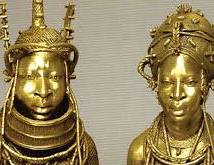
British forces looted artworks from the Kingdom of Benin in 1897. In June 2025, the Netherlands returned 119 Benin Bronzes to Nigeria, demonstrating the possibilities of provenance research, diplomatic engagement and sustained advocacy.
But Olufuye argued that physical restitution must be accompanied by attention to the digital representations of returned objects.
Photographs, high-resolution scans, museum catalogue records and digital reproductions continue to shape how cultural objects are understood and accessed internationally. Returning an artefact does not automatically resolve questions about who controls its digital image, how its history is documented or who benefits from its subsequent commercial use.
“A museum may control the catalogue. A platform may control what appears in search results. An AI developer may control the dataset. The people who know the heritage best may have the least practical means to correct the record or influence what happens next,” he observed.
His position was that Nigeria must pursue physical restitution and digital governance together.
Return agreements should address access to existing digital records, while digitisation projects should involve the communities whose heritage is being documented. Commercial arrangements, in turn, should establish how cultural custodians and practitioners will participate and benefit.
Olufuye also highlighted the need to distinguish between different forms of rights associated with a cultural object.
Using a handwoven cloth as an illustration, he explained that ownership of the physical fabric, the traditional patterns associated with its cultural origin, the knowledge used to select materials and prepare dyes, and subsequently created photographs or digital design files are distinct matters.
A museum’s ownership of a cloth and its commissioning of a high-resolution photograph, for instance, do not automatically settle whether a fashion company can reproduce its traditional patterns or whether an artificial intelligence developer can incorporate the image and a recorded interview with a weaver into a commercial training dataset.
Each proposed use raises separate questions about authority, permission, cultural responsibility and economic benefit.
He therefore urged museums, universities, publishers and technology companies to establish precisely what material they intend to use, who can legally authorise its use, which cultural custodians should be consulted and what arrangements govern attribution, access and benefits.
Nigeria’s existing laws and the gaps in digital protection
Olufuye noted that Nigeria was not starting from scratch in the protection of traditional knowledge and cultural heritage.
He identified the Copyright Act 2022, particularly Section 74, as an important legal instrument providing protection for expressions of folklore.
The provision addresses certain commercial and non-customary uses, including reproduction, communication to the public and adaptation, subject to applicable statutory exceptions.
He also highlighted the requirement for appropriate identification of the originating community or place when an identifiable expression of folklore is published or communicated to the public.
The Nigerian Copyright Commission has statutory responsibilities in relation to authorising covered uses. Consequently, engagement with the Commission and relevant cultural custodians is important where such authorisation is required.
For physical cultural objects, he pointed to the National Commission for Museums and Monuments and its responsibilities, including restrictions relating to the export of antiquities.
He also referenced the 1970 UNESCO Convention, which establishes an international framework for cooperation against the illicit import, export and transfer of ownership of cultural property.
Another significant development was the 2024 World Intellectual Property Organisation Treaty on Intellectual Property, Genetic Resources and Associated Traditional Knowledge, which Nigeria signed upon its adoption.
The treaty establishes a patent disclosure requirement for inventions based on genetic resources or associated traditional knowledge once it enters into force for the parties concerned. The requirement is intended to make the origin or source of relevant genetic resources and associated traditional knowledge more visible in patent applications.
However, Olufuye cautioned against assuming that this treaty automatically resolves every issue concerning cultural heritage in digital environments.
Museum scans, audio recordings, photographs and textile designs, for example, still require examination under applicable intellectual property laws, permissions and contractual arrangements.
For institutions considering the use of cultural material, he proposed four fundamental questions: What exactly is being used? Who has the legal authority to grant permission? Whose cultural responsibilities should guide the decision? And what has been agreed regarding credit, access and benefits?
Where provenance is uncertain or multiple communities have legitimate interests, institutions should document the available evidence, acknowledge uncertainty and provide mechanisms through which inaccurate records can be corrected.
He described catalogue records as particularly important because they often constitute the first point of reference for researchers, journalists and young people seeking information about cultural objects.
Artificial intelligence: The new frontier of cultural appropriation
Perhaps the most pressing challenge identified during the webinar was the growing use of artificial intelligence to process and commercialise cultural material.
Olufuye illustrated the issue through the example of a university that records oral histories for preservation. Years later, a technology company approaches the institution seeking to use those recordings to develop a commercial speech model.
The original participants may have consented to having their stories preserved for future generations, but that consent does not necessarily extend to using their voices to train a commercial artificial intelligence product.
The distinction, he argued, is fundamental.
Institutions must examine the original terms of consent before approving new uses of recorded material. They should also demand transparency from technology vendors regarding the sources of their training materials, whether supplied files can be reused by vendors or subcontractors, and how requests for correction, withdrawal or deletion will be handled where applicable.
He further advocated clear labelling of AI-generated images and audio where they could be mistaken for historical records, authentic cultural objects or the voices of actual cultural custodians.
The concern is not simply that artificial intelligence can reproduce traditional expressions. It is that it can potentially generate misleading representations of cultural history, detach creative expressions from their origins and commercialise knowledge without the involvement of its custodians.
Yet Olufuye did not present technology as an enemy of cultural preservation.
Rather, he identified opportunities for mutually beneficial partnerships between museums, artisans, designers, publishers and creative industries.
A museum and a weaving association, for instance, could collaborate with designers on a collection that identifies and compensates its cultural contributors. A game developer could engage Nigerian artists and historians to produce historically informed settings, while a publisher could license approved recordings for educational purposes and support the documentation of underrepresented languages.
The essential requirement, he stressed, is that the terms of engagement must be negotiated before cultural material changes hands.
Agreements should clearly identify the material covered, specify how contributors will be credited, establish whether onward licensing is permitted and provide for payments and periodic reporting.
Fair compensation could take several forms, including upfront fees, a share of commercial sales or funding for apprenticeships and skills development.
Importantly, revenue-sharing arrangements must be transparent. Communities cannot meaningfully benefit from commercial exploitation if they have no access to the sales figures on which their entitlements depend.
Where permission is withheld, he argued, projects should be prepared to proceed without the material or return to the community with revised terms.
A practical 12-month roadmap
Beyond identifying the challenges, Olufuye proposed a 12-month pilot programme to translate the principles of heritage protection into practical action.
The initiative would involve two projects: one focusing on returned cultural objects, provenance research and digital records; the other concentrating on a living craft or performance tradition, with particular attention to community participation, documentation and fair licensing.
He suggested that the National Commission for Museums and Monuments could coordinate work relating to artefacts and provenance, while the Nigerian Copyright Commission could provide guidance on folklore authorisation and copyright issues.
Practitioners and customary custodians would help develop rules governing access and attribution, supported by universities, libraries and technical partners responsible for conservation, cataloguing and preservation.
Each pilot, he proposed, should have a designated coordinator, a modest budget and a clear mechanism for resolving complaints and competing claims.
By the end of the 12 months, the expected outcomes would include corrected and traceable catalogue records, copies of digital materials accessible to the communities entitled to use them, and sample agreements that smaller museums and artisan associations could adapt.
Progress should not be measured merely by the volume of material digitised.
Olufuye suggested assessing the number of provenance gaps resolved, the time required to correct inaccurate records and whether practitioners actually received promised payments or training.
For living traditions, another important indicator would be whether more young people had begun learning the craft.
Returning to his illustration of the young person searching online for Benin heritage, he envisaged a digital environment in which she could access reliable information about an artefact’s origin and history, find an approved account in a local language, connect with a living artisan, seek permission to build on a traditional design and report inaccurate records.
“That is a digital economy worth building,” he said.
Reclaiming ownership, dignity and economic value
The webinar ultimately brought into focus an important distinction between making cultural heritage digitally accessible and ensuring that its custodians retain meaningful control over its use.
Simpa’s presentation underscored the continuing relevance of customary law, indigenous knowledge and community-based institutions in preserving cultural identity. Olufuye demonstrated why these foundations must be complemented by modern legal safeguards, responsible digitisation, transparent licensing and fair economic arrangements.
Together, their contributions reinforced Okenwa’s opening argument that heritage protection must go beyond preserving objects or making cultural information available online.
It must also recognise the rights of communities to participate in decisions concerning their heritage and to benefit from the economic value it generates.
As artificial intelligence and other digital technologies continue to reshape the global creative economy, Nigeria faces an important opportunity to move beyond the passive documentation of its cultural resources towards a framework that gives communities a meaningful voice in their preservation, representation and commercial use.
The task is not to keep Nigerian heritage out of the digital economy. It is to ensure that its entry into that economy does not erase the people, histories and knowledge systems that give it meaning.
As Okenwa warned, “Heritage should not become vulnerable simply because it has entered the digital space. Its owners and custodians must not be erased from the value it creates.”
That may well be the defining test of Nigeria’s efforts to reclaim its heritage: not simply whether its cultural treasures can be seen and accessed around the world, but whether the communities that created and preserved them remain visible, respected and fairly rewarded.