The Anambra State Police Command has intensified efforts to prevent a breakdown of law and order in the Diocese of Awka amid an escalating leadership dispute involving the suspended Archbishop of the Province of the Niger and Bishop of Awka, Most Revd Dr. Alexander Chibuzo Ibezim, and the church leadership’s appointed supervising bishop, Rt. Rev. Dr. Samuel Chukwudi Ezeofor.
The intervention came as the dispute over Ibezim’s six-month compulsory administrative leave moved deeper into the courts, with competing claims over ecclesiastical authority, due process and the administration of church affairs threatening to unsettle worshippers and congregations.
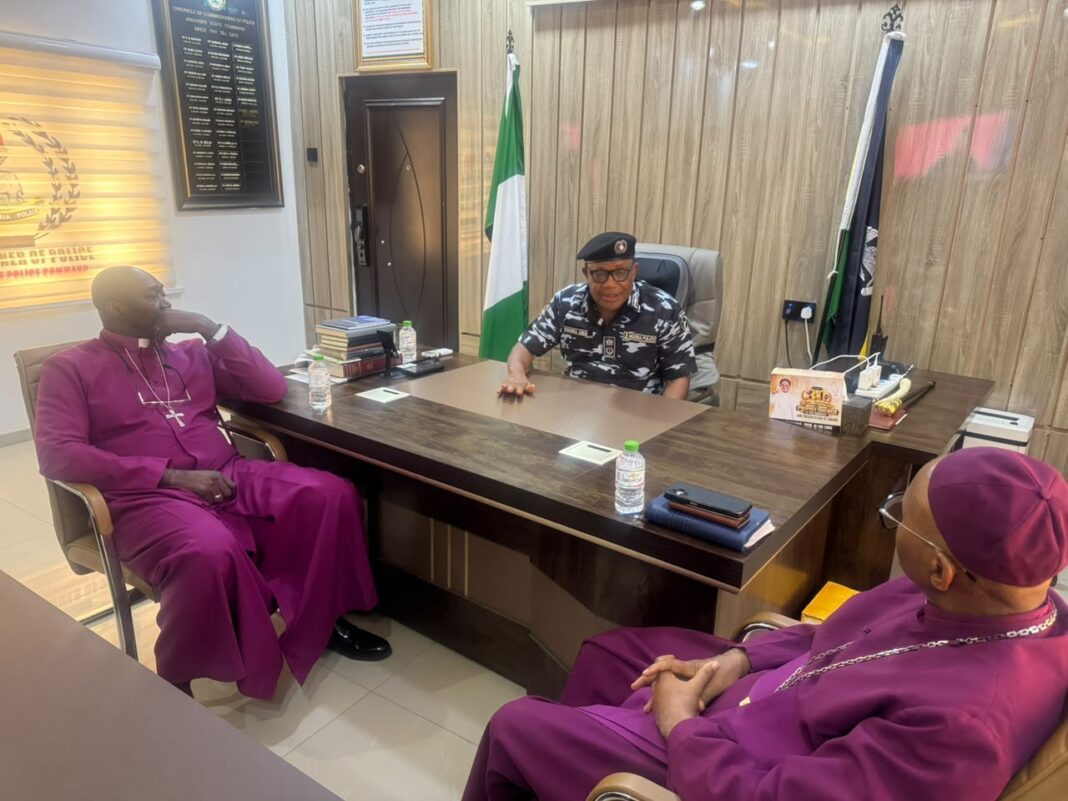
On Friday, October 23, 2026, the Anambra State Commissioner of Police, CP Nnanna Oji Ama, met with Ibezim and Ezeofor at his office to discuss the dispute and measures to preserve peace.
According to a statement issued by the Police Public Relations Officer, SP Tochukwu Ikenga, the commissioner acknowledged the ongoing court proceedings and urged the parties to respect the judicial process while pursuing peaceful dialogue through the established ecclesiastical hierarchy of the Anglican Church.
Ama stressed that parishioners and worshippers must not be drawn into the disagreement or made to bear the consequences of differences among church leaders.
He called on all concerned to demonstrate restraint, mutual respect and maturity in the interest of peace, unity and the sanctity of worship.
The commissioner also cautioned against inflammatory statements, confrontational conduct and any action capable of escalating tensions or threatening public peace, warning that the police would take appropriate lawful measures to prevent any breach of law and order.
Reaffirming the Command’s impartiality, Ama said the police would continue to address legitimate security concerns professionally, respect the authority of the court and uphold the rights of all parties in accordance with the law.
The intervention underscores growing concerns that the prolonged disagreement could spill beyond the church’s internal governance structures and create a security challenge if rival positions translate into confrontations at worship centres.
Court declines Ibezim’s bid to continue in office
The police meeting followed proceedings at the Anambra State High Court in Awka on Thursday, October 22, where Justice Obiorah Nwabunike heard an application by Ibezim seeking to continue exercising authority over the Diocese of Awka.
Ibezim’s legal team was led by Senior Advocate of Nigeria Beluolisa Nwofor, who has also been identified in reports as the suspended chancellor of the diocese.
However, amid multiple applications challenging the court’s jurisdiction to entertain the substantive dispute, the court declined to grant Ibezim’s application to continue running the church under an interlocutory injunction.
The matter was adjourned until November 26, 2026.
The case has brought renewed attention to the constitutional framework governing the Church of Nigeria (Anglican Communion), particularly the extent of the Primate’s supervisory authority and the procedures required when allegations are made against a serving bishop.
How the crisis began
The immediate controversy dates to October 13, 2026, when the Primate of the Church of Nigeria, Most Revd Dr. Henry Chukwudum Ndukuba, directed Ibezim to proceed on six months’ compulsory administrative leave.
In a letter issued that day, Ndukuba said the measure was intended to facilitate a fair and thorough investigation into developments within the Diocese of Awka and help restore peace and reconciliation.
The directive followed the work of administrative panels, including a visitation team led by the Dean of the Church of Nigeria, as well as a meeting between the Primate and Ibezim on October 9.
Under the arrangement, Ibezim was instructed not to officiate at activities of the Church of Nigeria, the Province of the Niger or the Diocese of Awka during the period of leave. Ezeofor, the Bishop of Aguata, was appointed to supervise the Diocese of Awka and coordinate the Province of the Niger.
The Primate reportedly relied on Section 29(1) of Chapter V of the Church of Nigeria’s 2020 Constitution and Canons, while maintaining that the measure was administrative rather than a disciplinary sanction.
Ibezim and supporters within the diocese have challenged the intervention, arguing that the church must comply with its constitutional and canonical provisions before taking measures that affect the responsibilities and tenure of a serving bishop.
The diocesan board has also rejected the leave directive and Ezeofor’s appointment, reportedly questioning the authority under which the decisions were made. At one point, the dispute prompted threats that the diocese could withdraw from the Church of Nigeria if the disagreement remained unresolved.
These positions have not yet been conclusively settled by a final judicial determination.
Land allegations add another dimension
Beyond the question of leadership, the crisis has been linked to allegations concerning the sale of church-owned land without the necessary authorisation.
A petition submitted to the Economic and Financial Crimes Commission’s Enugu Zonal Directorate on July 28, 2025, by Chief G. Tagbo, SAN, on behalf of Echezona Onuigbo, a member of St. Faith Cathedral, Awka, accused Ibezim of selling church property without the mandatory approval of the Board of Trustees.
The complainants alleged that some transactions involved long-held diocesan property and that questions remained about the authorisation of the sales and the handling of the proceeds.
Different reports have cited varying figures for the alleged transactions, including amounts exceeding ₦752 million and an alleged land sale valued at approximately ₦2 billion.
Ibezim has denied wrongdoing, while the Diocese of Awka’s board has previously defended its land-sale policy, maintaining that the transactions were authorised through diocesan processes and that proceeds were paid into diocesan accounts.
In September 2025, Justice F.I. Aniukwu of the Anambra State High Court granted an interim order restraining the EFCC from arresting, detaining or harassing Ibezim pending further proceedings relating to his fundamental rights application.
That order was not a judicial determination of whether the disputed land transactions were lawful or whether the allegations against him were substantiated.
A dispute with implications for church unity
The unfolding crisis has exposed tensions over the balance between episcopal authority, institutional accountability and the rights of church officials facing investigation.
At issue is not only whether the Primate acted within the powers conferred by the Church of Nigeria’s governing instruments, but also how the church should investigate allegations, protect its property and ensure that internal disagreements do not undermine its wider mission.
The dispute has also generated additional legal confrontations, including a reported demand for ₦5 billion in damages by Nwofor over his alleged removal as diocesan chancellor.
The threat of diocesan withdrawal, competing instructions over church administration and uncertainty surrounding leadership at the parish level have further heightened concerns about the potential consequences for clergy, church workers and congregations.
For many worshippers, the immediate concern is whether they can continue attending services without being caught between opposing factions or witnessing confrontations at places of worship.
That concern may be responsible for the police intervention, which seeks to ensure that disagreements among church leaders do not compromise public safety or the right of congregants to worship peacefully.