
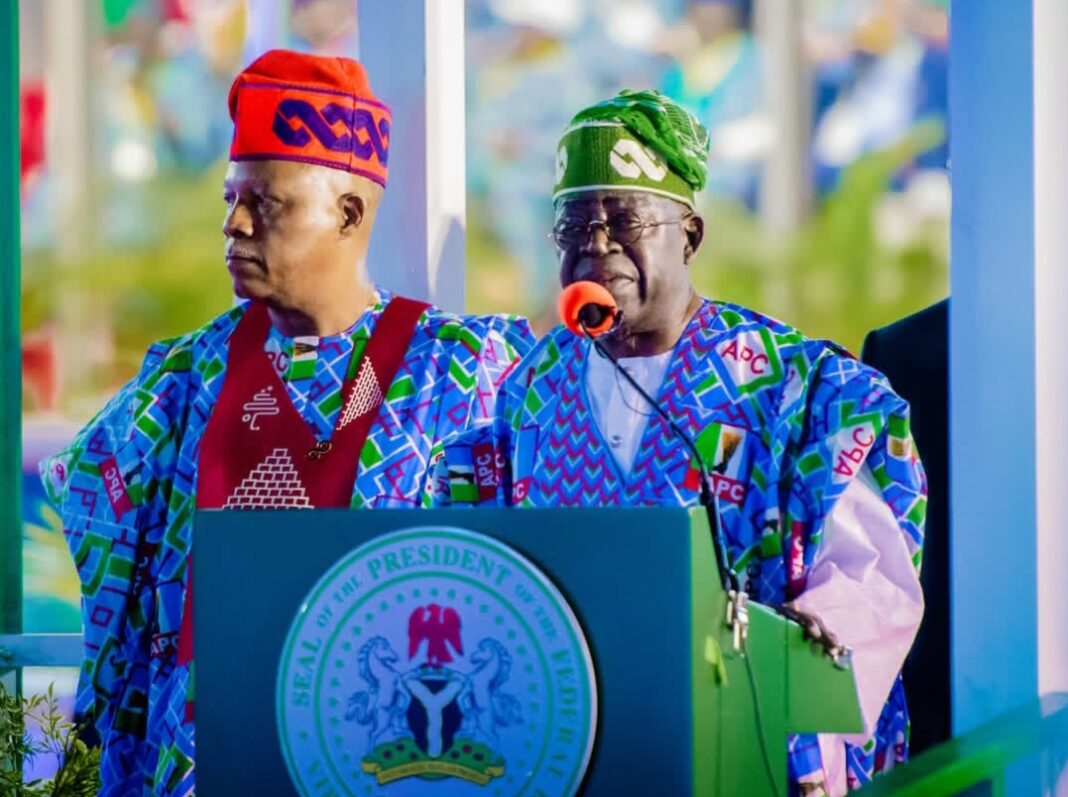
President Bola Ahmed Tinubu has signalled that he will not personally attend every All Progressives Congress (APC) campaign rally ahead of the 2027 general election, citing the demands of governance, Nigeria’s financial obligations and the need to attract long-term investment. His declaration, however, comes against the backdrop of renewed public debate over his health, presidential visibility and the political calculations surrounding Vice-President Kashim Shettima and the North.
Tinubu made the remarks on Wednesday, October 14, 2026, during the inauguration of the APC Presidential Campaign Council in Abuja, where he charged party leaders to take the ruling party’s message to voters across the states, local government areas and wards.
The President said he agreed with party members who had cautioned against allowing electioneering to distract him from his constitutional responsibilities.
“You’ve warned me not to allow the rigour of the campaign to distract me from governance. I hear you. I am in full agreement with your decision. Nigeria needs more attention now,” he said.
Explaining why he would not accompany the campaign team to every location, Tinubu pointed to the country’s financial commitments and the importance of maintaining investor confidence.
“So, you will excuse me from going everywhere with you. We have bills to pay. The American creditors cannot wait,” he said, adding that Nigeria needed investors prepared to establish businesses and make long-term commitments that would benefit future generations.
The President nevertheless assured Nigerians that he would continue to address them directly while the campaign council coordinated mobilisation efforts across the country.
Health questions return to the political conversation
Although Tinubu presented his decision as a matter of administrative responsibility, his proposed limited presence at campaign events is likely to attract additional scrutiny because of recent public concerns about his health and physical availability.
In September, following an extended working vacation in Europe, the President dismissed speculation about his health. Speaking to journalists after arriving in Lagos on September 29, he declared that he was “healthy, sound, and ready to go,” rejecting suggestions that his absence indicated an inability to perform his duties.
Nevertheless, questions about presidential health and visibility have continued to feature in political discussions. A September report by The Guardian documented calls by the Allied Peoples Movement for greater clarity over Tinubu’s extended stay abroad, while the Presidency maintained that he was well and continued to discharge his responsibilities.
Against this background, some observers may interpret the President’s announcement that he will not attend every rally as a precaution against the physical demands of a nationwide campaign. Others may view it as a sensible division of labour between the President and the campaign organisation.
Neither interpretation establishes that Tinubu is medically incapacitated. His stated reason remains that governing the country must take priority over attending every political gathering. Without reliable medical evidence or a statement from the Presidency linking his campaign schedule to a health condition, claims of physical fragility remain unverified speculation.
Could the strategy be intended to manage northern expectations?
Tinubu’s announcement also invites political analysis of the APC’s efforts to consolidate support in northern Nigeria, a region that will be crucial to the President’s re-election prospects.
The North is not a politically uniform bloc, and its voting preferences are shaped by several factors, including economic conditions, security, religious and regional considerations, party loyalty and the performance of elected officials. Nevertheless, the region remains a major battleground in the contest for the presidency.
As it is today, many insist that his popularity has warned considerably on the streets, especially in the North, but there are those who contest this, citing what he has done there.
INSERT SHUAIB”S PIECE
Shettima, a former governor of Borno State and a prominent northern political figure, has been actively involved in efforts to build support for Tinubu’s second-term ambition. In September, the Federal Ministry of Information and National Orientation reported that the Vice-President had appealed to northern creative professionals to support the President’s re-election.
Separately, The Guardian reported on October 13 that Shettima was engaging northern stakeholders as political discussions intensified ahead of 2027. These developments underline the importance of regional mobilisation to the APC’s campaign strategy.
It is within this context that a more speculative interpretation of Tinubu’s decision may emerge: that by reducing expectations of his physical presence at campaign events, the President could be seeking to manage perceptions of his capacity while allowing Shettima and other northern leaders to shoulder a greater share of the party’s mobilisation.
Some political commentators may go further and suggest that visible concerns about presidential health could generate sympathy among northern voters, particularly those who favour Shettima or regard him as a potential successor should a vacancy arise.
However, there is no verified evidence that Tinubu is deliberately cultivating an image of physical fragility to win northern sympathy, nor is there evidence that his decision to limit rally appearances is part of a plan to prepare the country for a Shettima presidency. Such suggestions are being interpreted as political conjecture rather than established fact.
Indeed, the President’s public insistence that he remains fit for office sits uneasily with any theory that he is intentionally presenting himself as incapable of sustaining the demands of the campaign.
The Shettima succession question
Nigeria’s Constitution provides for the Vice-President to succeed the President if the office becomes vacant, subject to the applicable constitutional provisions. That possibility makes presidential health a legitimate matter of public interest, but it does not establish that a succession arrangement is being engineered to get critically needed votes.
Shettima’s position as Vice-President naturally places him within any discussion of presidential continuity. Yet the political implications of Tinubu’s reduced campaign appearances must be distinguished from the constitutional circumstances under which a Vice-President would assume the presidency.
The APC also has its own electoral calculations to consider. The party must decide how best to distribute campaign responsibilities, maintain unity among its competing interests and present a convincing case for another four years in office. A President who does not attend every rally can still lead a campaign through speeches, policy announcements, media engagements and strategic appearances.
Consequently, Shettima’s expanded role in northern mobilisation, if sustained, would not in itself demonstrate that the APC was preparing him to replace Tinubu. It could simply reflect the division of responsibilities within the ruling party’s campaign machinery, according to some political analysts.
The larger political question is whether the President’s limited participation will be perceived by voters as responsible leadership, a sign of reduced presidential visibility or an opening for speculation about the future of the administration.
Tinubu seeks to project party unity and continuity
Beyond the questions surrounding his campaign schedule, Tinubu used the inauguration to reinforce the APC’s claim to organisational unity and electoral readiness.
He described the council’s inauguration as more than a formal political gathering, characterising it as a renewed commitment between the governing party and Nigerians.
“We have not gathered merely to inaugurate a council. We have gathered to renew a covenant. A covenant with Nigerian people and the historic responsibility they have entrusted to us as Nigeria’s governing party,” he said.
He charged members to communicate the administration’s vision, record and policy agenda throughout the country, expressing confidence that the campaign organisation could secure victory at the ward level.
Tinubu also praised APC members for completing the party’s congresses, recalling predictions that the internal exercises would trigger a crisis.
“They said there will be implosion. We passed through it. We did not fail. You didn’t let us down. We got here together,” he said.
His remarks were intended to present a ruling party that had overcome internal disagreements and was ready to mobilise behind his re-election bid.
Governance, health and politics converge ahead of 2027
Tinubu’s decision not to attend every campaign event places three issues at the centre of the emerging political debate: the demands of governing Nigeria, public confidence in the President’s health and the APC’s strategy for securing support across the country.
The President has offered a straightforward explanation: national responsibilities, debt obligations and the need to attract investment cannot be suspended for campaign activities. His critics and political observers, however, may judge the decision against the wider questions surrounding his public appearances and the administration’s communication about his health.
For the North, the significance of the announcement will depend partly on how effectively Shettima and other APC figures translate regional outreach into electoral support. Whether the President’s reduced presence at rallies produces sympathy, raises doubts or has little electoral effect remains to be seen.
For now, claims that Tinubu is deliberately projecting health fragility to court northern sympathy or facilitate Shettima’s eventual takeover remain unsubstantiated. What is established is that the President has assigned the campaign council a greater responsibility for nationwide mobilisation while insisting that he will continue to govern and communicate directly with Nigerians.
As the 2027 contest approaches, the effectiveness of that arrangement will be judged not only by the APC’s campaign performance but also by the administration’s ability to sustain public confidence in presidential leadership, institutional continuity and its capacity to address the country’s pressing economic and security challenges.