
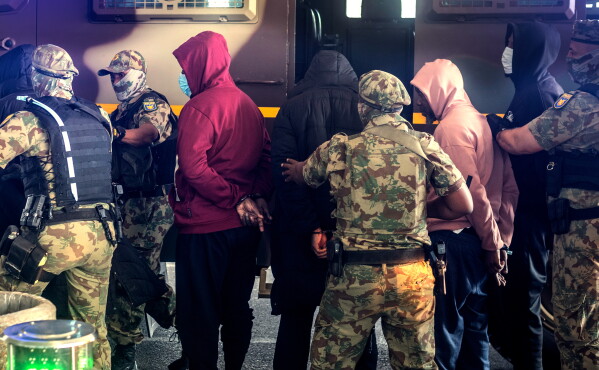
Six Nigerian nationals accused of belonging to the Black Axe organised-crime network have been extradited from South Africa to the United States to face charges arising from an alleged international romance-scam operation that prosecutors say defrauded more than 100 American women of over $6 million.
The men, who were arrested in Cape Town in 2021, were handed over to officials from the Federal Bureau of Investigation (FBI) and the U.S. Secret Service at Cape Town International Airport on Friday, according to South African authorities.
They are wanted in the United States on allegations including wire fraud and money laundering. South Africa’s Directorate for Priority Crime Investigation, known as the Hawks, said the alleged victims included pensioners and businesspeople who were drawn into sophisticated online relationships before being persuaded to send money.
The alleged scheme highlights the increasingly international nature of organised cybercrime, with criminal groups using social media, dating platforms, cryptocurrencies, bank accounts and money-laundering networks to move proceeds across borders.
The suspects are alleged to be members of Black Axe, a transnational criminal organisation that INTERPOL says has been linked to a significant share of cyber-enabled financial fraud, including romance scams, cryptocurrency and investment fraud and business-email compromise.
INTERPOL’s eight-month Operation Jackal IV, which ran from November 2025 to June 2026, involved law-enforcement agencies from 23 countries across six continents. The operation resulted in 58 arrests and the identification of 263 suspects linked to West African organised-crime networks.
South Africa was one of the principal locations targeted.
According to INTERPOL, South African authorities raided seven locations in Johannesburg linked to a syndicate allegedly running romance and investment scams against retirees in English-speaking countries. Thirty-nine people were arrested, 257 bank accounts were blocked and assets worth about $2.67 million were seized.
The investigation found that the Johannesburg network allegedly divided the scam process between different operators, including so-called “conversion” and “retention” agents, illustrating the organised and compartmentalised nature of some modern romance-fraud operations.
The latest extradition is not the first major international case involving alleged Black Axe activity in South Africa.
In 2021, U.S. authorities charged several alleged leaders of the organisation’s Cape Town zone with conspiracy to commit wire fraud and money laundering. The U.S. Department of Justice said the alleged schemes operated from Cape Town for years and included romance scams and advance-fee fraud.
According to the U.S. indictment, victims were contacted through social-media and dating websites and were persuaded to send money or valuable items after being told stories involving supposed travel difficulties, business problems and other emergencies.
One alleged Cape Town leader, Nigerian national Enorense Izevbigie, was subsequently extradited to the United States. U.S. prosecutors said he was involved in internet-fraud schemes between 2011 and 2021, including romance scams and advance-fee schemes.
Fraud extends beyond romance scams
South African authorities have also investigated Nigerians in other alleged financial-crime cases.
In one investigation, South African police said a Nigerian national was among suspects linked to an alleged scheme in which a victim was persuaded to transfer more than R3.4 million after being told that money was needed for a relative’s medical expenses. Police said the funds were subsequently distributed among alleged accomplices and that the case involved allegations of fraud and money laundering.
The cases demonstrate why South African and international investigators increasingly treat sophisticated financial fraud as organised crime rather than isolated incidents of internet deception.
Drug-trafficking investigations
South African police have also reported a number of arrests involving Nigerian nationals in drug-related investigations.
In April 2025, South African police said two Nigerian nationals were detained during an intelligence-led operation in the Western Cape after officers allegedly discovered methamphetamine at two premises. Police valued one seizure at approximately R795,000 and another at R135,000.
In March 2025, SAPS also arrested a Nigerian national at OR Tambo International Airport on suspicion of drug trafficking after an X-ray examination allegedly showed that he had swallowed objects suspected to contain cocaine.
Another operation in October 2025 resulted in the arrest of a 44-year-old Nigerian after police seized 55.8kg of crystal methamphetamine and 30.5kg of cocaine from a truck near the Huguenot Tunnel. SAPS estimated the total street value of the drugs at about R19 million.
In a separate 2025 operation in Mpumalanga, two Nigerian nationals were among five people arrested in connection with alleged drug dealing after police recovered Mandrax and crystal methamphetamine.
South African authorities’ investigations reflect a wider concern about criminal networks that operate across national borders.
INTERPOL says West African organised-crime groups increasingly use international networks to facilitate cyber fraud, money laundering, cryptocurrency transactions, investment scams and other forms of financial crime. The organisation’s recent operations have therefore focused not only on arresting individuals but also on tracing and freezing the money generated by criminal activity.
The United States has likewise stepped up prosecutions of alleged Nigerian-linked romance-fraud networks. In May 2026, U.S. authorities announced the extradition of Samuel Ugberaese from Nigeria to face charges arising from an alleged romance-fraud and money-laundering conspiracy targeting victims in the United States and elsewhere.
The repeated appearance of Nigerian nationals in some South African organised-crime investigations has also become politically and socially sensitive, particularly amid longstanding tensions involving immigration, unemployment and xenophobia.
South African and international authorities’ cases concern specific suspects and alleged criminal organisations. They do not establish that Nigerians living in South Africa generally participate in crime.
Indeed, Nigerians constitute a sizeable migrant and business community in South Africa, with many living and working lawfully in the country. At the same time, South African authorities have continued to investigate individual Nigerian nationals and alleged transnational networks for offences ranging from cyber fraud and money laundering to drug trafficking.
The distinction is particularly important in a country where foreign nationals have repeatedly been subjected to xenophobic attacks and where crime-related allegations can fuel hostility against entire migrant communities.
For the six men extradited on Friday, the next stage of the case will take place in the United States, where they are expected to face the charges for which they are wanted.
Their transfer underscores the increasingly limited ability of suspects in international fraud cases to shield themselves simply by operating from another country.
The cooperation between the Hawks, INTERPOL, the FBI and the U.S. Secret Service also demonstrates how law-enforcement agencies are increasingly following criminal proceeds across borders rather than treating cybercrime as a problem confined to the country where a victim lives.
The six suspects remain entitled to due process, and the allegations against them have yet to be tested in a U.S. court.