
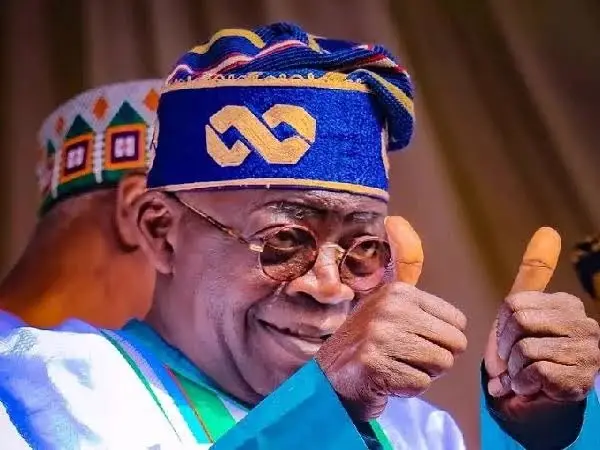
The race for Nigeria’s 2027 presidential election received a significant religious endorsement on Wednesday as the Charismatic Bishops Conference of Nigeria (CBCN) declared its support for President Bola Ahmed Tinubu’s bid for a second term.
The endorsement was announced at the grand finale of the CBCN’s 2026 Synod and the International Communion of Charismatic Archbishops, Bishops and Apostles (ICCABA), held at the National Christian Centre in Abuja.
The event, attended by senior government officials and Christian leaders, also featured the unveiling of Nigerian National Prayer Handbook, authored by CBCN President-General, Archbishop Prof. Leonard Bature Kawas.
‘This House Has Endorsed Him for 2027’
The political climax came when Kawas announced that the conference had resolved to support Tinubu in the 2027 presidential contest.
“We support him now. We support him today, we support him tomorrow, and we support him for as long as he’s willing to be our president,” Kawas said.
He subsequently made the endorsement explicit: “This house has endorsed him for 2027 presidency.”
According to reports from the event, the conference’s position followed an assessment of the Tinubu administration and its record since taking office in May 2023. Kawas and other CBCN representatives pointed particularly to what they regarded as inclusivity in government appointments, the administration’s handling of religious diversity and efforts to tackle insecurity.
The endorsement is politically significant because Tinubu and Vice-President Kashim Shettima ran on a Muslim-Muslim ticket in 2023, a decision that generated intense opposition from sections of Nigeria’s Christian community.
Kawas said the CBCN had initially had reservations about the same-faith ticket but that its assessment had changed following the administration’s subsequent appointments and policies.
A Different Religious Conversation From 2022
The CBCN endorsement also inevitably recalls one of the most controversial religious episodes of the 2023 election cycle: the appearance of men dressed as bishops at the July 2022 unveiling of Shettima as Tinubu’s running mate.
The episode became known as the “fake bishops” controversy, although that description remains contested.
At the Shehu Musa Yar’Adua Centre in Abuja on July 20, 2022, more than 30 men and other Christian clerics appeared at the event in ecclesiastical clothing. Their presence attracted immediate attention because Tinubu had just selected Shettima, a fellow Muslim, as his running mate despite sustained opposition to a Muslim-Muslim ticket from sections of the Christian community.
The Christian Association of Nigeria (CAN) quickly dissociated itself from the men. Its representatives challenged the APC to identify the supposed bishops and the churches they represented. The Catholic Church also said the men were not its representatives.
Video: NAFDAC boss, Prof. Mojisola Adeyeye, blows hot over calls to resign
Police Arrest 46 After Peter Obi’s Convoy Blocked in Benue, One Dies, 10 injured
Benue Youths: They run away from bandits, but are ever ready for political assignments
The controversy deepened after photographs and videos circulated showing some of the men wearing clerical garments associated with established Christian denominations. Critics accused the APC and the Tinubu campaign of attempting to manufacture an appearance of Christian acceptance for the Muslim-Muslim ticket.
Tinubu’s campaign organisation denied the allegation that the men had been hired, describing them instead as lesser-known or “upcoming” Christian leaders who supported the ticket.
The men themselves later appeared at a press briefing and said they were genuine Christian ministers, although they acknowledged that they did not represent CAN. They said they attended because of their support for Shettima and identified themselves with various independent Christian ministries. Some also produced documents they said demonstrated their ordination and church affiliations.
There were also allegations from one of the men, reported in the Nigerian press, that some participants had been recruited and paid to attend. Those claims were disputed and should therefore be treated as allegations rather than an established finding.
What was not disputed was the political impact of the episode. The images became a symbol of the bitter argument over the Muslim-Muslim ticket and raised questions about the use of religious symbolism in election campaigns.
From Controversy to Endorsement
Four years later, the political symbolism is markedly different.
Rather than a group of disputed clerics appearing at a campaign-related event to demonstrate supposed Christian support, the CBCN has now publicly and institutionally declared its backing for Tinubu.
The 2022 controversy involved questions over who the individuals were, who invited them and whether their appearance was intended to create an impression of wider Christian acceptance. The 2026 CBCN endorsement, by contrast, was delivered openly by the organisation’s president-general at its own national synod.
It nevertheless raises a question about how much political weight should be attached to endorsements from individual churches, religious networks and clerical organisations in a country where no single Christian body speaks for all Christians.
CAN remains the umbrella organisation traditionally associated with representing Nigeria’s major Christian blocs, while numerous Pentecostal, evangelical, charismatic and independent organisations operate alongside it. An endorsement by the CBCN should therefore be understood as the position of that organisation rather than as a blanket endorsement by Nigerian Christians.
Information Minister: Keep the Pulpit Out of the Election War
Speaking at the synod, Minister of Information and National Orientation Mohammed Idris urged religious leaders to use their influence to promote peace, national cohesion and responsible citizenship ahead of the 2027 election.
“Keeping this country united requires more than government action. It requires responsible leadership across society, including religious leadership,” Idris said.
He specifically warned against presenting insecurity as a religious conflict, noting that terrorist and criminal groups have attacked Nigerians across religious and ethnic lines.
“No election should be allowed to turn Christian against Muslim, Muslim against Christian, North against South, or one ethnic group against another. Nigeria belongs to all of us,” he said.
Idris also called on clerics to keep their pulpits as platforms for truth, peace and responsible citizenship rather than incitement, while encouraging them to help steer young Nigerians away from radicalisation and criminality. MMinistry of Information
His intervention comes as the political temperature around 2027 begins to rise, making the role of religious leaders potentially consequential in shaping how voters interpret questions of security, identity, ethnicity and economic hardship.
Security as Part of the Government’s Case
The minister used the occasion to highlight the Federal Government’s security record.
He said approximately 1,000 terrorist elements, including dozens of their leaders, were eliminated during the first quarter of 2026. That figure comes from the military’s operational assessment and was also cited by Idris during a June security briefing.
He also pointed to the August rescue of 308 abducted Nigerians from Niger and Kwara states.
The Presidency said the 308 victims comprised 163 people abducted from Woro community in Kwara State and 145 others from Niger State. They were rescued from the Kainji Lake National Park area in an intelligence-led operation involving the military, Department of State Services and Nigeria Police Force under the National Counter-Terrorism Centre.
The government has presented the operation as evidence of improving inter-agency coordination and intelligence-led security operations, although the continuing prevalence of kidnapping and terrorism means insecurity remains one of the major political vulnerabilities confronting the administration.
The Economic Message
Idris also used the gathering to highlight government programmes aimed at young Nigerians, including NELFUND, 3MTT, NYIF, NATEP, SVCG, SUPA and iDICE.
He argued that Nigeria’s greatest resource is not only its oil and other natural resources but also the skills and productive capacity of its population. The minister urged churches and other faith-based organisations to expand their role in education, healthcare, skills development, youth empowerment, humanitarian work and community development. MMinistry of Information
That appeal places the Church within the administration’s argument that economic recovery should ultimately translate into opportunities for young Nigerians.
SGF: Government Needs the Church
Representing President Tinubu, Secretary to the Government of the Federation George Akume praised churches for their humanitarian work, prayers and contribution to national cohesion.
Akume acknowledged the sacrifices associated with the government’s economic reforms but maintained that those sacrifices would ultimately produce benefits for Nigerians.
“We commend our citizens for their patriotism and resilience, and assure them that it will never be in vain,” he said. MMinistry of Information
He described the relationship between government and the Church as mutually important.
“Government needs the moral reach of the Church, and the Church needs an enabling civic environment to thrive. Above all, Nigeria needs us to work together for the common good,” Akume said.
The CBCN endorsement gives Tinubu another public expression of support from a Christian constituency at a time when the political parties are beginning to position themselves for 2027.
It also provides an interesting contrast with the religious politics surrounding the 2023 election.
In 2022, the appearance of disputed “bishops” at the Shettima unveiling became an embarrassment for the APC and intensified suspicions that the party was struggling to secure Christian acceptance for its same-faith ticket. The campaign organisation denied that the clerics were fake or hired, while the men themselves maintained that they were genuine Christian leaders.
In 2026, by contrast, the CBCN has openly put its institutional name behind Tinubu’s re-election bid.
Whether that endorsement translates into votes is another question.
Nigeria’s Christian population is politically diverse, and individual denominations, pastors and congregations do not necessarily vote according to the positions of national religious organisations. The CBCN declaration should therefore be seen as an important political signal rather than proof of a consolidated Christian voting bloc.
The significance may ultimately lie less in the number of votes the endorsement can deliver than in the political narrative it helps create: four years after the Muslim-Muslim ticket triggered an unprecedented religious debate around the 2023 election, a charismatic bishops’ organisation is now publicly arguing that Tinubu’s record has earned him another term.
For the Tinubu camp, that is a considerably more useful image of Christian acceptance than the disputed photographs of the “fake bishops” that dominated the 2022 campaign.
And for the opposition, the endorsement creates another question for the 2027 race: whether it can persuade Christian voters that religious identity, rather than the government’s record on the economy, security, governance and inclusion, should be the decisive issue at the ballot box.