
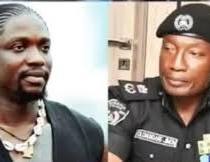
Activist posts video of paraded police officers after Force challenges him to substantiate claims; police say allegations remain unverified as Presidency, lawyers and public figures join widening controversy
The confrontation between social media activist Martins Vincent Otse, popularly known as VeryDarkMan, and the Nigeria Police Force intensified on Thursday after the activist released what he described as his “first evidence” in support of allegations that some police personnel aid kidnappers and bandits.
Otse posted a video on his Instagram account with the brief caption, “My evidence number 1,” only hours after the Police Force publicly challenged him to substantiate allegations he made at the 66th Annual General Conference of the Nigerian Bar Association in Port Harcourt, Rivers State.
The footage shows police officers being paraded. However, neither the accompanying post nor the reports reviewed so far provide a detailed explanation linking the individuals in the video to VDM’s specific allegation that officers stationed at highway checkpoints identify financially capable travellers and pass information about them to criminal groups.
That distinction is important: the video constitutes material VeryDarkMan has presented as evidence, but the underlying allegation has not been independently established by an official investigation or court proceeding.
https://www.instagram.com/p/Dci4VLeMtAm/?utm_source=ig_embed&utm_campaign=embed_video_watch_again
How the controversy began
The dispute followed VDM’s appearance as a panellist at the NBA’s annual conference in Port Harcourt on Tuesday, where he spoke extensively about insecurity, kidnapping and the vulnerability of Nigerians travelling on major highways.
During the discussion, he questioned the effectiveness of police checkpoints on routes including the Lagos-Abuja highway and the Lokoja axis.
He alleged that some officers at such checkpoints could identify travellers who appeared capable of paying ransom and subsequently relay information about them to kidnappers.
According to reports of his remarks, VDM suggested that an officer could observe a traveller in a particular vehicle, determine that the person might be financially valuable to kidnappers and then pass information about the traveller’s identity or movement to criminal elements.
He went further, alleging that security agencies know the identities and locations of some people behind kidnappings and violent attacks but have failed to stop them.
At the centre of his remarks was his assertion that the perpetrators popularly described as “unknown gunmen” should not necessarily be assumed to be unidentified civilians.
“There are no unknown gunmen anywhere,” he said, according to reports of the conference. He subsequently included personnel from the military, Immigration and Customs among those he described as the “unknown gunmen.”
In another part of the discussion, VDM alleged that some police officers were poorly remunerated and claimed that this could contribute to misconduct, while also accusing some personnel of passing information to criminal groups and, according to one report, even renting firearms to them.
Police reject allegations, demand evidence
The Nigeria Police Force responded by rejecting the allegations as unsubstantiated and warning that claims of such gravity required credible evidence.
In a statement issued by Force Public Relations Officer, CSP Ani Iniedu, the Force invited Otse to provide the information on which his allegations were based, specifically requesting evidence that checkpoint personnel identify wealthy individuals and subsequently transmit information about them to kidnappers for the purpose of facilitating abductions.
The Force said evidence supplied by the activist would be treated urgently and investigated.
It also defended officers deployed to checkpoints, saying their responsibility was to prevent crime, detect criminal activity and protect citizens.
According to the police, officers operating in such locations regularly confront criminal elements and have themselves been ambushed, attacked and killed. Police stations and operational assets, the Force added, have also been targeted by terrorists, kidnappers and other violent criminals.
At the same time, the Force acknowledged that individual officers found to have compromised their duties could face disciplinary action and prosecution.
The police therefore drew a distinction between legitimate criticism of policing and what it described as blanket or unverified accusations capable of damaging public confidence in the institution.
Before releasing his latest video, Otse had taken a confrontational position on the police invitation.
In a video posted online, he said he was prepared to honour the invitation but would not submit his evidence during police questioning.
Instead, he challenged the Force to charge him to court.
“I will tender the evidence in court,” he said in substance, maintaining that his lawyers were ready to defend him.
He also accused the police of concentrating on his allegations against officers while ignoring what he described as his broader point about poor welfare and remuneration among police personnel.
VDM argued that better welfare for police officers was essential to improving security.
His position created an unusual sequence: the police demanded evidence, the activist initially insisted that he would only present it in court, and he subsequently released a video publicly described as his first piece of evidence.
What does the “first evidence” actually establish?
This is now the central question in the dispute.
Reports examining the video say it shows police officers being paraded, but VDM did not, in the post itself, provide a detailed explanation establishing how the footage proves his particular allegation about officers supplying information about travellers to kidnappers.
VDM’s comments came during a conference session devoted to insecurity at a time when kidnapping, banditry and attacks on civilians remain major public concerns.
He told the gathering that his contribution was based on what he described as firsthand experience of victims and communities affected by violence.
Defending his presence at a lawyers’ conference, he said he had not been invited to teach lawyers the law but to share experiences from his encounters with insecurity.
He pointed to the reported abduction of a judge travelling from Sokoto State who was kidnapped in Kebbi on July 26 and released after about a week.
“This is not a topic of ‘may I, my lord’ because your lords are being kidnapped,” he said, arguing that insecurity had become an issue directly affecting the legal profession.
He also referred to his visits to communities affected by violence, including Yelwata in Benue State, and described seeing the aftermath of attacks.
Why the NBA invitation became controversial
The choice of VDM as a panellist had already generated debate within the legal community before his comments about the police triggered the latest confrontation.
The Nigerian Bar Association subsequently presented him with a recognition award following his appearance at the conference, commending him for attending and sharing his experiences with participants.
But prominent lawyer and Senior Advocate of Nigeria, Femi Falana, criticised the decision to invite Otse to speak on specialised issues such as national security.
Falana argued that past NBA conferences had generally featured individuals with relevant professional expertise when discussing specialised subjects.
VDM responded by saying his invitation was based on experience rather than academic credentials. He characterised the criticism as “classism” and argued that ordinary Nigerians who experience insecurity firsthand should have a voice in national conversations about security.
The argument has consequently developed along two separate but overlapping lines: whether VDM was an appropriate speaker at a major legal conference, and whether his allegations against security personnel can be substantiated.
Presidency joins criticism
The controversy has also drawn the Presidency into the dispute.
President Bola Tinubu’s Senior Special Assistant on Media and Publicity, Sunday Dare, criticised the NBA for providing VDM with a platform to make what he described as “unguarded and reckless” accusations against the police and security agencies.
The presidential criticism adds a political dimension to what began as a dispute between a social-media activist and the police.
It also places the NBA in an uncomfortable position: the association gave VDM a platform and subsequently recognised his contribution, while government officials and sections of the legal profession have questioned whether such a platform should have been provided for allegations of this nature.
Police-VDM tensions predate the latest dispute
The latest confrontation is not VDM’s first major clash with the Nigeria Police Force this year.
Earlier in August, the Force invited him to substantiate separate allegations concerning Assistant Inspector-General of Police Moshood Jimoh.
The police said the allegations were being examined through its internal accountability mechanisms, while stressing that a related criminal case had already been investigated and was before a competent court following legal advice from the Directorate of Public Prosecutions.
The Force also said AIG Jimoh had been invited for questioning as part of an administrative review.
That earlier episode is significant because it demonstrates that the current dispute did not emerge in isolation. VDM and the police had already entered into a cycle in which the activist made public allegations, the Force demanded substantiation and both sides disputed how the claims should be investigated.
A recent court victory adds another layer
The latest confrontation also comes weeks after a Federal High Court in Abuja reportedly struck out a police impersonation case against Otse.
VDM announced the development on August 4, saying the case had been dismissed and that he had been discharged. Reports said the case arose from allegations relating to his use of police-style clothing.
The development is relevant to the current controversy because it has further shaped the activist’s public narrative of his dealings with law-enforcement authorities.
It does not, however, determine the truth or otherwise of his present allegations concerning police complicity in kidnapping.
The police also point to misconduct investigations
The Force’s demand for evidence comes against a background in which allegations of police misconduct are themselves routinely investigated.
In the earlier AIG Jimoh controversy, for example, the police confirmed that an administrative investigation was under way while maintaining that matters already before the courts should not be tried in the media.
This distinction – between an allegation, an administrative investigation and a court-established fact – is likely to be crucial as the VDM controversy develops.
The Police Force has not said that misconduct by its personnel is impossible. Rather, its position is that individual wrongdoing should be established through evidence and that officers found culpable should face disciplinary measures or prosecution.
The irony of the latest “evidence”
There is also an important irony in the timing of VDM’s post.
On Thursday, he told the police he would not hand over his evidence and challenged the Force to charge him to court. Hours later, he released what he called “evidence number 1” to the public.
The release therefore appears to be the beginning of a possible sequence rather than the conclusion of the dispute.
The wording “number 1” suggests that further material may follow. Whether subsequent material will contain names, dates, communications, financial records, witness accounts, operational documents or other evidence directly connecting police officers to kidnappers remains to be seen.