
By Paul Ibe
Akin Osuntokun’s latest intervention, titled “Atiku Abubakar Cannot Heckle His Way to the Presidency,” published in THISDAY on October 16, 2026, is a curious mixture of selective history, political prejudice and recycled allegations masquerading as informed commentary. It is remarkable that at a time when Nigerians are grappling with unprecedented economic hardship, insecurity and growing uncertainty about their future, Osuntokun considers it more important to excavate alleged private conversations from over two decades ago in an attempt to disqualify former Vice President Atiku Abubakar from seeking the presidency.
Of particular interest is his resurrection of a story attributed to former Cross River State Governor Donald Duke, who claimed that former military President Ibrahim Babangida once told President Olusegun Obasanjo that Atiku could not rule Nigeria. This is precisely the sort of tale by moonlight that should have no place in serious political analysis.
According to the account, Babangida allegedly pretended to have forgotten his keys, returned to Obasanjo’s private study and whispered a warning about Atiku. We are then invited to treat this extraordinary recollection of a supposed private exchange as a definitive assessment of Atiku’s presidential suitability.
But where is the independent corroboration? Has Babangida publicly authenticated those precise words? Even assuming, without conceding, that the conversation occurred exactly as narrated, since when did an alleged private judgment made over twenty years ago become a permanent disqualification from democratic leadership?
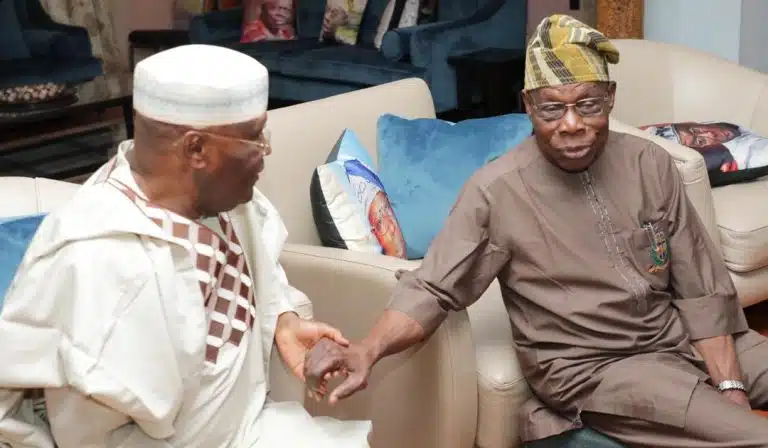
The irony is that Osuntokun chooses to dwell on what Babangida allegedly said in private while conveniently sidestepping what Obasanjo subsequently declared in public. On October 11, 2018, Obasanjo openly endorsed Atiku for the presidency. He acknowledged their past disagreements, reconciled with his former deputy and offered an unambiguous assessment of his leadership credentials. His words deserve to be recalled: “You surely understand the economy better.” Obasanjo went further, praising Atiku’s business experience, national and international reach, accessibility and capacity to provide leadership superior to that of the incumbent administration.
These were not anonymous whispers behind closed doors. They were public declarations made before political leaders, religious figures and the Nigerian media. Indeed, Obasanjo acknowledged that there had once been an understanding for Atiku to succeed him. That documented admission is considerably more relevant than Osuntokun’s speculative reconstruction of conversations from another political era. One would have expected a commentator concerned with historical accuracy to reconcile these facts rather than cherry-pick episodes that reinforce his preferred conclusion.
As for Babangida, any serious examination of his assessment of Atiku must account for the full history of their political relationship, including subsequent engagements, rather than elevate an uncorroborated remark into an eternal verdict. Neither Obasanjo nor Babangida holds a hereditary franchise to determine who may govern Nigeria. Whatever they may have thought about Atiku at different points in their political lives, the final authority belongs to the Nigerian electorate.
Osuntokun also suggests that Atiku’s age and repeated presidential contests should persuade him to surrender his ambition and become a mentor to younger politicians. This argument is as selective as it is unpersuasive. If age, experience and repeated electoral contests are legitimate subjects of political scrutiny, they must apply equally to all candidates, including President Bola Ahmed Tinubu. They cannot suddenly become disqualifying considerations simply because the candidate under examination is Atiku Abubakar.
Age does not confer competence, but neither does it automatically extinguish it. The appropriate questions concern judgment, capacity, policy, integrity and the ability to assemble a credible governing team.
Atiku has offered Nigerians his experience in public administration, economic management, enterprise development and national leadership. These credentials are open to legitimate scrutiny, just as Tinubu’s performance after more than three years in office must be subjected to rigorous examination.
On zoning, Osuntokun advances the argument that another northern presidency would violate an expectation that power should remain in the South for eight years. Regional balance is important to national cohesion. But zoning is a political arrangement, not a constitutional prohibition against qualified Nigerians seeking elective office. More importantly, it cannot become an instrument for shielding an incumbent from accountability.
Nigerians are entitled to consider regional equity alongside competence, performance, national security and economic survival. It is for voters, not columnists, to decide how these considerations should influence their ballots.
Osuntokun’s attempt to portray Atiku as the principal architect of opposition fragmentation is equally simplistic. The crisis within the opposition cannot credibly be attributed to one individual while ignoring the ambitions, choices and conduct of other political actors. Political parties are collective institutions, and responsibility for their successes and failures must be assessed accordingly. Atiku has participated in efforts to build a broader opposition coalition and now leads the ADC presidential ticket alongside Rotimi Amaechi. Whether that coalition persuades Nigerians is a matter to be settled democratically, not through predetermined assertions about his supposed unelectability.
Then there is Osuntokun’s fascination with Atiku addressing the President as “Bola.” When did addressing a public official by his given name become a constitutional offence or a measure of political desperation? Bola is the President’s name, not an insult. Those who regard its use as an affront should explain why the substance of public accountability matters less to them than presidential titles.
The real political pollution is not calling a president by his name. It is the growing tendency to treat legitimate criticism of public officeholders as an act of disrespect. What Nigerians require from political commentators is a searching examination of governance. How have the administration’s economic policies affected household incomes? What has happened to the purchasing power of wages? How secure are communities? What measurable relief has reached ordinary Nigerians?
These questions deserve more attention than an alleged conversation about misplaced keys in Aso Rock more than twenty years ago. Osuntokun is entitled to his preferences, prejudices and political conclusions. He is even entitled to believe that Atiku should not be President. What he is not entitled to is the pretence that his personal judgment constitutes the verdict of the Nigerian people. In a democracy, presidential ambition is neither granted nor extinguished by the approval of political columnists.
On January 16, 2027, Nigerians will have the opportunity to examine the competing candidates, evaluate their records, consider their proposals and exercise their constitutional right to determine who governs them. They will not be required to consult Osuntokun’s preferred political history before casting their ballots. Atiku Abubakar does not require Akin Osuntokun’s permission to seek the presidency, any more than Bola Tinubu requires his endorsement to pursue re-election.
Both must submit themselves to the sovereign judgment of Nigerians. Ultimately, Atiku’s presidential fate will be determined by the votes of Nigerians, not by Akin Osuntokun’s biases, recycled anecdotes or tales by moonlight. That is democracy. And that is the verdict that matters.
● Ibe, Media Adviser to Atiku Abubakar, writes from Abuja.