
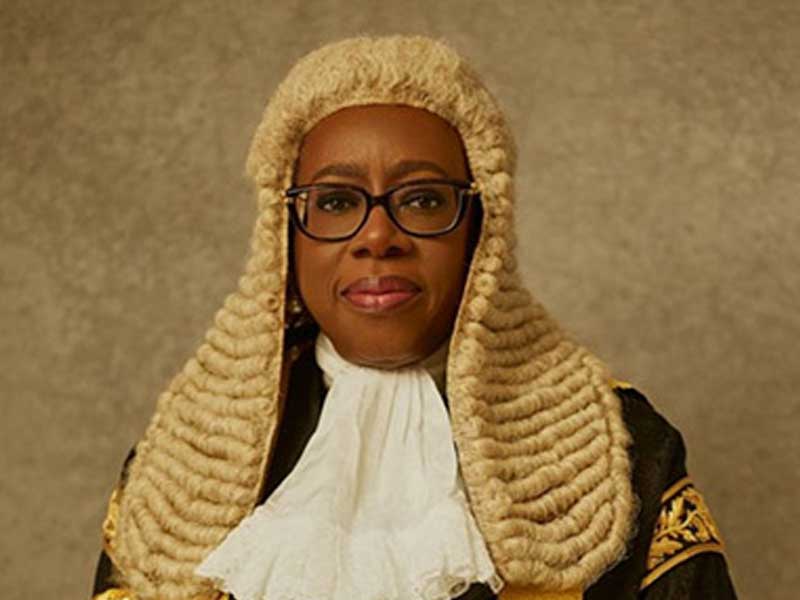
Senior Advocate of Nigeria, Chief J.S. Okutepa, has questioned the timing and legal basis of Justice James Omotosho’s decision to withdraw from the ongoing money-laundering trial of Ali Bello and Dauda Sulaiman, arguing that the circumstances surrounding the recusal raise important questions about judicial impartiality, evidentiary integrity and the proper handling of criminal proceedings.
Justice Omotosho of the Federal High Court in Abuja recused himself on September 24, 2026, as the case came up for the adoption of written addresses on the defendants’ no-case submissions. He ordered that the case file be returned to the Chief Judge of the Federal High Court for reassignment.
The case, marked FHC/ABJ/CR/550/2022, was instituted by the Economic and Financial Crimes Commission (EFCC) in 2022. Bello, who is the Chief of Staff to Kogi State Governor Usman Ododo and a nephew of former Kogi Governor Yahaya Bello, is standing trial alongside Dauda Sulaiman over allegations involving about ₦10.27 billion said to have been diverted from the Kogi State Government. The defendants have denied wrongdoing.
The immediate trigger for the latest development was a controversy over the alleged alteration or deletion of messages contained in a mobile phone that had been admitted as evidence.
How the evidence controversy began
The evidence controversy came to light on February 5, 2026, when Justice Omotosho disclosed in open court that the court registrar, Nasiru Zubairu Onimisi, had allegedly admitted to interfering with a mobile phone tendered by the EFCC as Exhibits N and O.
According to reports of the proceedings, the judge said the registrar had told him that Sulaiman approached him to delete certain WhatsApp messages from the phone using a code. The judge subsequently ordered the Nigeria Police Force and the Department of State Services to investigate the registrar and the second defendant.
Justice Omotosho reportedly played in open court a recording of the registrar’s account of what happened. The phone was subsequently examined in court, with the proceedings indicating that some of its contents had been altered or deleted.
The deleted material was said to include WhatsApp exchanges that the prosecution considered relevant to the allegations against the defendants. Reports from the proceedings cited messages referring to large sums of money and transactions involving individuals connected to the case.
The EFCC subsequently sought a thorough investigation of the phone and the circumstances surrounding the alleged interference, while defence lawyers urged the court to await the outcome of the investigation.
Despite the controversy, the substantive trial continued.
On February 16, the EFCC’s 17th prosecution witness, investigator Ahmed Audu Abubakar, continued his testimony, including evidence concerning financial transactions and properties allegedly connected to the defendants. The court also dealt with objections to the admissibility of the defendants’ statements and ordered a trial-within-trial before ultimately admitting the statements.
EFCC closes its case
The prosecution eventually called 17 witnesses and closed its case on June 2, 2026.
The defendants then filed no-case submissions, contending that the EFCC had failed to establish sufficient evidence to require them to enter a defence.
The matter was consequently listed for the defendants to adopt their written addresses on the no-case submissions on September 24.
It was at that stage, roughly seven months after the evidence-tampering controversy first came to light, that Justice Omotosho announced his withdrawal.
Why Justice Omotosho recused himself
In his ruling, Justice Omotosho said the disputed exhibit was not peripheral to the case but constituted a material part of the prosecution’s evidence.
The judge said some of the contents of the phone had already been downloaded onto a flash drive that was itself tendered in evidence. He explained that determining the no-case submissions could require the court to assess the probative value of the disputed exhibit.
According to reports of the ruling, Omotosho reasoned that whatever approach he adopted could create a perception problem.
If he gave the disputed exhibit significant evidential weight, questions could arise about whether the circumstances surrounding the alleged interference had influenced his assessment. Conversely, if he attached little or no weight to it, there could be a perception that he was discounting the seriousness of the alleged interference.
The judge also disclosed another circumstance that he considered relevant: during the pendency of the case, he had dealt with a separate forfeiture proceeding involving a Gwarimpa property which he said was connected to the defendants and the present matter.
Omotosho therefore concluded that continuing with the proceedings could create an appearance of bias and potentially undermine public confidence in the administration of justice.
He consequently returned the file to the Chief Judge for reassignment.
Okutepa challenges the timing
It is against this background that Okutepa has questioned whether the alleged evidence interference, by itself, required Justice Omotosho to withdraw from the trial.
In his legal opinion on the development, the SAN argues that the integrity or admissibility of disputed evidence and the impartiality of the judge are separate legal questions.
His central concern is the timing.
Okutepa points out that the alleged interference became known in February, yet the judge continued to preside over the proceedings, supervised the prosecution’s evidence, dealt with evidential objections and allowed the EFCC to call its 17th witness before closing its case in June.
If the circumstances surrounding the disputed exhibit had already created a reasonable apprehension that the judge could not fairly determine the case, Okutepa asks, why did that apprehension become decisive only after the prosecution had completed its case and the defendants had filed no-case submissions?
That question, in his view, deserves judicial scrutiny.
The SAN’s argument does not depend on determining whether the allegations of evidence tampering are true. Rather, it concerns whether the alleged interference necessarily prevented the trial judge from carrying out the narrower judicial task required at the no-case stage.
What a no-case submission requires
A no-case submission generally concerns whether the prosecution has produced sufficient evidence to require a defendant to be called upon to enter a defence. It is not, at that stage, a final determination of guilt or innocence.
That distinction is central to Okutepa’s argument.
He maintains that Justice Omotosho could have considered the prosecution’s evidence while excluding, discounting or otherwise treating cautiously any portion of Exhibit N that was found to have been compromised.
In other words, according to the SAN’s reasoning, an evidentiary problem does not automatically become a judicial-bias problem.
The court could determine the evidential consequences of the alleged interference without necessarily determining the defendants’ ultimate criminal liability.
This distinction becomes particularly important because the prosecution had already called 17 witnesses and presented documentary and other evidence before closing its case.

The unresolved investigation
Another significant feature of the dispute is the status of the investigation into the alleged tampering.
When the case returned on September 24, Justice Omotosho reportedly asked the EFCC about the outcome of the investigation ordered in February.
Counsel for the EFCC, Abbas Mohammed, reportedly told the court that he understood the DSS had concluded its investigation and forwarded its report to the Office of the Director of Public Prosecutions of the Federation at the Federal Ministry of Justice, but said he did not have the details of the outcome.
Justice Omotosho, however, said the investigation remained unresolved from the court’s perspective after approximately seven months. That unresolved status formed an important part of his concern about continuing with the matter.
The issue is therefore no longer simply whether messages were deleted. It also encompasses questions about the preservation of evidence, the outcome of the investigation, the responsibility of anyone found to have interfered with exhibits and the effect of any compromised evidence on the prosecution’s case.
The legal test for recusal
Okutepa has cautioned against allowing public perception, speculation or unease to replace the established legal principles governing judicial recusal.
The central question in a recusal inquiry is ordinarily whether the circumstances provide an objective and reasonable basis for apprehending that a judge may not be able to approach the matter impartially.
The principle is closely connected with the broader requirement that justice must not only be done but must also be seen to be done.
The important distinction, therefore, is between a concrete and objectively reasonable apprehension of bias and a mere suspicion that a judge might be influenced by circumstances surrounding a case.
That distinction is significant in the Bello proceedings because Justice Omotosho did not find that he was personally incapable of acting impartially. His stated concern was instead that continuing with the case could create perceptions capable of undermining confidence in the judicial process.
The Gwarimpa forfeiture issue
Justice Omotosho also referred to his previous involvement in a forfeiture proceeding concerning a property in Gwarimpa, Abuja.
The judge said that matter was connected to the present defendants and the current proceedings and that this was another factor relevant to how his continued participation might be perceived.
Okutepa, however, argues that previous judicial involvement in a related proceeding does not automatically establish bias.
The critical question, according to the SAN, is whether the earlier proceeding created an objective and reasonable basis for concluding that the judge could no longer approach the criminal trial with an open mind.
That is a fact-specific inquiry rather than an automatic consequence of having previously dealt with related property or forfeiture proceedings.
A trial now faces reassignment
Justice Omotosho’s recusal means that the case will have to be reassigned by the Chief Judge of the Federal High Court.
The immediate procedural consequence is that the defendants’ pending no-case submissions will have to be dealt with by the judge who takes over the matter, subject to whatever directions that judge may issue concerning the existing record and proceedings.
The recusal does not amount to a finding that Ali Bello or Dauda Sulaiman committed the alleged offences. Nor does it resolve the allegations concerning the court registrar or determine the ultimate evidential value of the disputed exhibits.
Those issues remain matters for investigation and judicial determination.
What happens to the disputed evidence?
The future of Exhibit N may now become one of the most important questions in the proceedings.
• The judge’s ruling indicates that some contents of the phone had already been extracted and transferred to a flash drive admitted in evidence. That could become relevant to arguments about whether the original device’s alteration affects the reliability or admissibility of the extracted material.
The reassigned judge may therefore have to consider questions including:
• what portions of the original phone were altered or deleted;
• when the alterations occurred;
• who was responsible;
• whether the extracted material accurately represents the contents of the device before the alleged interference;
• whether the prosecution can independently establish the authenticity and relevance of the affected evidence; and
• what effect, if any, the disputed material has on the prosecution’s overall case.
These questions could become particularly important when the court considers the defendants’ no-case submissions.
The controversy has moved the case beyond the allegations of financial misconduct that originally brought Bello and Sulaiman before the court.
It now raises institutional questions about the security of exhibits once they have been admitted into evidence, access to electronically stored evidence, the responsibility of court officials and the speed with which allegations of interference with evidence are investigated.
It also highlights a difficult balance in judicial administration.
On one hand, judges must protect the appearance and reality of impartiality and ensure that litigants and the wider public retain confidence in the courts.
On the other hand, criminal proceedings are expected to move forward on the basis of established legal principles, and the withdrawal of a judge after a trial has progressed substantially can create additional delay and procedural complications.
Okutepa’s intervention focuses on that second concern. His position is that alleged interference with an exhibit should primarily trigger a process for identifying those responsible, preserving the evidence, assessing its impact and allowing the court to determine what evidential weight it deserves.
He cautions that evidence tampering should not, by itself, become a mechanism capable of derailing a trial that has already advanced considerably.
Possible appellate scrutiny
Okutepa has further suggested that, subject to the full contents of Justice Omotosho’s ruling and the applicable procedural rules, the prosecution may have grounds to challenge aspects of the recusal decision through the appellate process.
An appellate court, if the issue reaches it, could provide guidance on several questions: when an evidentiary controversy creates an objectively reasonable apprehension of bias; whether a judge can continue with a trial after an allegation of interference involving a material exhibit; and whether the timing of a recusal after the close of the prosecution’s case affects the proper exercise of judicial discretion.
Such a determination could have implications beyond the Bello case, particularly for trials involving electronic evidence and allegations of interference with exhibits.
For now, the case returns to the Chief Judge of the Federal High Court for reassignment, while the allegations surrounding the disputed evidence remain unresolved.
The defendants remain entitled to the presumption of innocence, and the allegations against them have not been judicially determined. The next stage of the proceedings will depend on the reassignment of the case and the treatment of the pending no-case submissions by the new judge.