
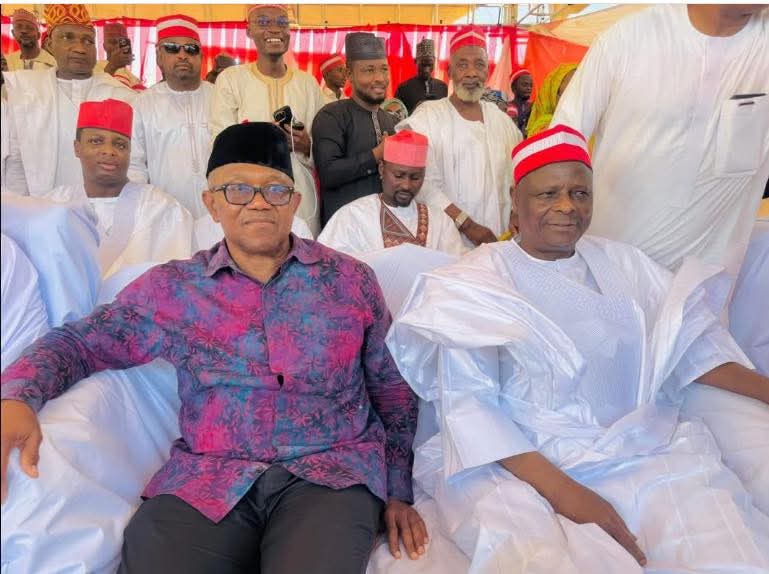
Fresh uncertainty has gripped the country’s opposition landscape as former Anambra State governor Peter Obi and ex-Kano State governor Rabiu Musa Kwankwaso become the focal point of shifting alliances and quiet power negotiations ahead of the 2027 general elections.
Multiple sources within opposition circles say a fragile coalition – built around the African Democratic Congress (ADC)—is showing signs of strain, following indications that both Obi and Kwankwaso may be reconsidering their positions within the bloc.
The coalition, which includes heavyweight figures such as Atiku Abubakar, had been designed as a united front to challenge the ruling party. However, disagreements over leadership structure and candidate selection have triggered internal discord.
Insiders describe the situation as “fluid,” with competing ambitions threatening to derail months of behind-the-scenes negotiations.
Defection Speculation Intensifies
At the center of the uncertainty are reports that the two politicians are exploring a move to an emerging platform, the Nigeria Democratic Congress (NDC). Though no official confirmation has been issued, party strategists suggest the move is being weighed as a way to secure a more stable and less contentious political base.
Supporters of both men argue that a fresh platform could eliminate entrenched rivalries and provide a “litigation-free” path to the ballot.
Kwankwaso Douses Alliance Rumours
Amid growing speculation of a joint presidential ticket, Kwankwaso has publicly denied that any binding agreement exists between him and Obi.
Speaking through allies, he emphasized that no formal alliance has been concluded and that discussions remain preliminary. Observers note that such denials are typical in Nigeria’s pre-election cycle, where political actors often maintain strategic ambiguity while negotiations continue.
Political observers say a partnership between Obi and Kwankwaso would carry significant electoral weight.
Obi, who ran under the Labour Party in 2023, commands a strong following among young voters and in the South-East. Kwankwaso, leader of the influential Kwankwasiyya movement, retains deep grassroots support across northern Nigeria.
A combined ticket could, in theory, bridge regional divides and consolidate the so-called “third-force” movement – voters seeking alternatives to Nigeria’s traditional political blocs.
Despite the apparent strategic logic, several hurdles remain.
Foremost is the question of leadership. Neither Obi nor Kwankwaso is widely seen as willing to cede the presidential ticket, raising concerns that negotiations could stall over who leads and who deputizes.
There are also fears that further fragmentation within the opposition could ultimately benefit the ruling party by splitting votes, as seen in previous election cycles.
The unfolding developments highlight a pattern in Nigerian politics: fluid party affiliations and alliance-building driven more by electoral strategy than ideological alignment.
For voters, the constant realignment may reinforce perceptions of instability within the opposition. For political actors, however, it reflects a high-stakes effort to recalibrate ahead of what is expected to be a fiercely contested 2027 race.
With no definitive announcements yet, the coming months are likely to see intensified consultations, strategic denials, and possible realignments.
Whether Obi and Kwankwaso ultimately converge on a joint platform – or pursue separate paths – could prove decisive in shaping the balance of power in Nigeria’s next presidential election.
For now, the opposition’s path to unity remains uncertain, and the political chessboard continues to shift.