
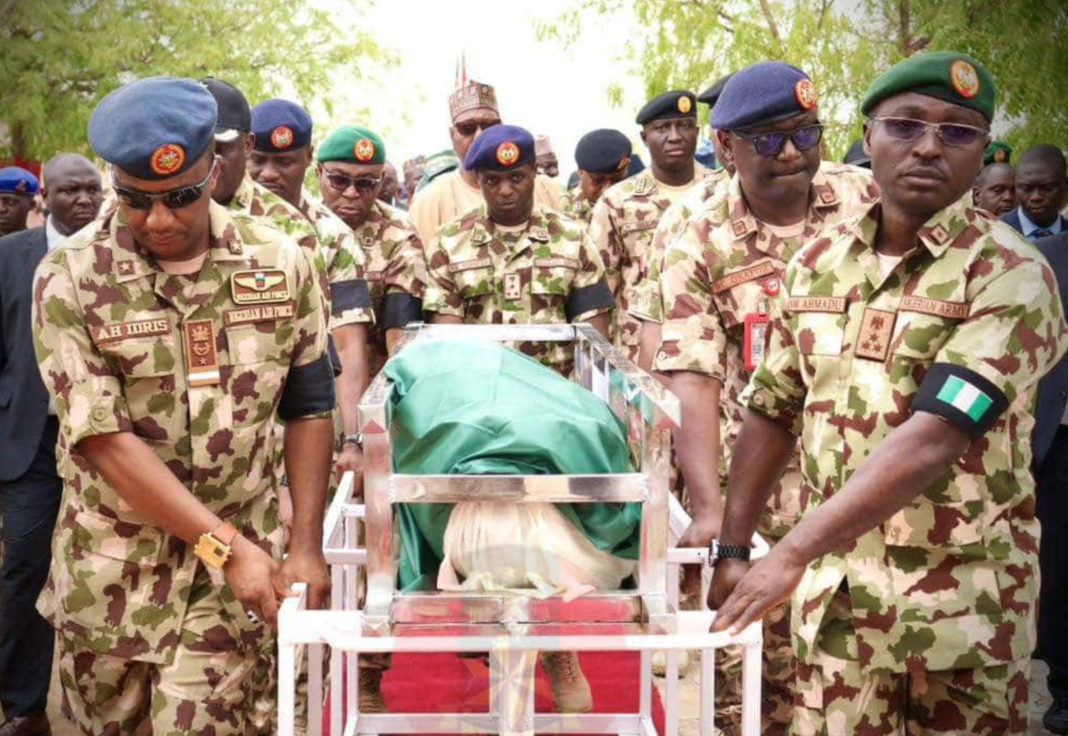
In a solemn ceremony marked by bugle calls and heavy silence, Nigeria on Wednesday, April 15, 2026, laid to rest Brigadier General Oseni Omo Braimah, Captain Ismail, and other soldiers whose deaths are now stirring deeper national reflection – not just grief.
At the Maimalari Cantonment Cemetery in Maiduguri, Borno State, the ritual of military honour unfolded with precision. But beyond the ceremonial gun salutes and folded flags, a more unsettling reality lingered: the war these men died fighting may be entering a more dangerous phase.
Brigadier General Braimah, Commander of the 29 Task Force Brigade under Operation Hadin Kai, was killed on April 9 during a coordinated midnight assault on a military formation in Benisheikh – an attack described by insiders as one of the fiercest in recent months.
While the military maintains that troops “repelled the attack,” emerging accounts suggest the insurgents struck with unusual coordination, raising fresh concerns about evolving tactics and possible intelligence gaps on the frontlines.
As dignitaries – including Borno State Governor Babagana Umara Zulum and top defence chiefs – paid tribute, the ceremony became more than a farewell. It became a moment of reckoning.
A War Growing More Complex
The burial comes amid a surge of troubling developments in Nigeria’s counterinsurgency efforts.
Just days before the ceremony, authorities confirmed they are on high alert over intelligence pointing to potential large-scale terrorist attacks targeting critical infrastructure, including Abuja’s airport and detention facilities.
At the same time, controversy is mounting over a recent military airstrike in the northeast that reportedly killed scores of civilians at a market long suspected to be within insurgent-controlled territory.
The incident has reignited difficult questions:
Are Nigeria’s military gains coming at too high a cost? And is the line between insurgents and civilians becoming dangerously blurred?
For grieving families at the cemetery, such debates feel distant – but they underscore the complexity of the war their loved ones fought.
The Human Face of Sacrifice
Rows of uniformed soldiers stood in rigid formation as the remains were lowered into the earth. Nearby, families clutched folded flags – symbols of honour that cannot replace what has been lost.
Each citation read aloud told a story of duty and courage. Yet beyond the official language lay quieter truths: interrupted futures, children without fathers, and communities forever altered.
President Bola Tinubu had earlier described the fallen as “unforgettable heroes,” praising their role in preventing further devastation during the attack.
Still, civil society groups warn that the killing of a senior officer like Brigadier General Braimah should be seen as a “national alarm bell” about the state of Nigeria’s security architecture.
Between Honour and Uncertainty
As the final notes of the bugle faded, the cemetery emptied – but the questions did not.
Nigeria continues to battle a 17-year insurgency that has claimed thousands of lives and displaced millions.
Recent mass terrorism trials, airstrike controversies, and rising threats to major cities all point to a conflict that is far from contained.
For the Armed Forces, the loss of a brigade commander on the battlefield is both a tactical and symbolic blow. For the nation, it is a reminder that the cost of war is not only counted in victories – but in lives buried with honour.
In death, Brigadier General Braimah and his fellow soldiers have become more than heroes.
They have become a mirror – reflecting both the bravery that sustains Nigeria and the urgent challenges that threaten it.
And as the country mourns, it must also confront a difficult truth: the war they died fighting is changing – and so must the response to it.