
The statistics are grim and fearful, though with a silver-lining that while there is an improvement in the country’s macroeconomic indices, more Nigerians will suffer economically.
The International Monetary Fund (IMF) has cautioned that millions could face worsening poverty and food insecurity as rising prices of food, fuel and other essential commodities continue to erode household purchasing power, despite improvements in the country’s macroeconomic fundamentals.
Many Nigerians point to IMF, which is raising the latest concerns, as the one behind the present policies driving more than 63% into penury. This has led to the posting of a particular thought-provoking poster making the rounds on social media. It goes: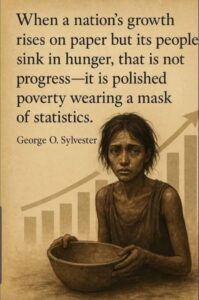
The latest warning reinforces concerns the IMF raised in its June 2026 Article IV Consultation on Nigeria, where it noted that although reforms implemented over the past three years have strengthened economic resilience, living conditions remain difficult for many Nigerians. The Fund estimated that poverty had risen to about 63 per cent of the 230 million population under the national poverty line, while about 27 million Nigerians experienced food insecurity during the latter part of 2025.
COMPLIMENTS.
Please read trending reports on Everyday.ng
Obi Group Seeks Probe After He Says He May Not Live To Contest 2027; Presidency Dismisses Claims
https://everyday.ng/?p=99614
After Warning 145m Nigerians in Poverty, IMF Again Says Rising Cost of Essentials Will Worsen Poverty
https://everyday.ng/?p=99619
EFCC says will appeal court award of N10m to former Minister Agunloye
https://everyday.ng/?p=99634
Appeal Court Shifts judgment in David Mark, Aregbesola’s appeal against FHC judgment
https://everyday.ng/?p=99632
Tinubu to CSOs: Put Nigeria First, Shun Harmful Foreign Influence
https://everyday.ng/?p=99627
For comments, adverts, releases, please reach us on:
Twitter on: @Everyday_ng;
E-mail: info@everyday.ng
Telephone, WhatsApp & Telegram: +234 802 2198060.
Contact Address: Back Suite, Off Umaru Musa Yar’Adua Way, Kukwaba District, Abuja.
God bless the Federal Republic of Nigeria.
The latest warning came as the IMF retained its growth forecast for Nigeria at 4.1 per cent in 2026 and 4.3 per cent in 2027, reflecting confidence that ongoing economic reforms, improved macroeconomic stability and favourable oil market conditions will sustain the country’s recovery.
The projections are contained in the IMF’s July 2026 World Economic Outlook (WEO) Update, released on Tuesday, which painted a mixed picture for Nigeria and the wider Sub-Saharan African region. While acknowledging that Nigeria has made notable progress in stabilising its economy after years of fiscal and foreign exchange challenges, the Fund warned that the benefits of the recovery are yet to reach millions of households struggling with the rising cost of living.
According to the IMF, Nigeria remains one of the larger African economies benefiting from earlier macroeconomic reforms and improved terms of trade as an oil exporter, but these gains are being offset by surging prices of essential goods.
“Nigeria is supported by improved macroeconomic stability and favourable terms-of-trade effects, though higher prices for essentials are expected to further aggravate poverty and food insecurity,” the Fund stated.
The IMF noted that higher global prices for fuel, food and fertiliser may boost Nigeria’s export earnings and government revenues because of its status as an oil producer, but they also increase inflationary pressures by raising transportation and production costs across the economy.
These price increases, the Fund warned, are likely to reduce the purchasing power of households, deepen hardship among low-income families and increase pressure on food supplies.
The IMF nevertheless maintained that Nigeria’s economy is expected to continue expanding steadily, with real Gross Domestic Product (GDP) projected to grow by 4.1 per cent in 2026 before strengthening to 4.3 per cent in 2027. The projections are broadly in line with the Fund’s earlier assessment that recent fiscal, monetary and exchange-rate reforms are gradually restoring investor confidence and strengthening external buffers.
Sub-Saharan Africa Faces Uneven Recovery
For Sub-Saharan Africa, the IMF projected economic growth of 4.3 per cent in 2026 and 4.5 per cent in 2027, but stressed that regional averages conceal significant differences among countries.
According to the Fund, oil-importing economies that depend heavily on imported food and energy are expected to suffer the greatest impact from rising global commodity prices. By contrast, larger economies such as Nigeria are benefiting from earlier economic reforms, although they remain vulnerable to higher domestic prices and weaker development financing.
The IMF also observed that most African economies are yet to benefit significantly from the rapid expansion of the global artificial intelligence (AI) industry, unlike several Asian economies that have become deeply integrated into AI-driven manufacturing and technology supply chains.
Globally, the IMF revised its economic outlook downward, forecasting world growth of 3.0 per cent in 2026, compared with the average 3.5 per cent recorded in 2024 and 2025. Growth is expected to recover modestly to 3.4 per cent in 2027.
The Fund attributed the slowdown largely to the economic consequences of the conflict in the Middle East, particularly its impact on energy markets, supply chains and investor confidence. It said the negative effects of the conflict were only partly offset by increased investment linked to advances in artificial intelligence and stronger demand for technology-related products.
The IMF also warned that global headline inflation, which had been easing over the past two years, is expected to rise from 4.1 per cent in 2025 to 4.7 per cent in 2026 before moderating to 3.9 per cent in 2027, signalling that the earlier disinflation trend has stalled.
Nigeria Faces External and Domestic Risks
Although Nigeria’s growth outlook remains positive, the IMF cautioned that the country’s recovery remains vulnerable to several external and domestic risks.
Among the most significant is the possibility of renewed escalation in the Middle East conflict, which could trigger another spike in global oil, food and fertiliser prices, disrupt international shipping routes and tighten global financial conditions.
The Fund warned that renewed commodity price shocks would likely translate into higher domestic inflation in Nigeria, worsen food insecurity and place additional pressure on government finances despite stronger oil revenues.
It also identified increasing trade fragmentation, slower global trade and reduced official development assistance as additional headwinds confronting developing economies, particularly across Africa.
IMF Calls for Continued Reforms
To safeguard economic stability and ensure that growth translates into improved living standards, the IMF urged governments to remain focused on restoring price stability, rebuilding fiscal buffers and accelerating structural reforms.
For Nigeria, this includes sustaining macroeconomic reforms, improving governance, strengthening agriculture and food production, expanding electricity supply, investing in infrastructure and human capital, and creating conditions that enable the country to benefit from emerging technologies such as artificial intelligence.
The Fund maintained that while Nigeria’s macroeconomic indicators have improved considerably, the ultimate measure of success will depend on whether economic growth translates into lower inflation, greater food security, job creation and better living standards for ordinary Nigerians.