
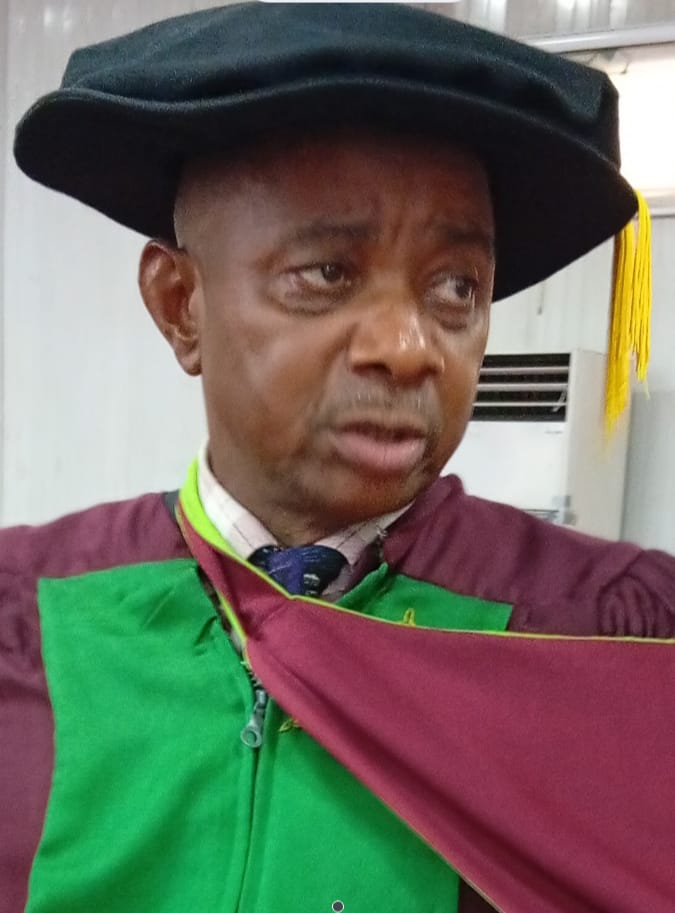
By Sabastine Abu
On a charged afternoon at the National Universities Commission (NUC) headquarters in Abuja, Professor Michael Akpan, a renowned economist and former Dean of the Faculty of Social Sciences at Bingham University, delivered a provocative public symposium in honour of two intellectual milestones: the 90th anniversary of John Maynard Keynes’s The General Theory of Employment, Interest and Money (1936–2026) and the 143rd birth anniversary of the legendary economist. The event, themed around the concept of Homo Economicus, the fabled “economic man” was nothing short of a scholarly performance, as the controversial soft-spoken professor transformed into a fearless defender of Keynesian economics.
Akpan, whom other speakers at the symposium describe as possessing a “meek mien” that belies a “ferocious Lion” when engaged in academic disputation, did not disappoint. He approached the podium with the dual task of commemorating Keynes’s revolutionary legacy while staunchly defending the classical foundations that Keynes himself sought to overturn.
In a room filled with policymakers and academics, Akpan argued that Homo Economicus, the rational, self-interested utility maximizer rooted in the writings of Adam Smith is not only alive but thriving. Tracing the model’s origins to the classical era, he delineated its five core attributes: profit maximization, rationality, self-interest, a short-term outlook, and perfect knowledge of economic actions.
“For centuries, this concept has shaped modern economics. The economic man is rational, self-interested, and efficient, but he is also often misunderstood. He was not designed to describe all human behavior but to model how individuals act within markets.”
Yet, Professor Akpan’s presentation went beyond mere historical homage. Responding directly to the symposium’s Keynesian backdrop, Akpan acknowledged the seismic shift Keynes introduced in 1936. Where Keynes argued that markets are inherently unstable and can settle into underemployment equilibria, thus necessitating active government intervention.
Akpan insisted that the principles of rationality and efficiency underlying Homo Economicus has remain essential analytical tools.
In the evolutionary life of the “Economic Man”, the bridge gap between Keynesian macroeconomics and micro-foundations, Akpan proposed an “evolved” version of Keynes. No longer a simple profit-maximizing individual, this modern Homo Economicus operates in complex, oligopolistic markets.
“In today’s world, the economic man has evolved. He now operates in imperfect markets shaped by technology, innovation, and global interdependence. He is not just a profit maximizer but also a problem solver, innovator, and strategist.”
Using real-world examples like the strategic competition between Dangote Cement and Bua Cement, Akpan demonstrated how even massive corporations remain bound by rational choice and efficiency-driven behaviour, albeit with multiple objectives.
In confronting the Homo Economicus critics, the professor noted that behavioral economists such as Richard Thaler and Cass Sunstein have demonstrated how emotions and cognitive biases frequently derail rational decision-making. He said, Feminist economists have also questioned why early economic theories featured no “economic woman,” exposing the model’s historical and gender biases.
Nevertheless, Akpan pushed back forcefully. He argued that these critiques, while valuable, do not invalidate the model’s utility. “He now operates as a firm rather than an individual, balancing multiple objectives beyond profit,” he explained, recasting the model as a guide rather than a perfect mirror of reality.
Most provocatively, given the symposium’s Keynesian backdrop, Akpan issued a direct challenge to the audience of Nigerian economists:
“Our task is not to discard economic models, but to reshape them to fit our environment, our values, and our people.”
While the timing of which seeks to honour a great thinker who arguably did more than any other to challenge laissez-faire orthodoxy was fitting, the symposium left some attendees questioning whether Akpan had truly grappled with Keynes’s core insight: that aggregate demand, not individual rationality, as the primary driver of economic cycles. Yet, in his closing remarks, Akpan dismissed the notion of a contradiction. “Despite the criticisms by asserting that the economic man continues to breathe through his vision. He is alive and active—adapting to new realities while remaining central to the logic that drives economies forward.”
Ultimately, Professor Akpan’s public symposium was less a celebration of Keynesianism than a spirited rearguard action against classical microeconomics. Whether one agrees with him or not, the event succeeded in sparking the kind of rigorous, cross-generational debate that both Keynes and Adam Smith would have applauded.
In applying the Homo Economicus principles to contemporary Nigerian situation, Akpan buttresses Keynes position on capitalism which seek to moderate the extreme impact of the economic theory that prescribes government intervention only in downturns for preservation but, agreed that the private sector should be allowed to run the economy in order to give room for healthy competition of ideas.
Highlights of the symposium was the unveiling of the Lord Keynes University by Professor Michael Akpan which he disclosed will be dedicated to teaching, research and mentoring of young economists who will be committed to addressing the economic challenges of Nigeria and beyond.
While commending Professor Akpan for his forthright vision and commitment to continue to engage the global economy like a true Keynesian, Professor Ojowu a former lecturer of Professor Akpan, Dr. Fasua (Special Adviser to the President on Economic Affairs), Professor Uwaleke and Professor Istifanus Zabadi, represented by Ass. Professor Shawai, all agreed that economics as a subject, is the ligament that connects and gives meaning to politics, sociology and all other disciplines of life. They however cautioned that economic theories like the one championed by Keynes will require different adjustment in its application on the Nigerian economic system that is bedevilled by deep rooted corruption which was not envisaged by the Economic man.
The speakers challenged Nigerian economists to be more deliberate, committed and truthful in their analysis of the economy which will serve as a guide to the government.
● Abu, PhD, mni, is journalist and national commentator.