
The widening war across the Middle East is rapidly evolving into a multi-front crisis—one that is devastating civilian life in Lebanon, threatening global energy supplies, and drawing in major powers from Washington to London.
Seven days after the latest escalation began, humanitarian agencies warn that the conflict has already unleashed a massive wave of displacement and civilian casualties, while military activity continues to intensify across the region.
According to the World Health Organization, at least 570 people have been killed and 1,313 injured in Lebanon since the fighting escalated, including 259 children.
Among the dead are 84 children, a figure that officials say underscores how heavily urban populations have been affected.
“This is only seven days of conflict and we are already seeing that almost 100 children have lost their lives,” said Abdinasir Abubakar, the WHO’s representative in Lebanon.
Airstrikes have largely struck densely populated areas, including neighborhoods in Beirut, where apartment buildings, residential blocks, and local infrastructure have been hit.
Humanitarian agencies warn the numbers could rise sharply as rescue operations continue and hospitals struggle with growing casualty lists.
A mass displacement crisis
The violence has forced hundreds of thousands to flee their homes in what the United Nations High Commissioner for Refugees describes as one of Lebanon’s largest displacement crises in years.
Nearly 700,000 people have been displaced in just over a week.
Lebanese authorities say more than 667,000 people have registered on the government’s emergency displacement platform, with the figure increasing by more than 100,000 in a single day.
Around 120,000 displaced people are currently sheltering in government-run collective centers, while many others have sought refuge with relatives or are searching for accommodation after fleeing their homes with only minimal belongings.
“Lives have been upended on a massive scale,” said UNHCR representative Karolina Lindholm Billing.
The conflict is also pushing refugees across borders. Syrian authorities report that over 78,000 Syrians and 7,700 Lebanese citizens have crossed into Syria since the escalation began.
War spreads after U.S.–Israel strike on Iran
The latest regional confrontation began on February 28, when the United States and Israel launched a coordinated strike on Iran.
The attack reportedly killed more than 1,200 people and injured over 10,000, triggering retaliatory missile and drone strikes by Iran against Israeli territory and targets linked to U.S. forces across the Middle East.
The conflict quickly spilled into Lebanon, where Israeli airstrikes intensified on March 2.
Meanwhile, the fighting has begun to destabilize other parts of the Gulf. Authorities in Bahrain reported that 32 people were injured after a drone strike hit the Sitra area, raising fears the confrontation could spread across the region.
New leadership turmoil in Tehran
Amid the escalation, Iran’s leadership has been thrown into turmoil.
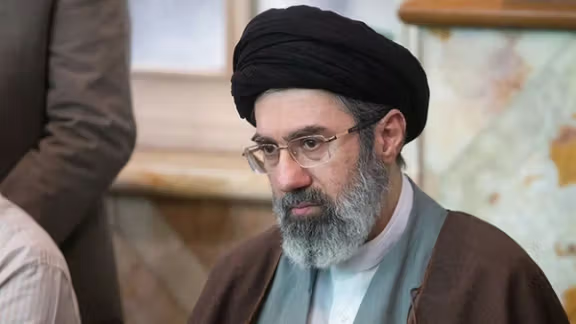
State media reported that Iran’s newly appointed Supreme Leader, Mojtaba Khamenei, was injured during the ongoing conflict. Officials described him as “janbaz,” a Persian term used for those wounded in war, though details about the incident remain unclear.
His appointment came only days after an Israeli airstrike in Tehran reportedly killed his father, Ali Khamenei, who had ruled Iran for decades.
Iran’s clerical oversight body, the Assembly of Experts, moved swiftly to install Mojtaba Khamenei as the country’s new supreme authority.
Analysts say his close ties to the powerful Islamic Revolutionary Guard Corps may shape Iran’s military response as the confrontation intensifies.
Oil chokepoint under threat
Beyond the battlefield, global markets are watching developments in the strategic Strait of Hormuz—a narrow maritime corridor through which roughly one-fifth of the world’s oil supply passes.
U.S. intelligence agencies say Iran has begun laying naval mines in the waterway. While only a limited number of mines have reportedly been deployed, the move has heightened fears that Iran could attempt to disrupt shipping.
Iran has already attacked several vessels in the strait and issued threats against others, though the shipping route remains open.
President Donald Trump warned that any attempt to close the strait would provoke an overwhelming military response.
“If for any reason mines are placed, and they are not removed forthwith, the military consequences to Iran will be at a level never seen before,” he wrote.
The tension has already pushed oil prices above $100 per barrel, reflecting fears that energy infrastructure across the Gulf could become targets.
Military preparations are also intensifying in Europe.
At RAF Fairford, a key U.S. bomber base in the United Kingdom, American crews have been seen preparing aircraft for potential operations.
Three B‑52 Stratofortress bombers and four B‑1 Lancer aircraft have arrived at the Cotswolds base in recent days, along with transport planes carrying munitions and spare parts.
The base is one of the few facilities in Europe capable of hosting long-range heavy bombers.
British Prime Minister Keir Starmer initially resisted allowing U.S. forces to use British bases during the early phase of the offensive, reportedly leading to disagreements with Washington.
However, London later approved their use for what officials described as the “specific and limited defensive purpose” of targeting Iranian missile systems.
U.S. Defense Secretary Pete Hegseth has since warned that the coming phase of the campaign could be the most intense yet, involving the largest concentration of American bombers and fighter aircraft deployed so far.
With airstrikes continuing in Lebanon, leadership uncertainty in Tehran, and global shipping routes under threat, diplomats warn that the conflict is edging toward a broader regional war.
For now, the most immediate consequences are being felt by civilians.
Across Lebanon, hundreds of thousands of families remain displaced, many sheltering in overcrowded schools and community centers as bombardment continues.
Aid officials say that if the fighting does not ease soon, the humanitarian crisis could rapidly surpass the country’s already fragile capacity to respond—turning a week of war into a prolonged catastrophe.