
Fresh borrowing request, costly international financing and a $5bn dollar-liquidity deal intensify concerns over debt sustainability, fiscal pressure and the country’s capacity to finance development.
Nigeria’s growing external debt exposure has come under renewed scrutiny following the World Bank’s disclosure that the country’s total external debt stock reached $145.02bn at the end of 2025, against the backdrop of the Federal Government’s continuing appetite for fresh borrowing.
The concerns have acquired additional significance following President Bola Tinubu’s latest request to the National Assembly for approval to raise approximately $7.7bn in external loans to finance part of the 2026 budget deficit.
The request, conveyed in a presidential letter dated October 26 and read before the Senate on November 4, effectively replaces an earlier proposal seeking approval for a much larger $20.5bn external borrowing programme.
The development raises a fundamental question about Nigeria’s fiscal direction: how much additional debt can the country responsibly accumulate while already committing an increasingly substantial share of its revenue to servicing existing obligations?
The World Bank’s International Debt Statistics 2026 puts Nigeria’s external debt at $145.015bn in 2025, compared with $135.988bn in 2024 and $83.213bn in 2015.
This represents a 6.6 per cent increase in one year and an approximately 74 per cent increase over the decade.
However, the figures require an important distinction. The World Bank’s external debt measure covers public and private external liabilities, whereas the Debt Management Office’s public debt figures cover the obligations of the Federal Government, state governments and the Federal Capital Territory.
The DMO’s December 2025 figures put Nigeria’s total public debt at approximately $110.97bn, comprising $51.86bn in external debt and $59.11bn in domestic debt.
By June 30, 2026, the country’s total public debt had risen further to approximately $120.93bn, or ₦166.79tn.
The latest DMO figures therefore show that the public debt position is continuing to expand, even as the broader World Bank figures reveal a much larger external liability across the entire economy.
The $7.7bn borrowing request and the expanding financing gap
The latest borrowing request comes after a series of upward revisions to the Federal Government’s financing requirements.
In December 2025, the government initially projected new borrowing of ₦17.89tn to finance the 2026 budget deficit.
However, following an expansion of the budget, the borrowing requirement was increased to ₦29.20tn in April 2026, representing an additional ₦11.31tn.
The revised financing plan included approximately ₦18.4tn in domestic borrowing and ₦10.79tn in external borrowing.
The Federal Government subsequently sought parliamentary approval for a supplementary external borrowing programme of approximately $20.5bn, alongside a euro-denominated component, to finance infrastructure and other development priorities over 2026 and 2027.
But on November 4, Tinubu withdrew the earlier proposal and submitted a replacement request for approximately $7.7bn.
The new request is intended to provide external financing for projects and programmes contained in the 2026 Appropriation Act.
The change reduces the immediate proposed external borrowing approval substantially, but it does not eliminate the underlying financing challenge.
The 2026 budget, signed into law in April, provides for total expenditure of ₦68.32tn against projected revenue of ₦36.87tn, leaving a fiscal deficit of ₦31.46tn.
Of particular concern is the allocation of approximately ₦15.8tn to debt servicing.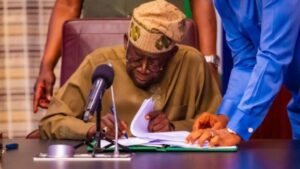
This means that almost one-quarter of the entire budget is committed to servicing existing debt, before accounting for other government obligations.
The implication is that the government must continue borrowing not only to finance infrastructure and development projects but also to bridge the gap between its revenue and expenditure.
Debt servicing is becoming a major fiscal constraint
Nigeria’s debt challenge is increasingly reflected in the relationship between government revenue and debt-service obligations.
The 2026 budget’s ₦15.8tn debt-service allocation is particularly significant when compared with the projected ₦36.87tn revenue.
Although the government expects to improve revenue collection through tax reforms, oil-sector recovery and stronger non-oil receipts, the financing gap remains substantial.
BusinessDay’s analysis of the earlier 2026 fiscal framework projected that debt servicing could consume approximately 45 per cent of federal revenue, although subsequent budget revisions changed the relevant revenue and expenditure assumptions.
More recently, the Federal Ministry of Finance has defended the government’s fiscal position, arguing that the debt-service-to-revenue outlook is improving.
In a statement published in October 2026, the ministry said the interest-to-revenue ratio had declined from 156 per cent to 124 per cent between the corresponding first-half periods. It also cited the World Bank’s projection of a 46 per cent full-year 2026 debt-service-to-revenue ratio.
The ministry cautioned against interpreting six-month figures as a complete measure of debt sustainability.
Nevertheless, even the government’s more favourable full-year projection suggests that a substantial proportion of available revenue will continue to be absorbed by debt obligations.
The implications are considerable.
Every additional naira committed to debt servicing reduces the fiscal room available for other priorities unless government revenue grows sufficiently to accommodate both.
This creates difficult choices involving infrastructure, healthcare, education, security, social protection and public-sector investment.
More importantly, where borrowing is used to finance recurrent expenditure or repay maturing obligations rather than productive assets, the country risks entering a cycle in which fresh loans generate limited additional capacity to repay existing ones.
The $5bn financing arrangement raises further questions
Another development deserving attention is Nigeria’s $5bn Total Return Swap arrangement with First Abu Dhabi Bank.
The transaction, which became a subject of public discussion in August 2026, represents a relatively sophisticated financing mechanism through which the Federal Government obtains dollar liquidity against collateral in the form of domestic government securities.
The Debt Management Office subsequently published an explanation of the transaction, stating that the government had pledged naira-denominated Federal Government bonds rather than oil revenues or strategic national assets.
Under the arrangement, Nigeria receives $5bn in foreign currency liquidity and provides domestic securities as collateral.
The World Bank’s discussion of such transactions identifies Nigeria among countries increasingly exploring total-return-swap arrangements as alternative sources of sovereign financing.
The reported collateralisation ratio of approximately 133 per cent means that securities worth about $6.65bn support the $5bn facility.
While the arrangement can provide immediate access to foreign exchange and potentially offer financing advantages over conventional borrowing, it is not free money.
The transaction creates repayment obligations and exposes the government to collateral, refinancing, valuation and potential margin-call risks, depending on the contractual terms.
The explanation is important because financing arrangements involving derivatives can make it harder for the public to understand the full extent of a country’s financial exposure.
The DMO’s publication of the transaction details is therefore welcome, but transparency should extend to the facility’s effective financing cost, repayment schedule, collateral valuation arrangements and conditions under which additional collateral could be demanded.

There is also a chronological distinction worth making: the $5bn transaction was entered into in 2026 and should not be treated as part of the World Bank’s December 2025 debt stock. Its subsequent implications must be assessed separately.
Expensive international borrowing presents another challenge
Nigeria’s return to the international bond market in 2025 also illustrates the cost of accessing private international financing.
The country raised approximately $2.3bn through a dual-tranche sovereign bond issuance, comprising:
– A 10-year bond carrying an interest rate of 8.625 per cent.
– A 20-year bond carrying an interest rate of 9.125 per cent.
These rates are considerably higher than the cost of borrowing from multilateral institutions.
The World Bank’s country data put Nigeria’s average interest rate on new official external borrowing commitments in 2025 at approximately 1.9 per cent, compared with 9.6 per cent for private creditors.
The difference has important implications for the government’s borrowing strategy.
Multilateral loans typically offer more favourable interest rates and longer repayment periods, although they can come with project conditions, procurement requirements and other restrictions.
Commercial borrowing offers greater flexibility and can provide substantial financing relatively quickly, but it generally exposes the country to higher interest costs and refinancing pressures.
Nigeria’s challenge is therefore not simply to secure access to international capital. It must secure financing on terms that do not undermine future fiscal stability.
What the debt figures mean for the naira and foreign reserves
The growing external debt burden also has implications for Nigeria’s foreign exchange market.
External loans must ultimately be serviced in foreign currency, irrespective of whether the money was initially used to finance infrastructure, budgetary expenditure or other government programmes.
This creates a continuing demand for dollars from government and other borrowers.
Where export earnings and foreign exchange reserves are insufficient to meet these obligations comfortably, the government may face difficult choices involving foreign exchange allocation, reserve management and additional external borrowing.
Nigeria’s dependence on crude oil exports makes the situation particularly important.
Oil production disruptions, fluctuations in international crude prices and difficulties meeting production targets can reduce the foreign exchange available to the economy.
Although the government’s reforms have sought to improve foreign exchange liquidity and strengthen revenue mobilisation, these improvements must be sustained over time.
A country that borrows heavily in foreign currency while earning a substantial proportion of its export income from a volatile commodity remains exposed to external shocks.
There is also the exchange-rate valuation effect.
A depreciation of the naira increases the domestic-currency equivalent of foreign debt, even where the dollar value of the obligation has not changed.
This can make the public debt burden rise substantially in naira terms and increase the cost of servicing external obligations from domestic revenue.
The DMO’s June 2026 figures, for instance, put external public debt at approximately $54.52bn, equivalent to ₦75.20tn at the exchange rate used in the report.
The real danger: borrowing without a corresponding increase in productive capacity
Perhaps the most important issue arising from Nigeria’s debt position is whether the borrowed funds are generating sufficient economic returns.
Borrowing is not inherently harmful.
Countries borrow to finance infrastructure, improve electricity supply, expand transportation networks, strengthen healthcare systems and support investments that private capital may not be able to finance independently.
When properly structured and efficiently deployed, such investments can increase productivity, expand the tax base, generate employment and ultimately strengthen the government’s ability to repay its obligations.
The problem arises when borrowing increases faster than the economy’s capacity to generate revenue.
Nigeria’s infrastructure deficit remains substantial, and the government has legitimate reasons to seek financing for projects that can improve economic competitiveness.
However, the country must establish a clear relationship between every major borrowing programme and the economic benefits expected from it.
For instance, an external loan for a railway project should be accompanied by measurable expectations regarding passenger and freight volumes, revenue generation, reduced transportation costs and broader economic benefits.
The same principle should apply to electricity projects, agricultural investments, industrial infrastructure and other publicly funded programmes.
Without such accountability, the government risks accumulating liabilities while the productive capacity needed to service them remains inadequate.
What Nigeria should prioritise now
The latest debt figures and borrowing announcements suggest that Nigeria needs a more disciplined approach to public financing.
First, the government should prioritise concessional financing from multilateral and bilateral institutions wherever possible, particularly for long-term infrastructure projects.
Second, the Federal Government should provide comprehensive disclosure of all financing arrangements, including derivative transactions, guarantees, collateralised facilities and other obligations that may not be immediately obvious in conventional debt statistics.
Third, borrowing should be tied to projects with demonstrable economic returns, rather than used to sustain an expenditure structure that consistently exceeds available revenue.
Fourth, Nigeria needs to accelerate revenue diversification. Improvements in tax administration, non-oil exports, domestic manufacturing, agricultural productivity and the wider business environment are essential to reducing dependence on borrowing.
Finally, the National Assembly should subject new borrowing requests to rigorous scrutiny, including an assessment of repayment capacity, interest costs, maturity profiles, currency exposure and the expected economic benefits of the proposed projects.
The bigger question for the Tinubu administration
The latest developments present the Tinubu administration with a difficult fiscal balancing act.
On one hand, Nigeria needs substantial investment to address decades of infrastructure deficits and stimulate economic growth.
On the other, the country’s increasing debt obligations, high commercial borrowing costs and persistent budget deficits leave limited room for financing mistakes.
The withdrawal of the earlier $20.5bn external borrowing proposal and its replacement with a $7.7bn request may represent a reduction in the immediate financing programme, but it does not resolve the question of how Nigeria intends to manage its expanding debt obligations.
Indeed, the more important concern is that the government continues to rely on new borrowing at a time when existing debt already places considerable demands on public revenue.
The World Bank’s warning that developing countries are borrowing more while paying increasingly high costs should resonate particularly strongly in Nigeria.
The country’s challenge is not necessarily to stop borrowing altogether. It is to ensure that borrowing produces economic value greater than the financial burden it creates.
Ultimately, Nigeria cannot borrow its way into sustainable prosperity unless the money borrowed expands its productive capacity, strengthens its revenue base and creates the means to repay those obligations.
Without that fundamental shift, successive borrowing programmes may provide temporary fiscal relief while transferring an increasingly expensive financial burden to future administrations and generations.