
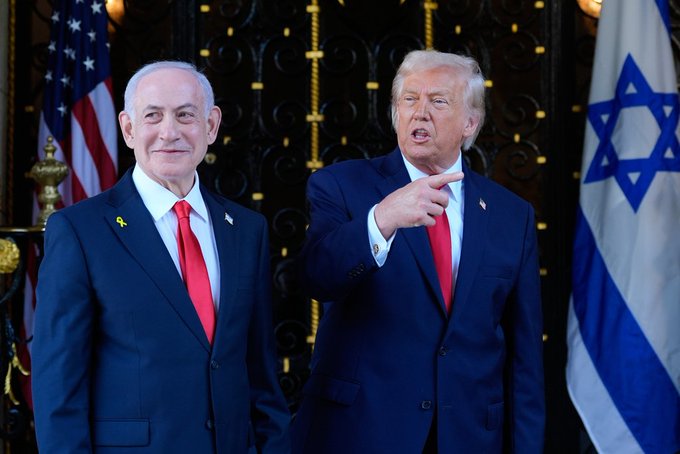
US President Donald Trump’s announcement that Washington will end its annual military assistance to Israel has raised questions about the future of one of America’s most enduring strategic partnerships in the Middle East, with uncertainty over how the proposed withdrawal would be implemented.
Trump made the declaration in a Fox News interview on November 3, saying he had reached an agreement with Israeli Prime Minister Benjamin Netanyahu to end the assistance by the close of 2026.
The US would, however, continue selling weapons to Israel and provide assistance if necessary, suggesting that the proposed change could involve a shift in the financial arrangement between the two allies rather than an end to military cooperation.
Trump argued that Israel had become sufficiently prosperous to finance its own defence requirements. He also acknowledged the domestic political dimension of the announcement, describing American military assistance to Israel as a talking point that Democratic politicians had used against Republicans.
“We were giving them $4 billion … and we made a deal months ago that we’re stopping,” Trump said.
However, the announcement has not been accompanied by details of an implementation plan, and the existing US-Israel military assistance framework is scheduled to run through September 2028.
Domestic politics behind the announcement
Trump’s comments came on Election Day during the US midterm elections, at a time when American support for Israel has become increasingly contentious, particularly among Democratic voters.
The President specifically referred to Democratic Senate candidate Abdul El-Sayed in Michigan, suggesting that ending the assistance would remove an issue that critics of his administration could use politically.
The remarks reflect a debate within American politics over the scale of Washington’s financial and military support for Israel, particularly following the war in Gaza.
A Quinnipiac University poll published in June 2026 found that 48 per cent of registered voters believed the United States was too supportive of Israel. Among Democrats, the figure was 66 per cent.
The 48 per cent figure represented the highest level recorded since Quinnipiac began asking the question in January 2017. The findings suggest that criticism of US support for Israel has extended beyond a section of the Democratic Party, although Republican voters remain considerably more supportive of the existing relationship.
Trump’s reference to the political cost of maintaining the assistance also indicates that domestic considerations are part of the discussion, alongside questions about American spending and Israel’s growing defence capabilities.
What is at stake in the $38bn agreement?
The current US-Israel military assistance arrangement was established through a 2016 memorandum of understanding signed under former President Barack Obama.
Under the agreement, Washington committed to providing $38 billion in military assistance over 10 years, covering fiscal years 2019 to 2028.
The arrangement comprises approximately $3.3 billion annually in Foreign Military Financing (FMF) and another $500 million for joint missile defence programmes.
The assistance is not simply a direct financial transfer to Israel. Much of the funding is used to purchase American-made military equipment, services and training.
Consequently, the arrangement also supports the US defence industry, creating an economic interest in maintaining military cooperation between the two countries.
American defence manufacturers benefit from the arrangement through contracts for aircraft, weapons systems, ammunition and other military equipment.
This makes the proposed withdrawal more complicated than a straightforward decision to stop sending money to a foreign government.
A reduction in direct grants could change how Israel finances its military procurement without necessarily ending its purchases of American weapons.
Netanyahu’s position and the implications for Israel
Trump has presented Netanyahu as the person who initiated discussions about ending the assistance.
The Israeli Prime Minister had, in fact, previously indicated that he wanted to reduce Israel’s dependence on American military funding.
In a January 2026 interview with The Economist, Netanyahu said he wanted to taper off military assistance over the following decade, potentially reducing it to zero.
His position was therefore one of gradual transition rather than the immediate termination suggested in Trump’s November announcement.
The distinction is significant for Israel, which has relied on American military assistance for decades and is facing substantial defence requirements following prolonged regional conflict.
An abrupt withdrawal could complicate efforts to replenish weapons stockpiles, maintain missile defence capabilities and finance future military procurement.
The announcement has also attracted criticism from Israeli opposition figures.
Former military chief Gadi Eisenkot criticised Netanyahu for allowing a potentially significant change in the US-Israel security relationship to emerge through the media rather than through a clearly communicated strategic process.
Yair Golan, leader of the Democrats party, similarly warned that reducing American assistance could undermine Israel’s security at a time when its defence requirements remain substantial.
The controversy also creates a political challenge for Netanyahu, whose close relationship with Trump has been an important feature of his political positioning.
Can Trump end the assistance unilaterally?
The most immediate obstacle is the existing security agreement and the role of the US Congress.
Although the 2016 memorandum of understanding is a political commitment rather than a treaty guaranteeing automatic payments, it establishes a framework for American military assistance through September 2028.
Congress retains a central role in appropriating the money each year, meaning that changes to the funding arrangement involve more than a presidential announcement.
The administration could pursue a negotiated reduction or restructuring of assistance, but the precise legal, budgetary and administrative steps would depend on the nature of the proposed change.
It is also important to distinguish between ending financial assistance and ending military cooperation. Trump has explicitly indicated that Israel would remain able to purchase American weapons.
This raises the possibility of a new arrangement under which Israel increasingly finances its own purchases while Washington maintains defence-industrial cooperation and strategic support.
A changing relationship, not necessarily a military divorce
The proposed withdrawal comes amid a wider discussion about the future of US-Israel security cooperation.
Israel has been investing in the development of its domestic defence industry, while its leadership has increasingly discussed reducing dependence on foreign military assistance.
For Washington, a transition from grants to commercial arms sales could preserve important defence-industry relationships even as direct financial support declines.
However, greater Israeli independence in weapons production could also raise questions about the future balance of American influence over its ally’s military capabilities and strategic decisions.
Ultimately, Trump’s announcement may mark an important shift in the political debate over American assistance to Israel. Whether it becomes an actual policy change, however, will depend on negotiations between the two governments, congressional decisions and the terms of any replacement security arrangement.
For now, the distinction between ending military aid and ending the broader American-Israeli defence partnership remains central to understanding what Trump’s announcement could mean.
● Report based on material from Indian Express Pvt Limited.