
Former Vice-President alleges voter-card buying, accuses APC of attempting to manipulate northern votes; DSS rejects separate allegations of planned disruption as opposition and ruling party trade accusations
Former Vice-President Atiku Abubakar has called on Nigerians to approach the 2027 general election with determination, urging voters to turn out in large numbers, resist electoral manipulation and protect their votes from polling units until they are properly secured.
Atiku, the presidential candidate of the African Democratic Congress (ADC), delivered the message on Wednesday during the flag-off of his party’s presidential campaign in Sokoto State, an event held amid heightened political tension, allegations of intimidation and controversy over the opposition party’s activities in the state.
Addressing supporters, the former Vice-President accused members of the ruling All Progressives Congress (APC) of allegedly going from village to village in northern Nigeria to purchase voters’ cards in an attempt to manipulate the electoral process.
He warned that opposition supporters could inadvertently create an opportunity for electoral malpractice if they failed to participate massively in the forthcoming election.
“Let us come out and vote as if it were Judgment Day. Come out in large numbers, protect your votes and escort them until they are secured,” Atiku told the gathering.
He added that low voter turnout could allow those allegedly buying voters’ cards to create a misleading impression that the ADC and other opposition parties lacked sufficient support in northern Nigeria.
Wednesday’s campaign launch followed days of controversy between the ADC and the Sokoto State Government, which is controlled by the APC.
The disagreement had raised questions about whether the opposition party would be able to hold its planned campaign event without interference.
Before the rally, the ADC accused the state government of frustrating its political activities, including allegedly denying it access to public facilities and logistical support. The party also complained about the reported sealing of its state office, an action the government defended, dismissing suggestions that it was intended to prevent the opposition from campaigning.
The ADC subsequently kept the rally venue undisclosed for security reasons, with its campaign committee saying it was taking precautions following reports of possible attempts to disrupt the gathering.
The party’s spokesman, Dahiru Maishanu, said the organisers had approached the police and the Department of State Services (DSS) for security assistance.
The Sokoto State Police Command confirmed receiving a formal request for security coverage and said the Commissioner of Police had directed that adequate protection be provided.
Police spokesperson DSP Ahmed Rufai maintained that political campaigns were a constitutional right and that the command would not deny any political party the opportunity to exercise that right.
The ADC eventually settled on its state secretariat along Ilorin Road, Sokoto, as the venue.
Atiku arrives as thousands of supporters gather
Atiku arrived at the Sultan Abubakar III International Airport at approximately 1pm on Wednesday, accompanied by members of his campaign team.
He was received by prominent ADC figures, including his running mate, former Rivers State Governor Rotimi Amaechi; former Sokoto State Governor and Senator representing Sokoto South, Aminu Waziri Tambuwal; former Attorney-General of the Federation, Abubakar Malami; and the party’s Sokoto governorship candidate, Mannir Muhammad Dan’iya.
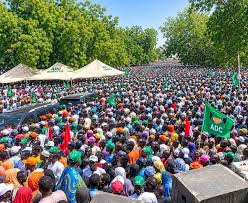
Thousands of supporters reportedly gathered at the ADC secretariat and surrounding roads to welcome the presidential candidate.
Atiku and his entourage did not reach the campaign venue until approximately 4:30pm, despite arriving in the state earlier in the afternoon, as a result of the large crowd that turned out to receive them.
Some supporters alleged that personnel of the Sokoto Marshal and the Sokoto State Community Guard Corps had been deployed to restrict movement around the town and block access routes.
One supporter, Abubakar Yusuf, claimed that the crowd overwhelmed the alleged restrictions and remained determined to attend the event.
October 30 incident raises fears over political violence
The political atmosphere surrounding the rally had become particularly tense following an incident involving the ADC governorship candidate, Mannir Muhammad Dan’iya, near the Sultan Abubakar III International Airport.
Dan’iya alleged that his convoy was attacked at approximately 9pm on Friday, October 30, shortly after he had escorted Tambuwal to the airport for his return journey to Abuja.
According to the ADC candidate, personnel of the Sokoto Marshal and the state Community Guard Corps blocked his convoy, and gunshots were subsequently fired during the confrontation. He also alleged that vehicles in his convoy were damaged and two DSS operatives attached to his security team were detained.
The Sokoto State Police Command confirmed receiving a report about the incident and announced that an investigation had commenced.
However, the APC rejected the ADC’s account, describing the allegations as fabricated and accusing the opposition of attempting to attract public sympathy and discredit the state government.
The incident further deepened mistrust between the two political camps ahead of the presidential campaign launch.
Atiku and DSS clash over alleged plot to disrupt rally
The controversy escalated on Tuesday, November 3, when Atiku accused the leadership of the DSS of allegedly recruiting protesters to create disorder in Sokoto and provide grounds for the imposition of a curfew that could prevent the ADC from holding its campaign.
The former Vice-President also alleged that the state government was using administrative restrictions and political intimidation to frustrate the opposition.
He insisted that the ADC would not abandon its campaign plans despite the alleged obstacles.
However, the DSS rejected the accusation, describing it as inconsistent with its operations and commitment to protecting political actors across party lines.
In a statement issued through its Deputy Director of Public Relations and Strategic Communications, Favour Dozie, the service said its operatives had actually rescued Dan’iya during the October 31 incident.
The agency claimed that two of its personnel were assaulted during the operation and were still receiving medical attention.
It further said Dan’iya had personally contacted the State Director of the DSS to appreciate the operatives for protecting him and to request additional security reinforcement.
Despite rejecting Atiku’s allegations, the DSS said its Director-General had ordered an investigation into the matter.
The competing accounts highlighted the growing tension between the opposition and the authorities in Sokoto, although the allegations of a plot to manufacture protests have not been independently verified.
Why Atiku chose Sokoto
Explaining the decision to begin his presidential campaign in Sokoto, Atiku described the state as a place of considerable historical, cultural and religious significance to Nigeria.
He said the decision was deliberate, stressing the importance of peaceful coexistence among Nigerians of different religious backgrounds.
“They said we would not come to Sokoto, but here we are. They said we would not hold the campaign rally, but we have come,” he declared.
According to him, Sokoto represents peace and historical continuity, making it an appropriate location to begin the ADC’s campaign activities.
The choice of Sokoto also carries political significance because of its importance in northern Nigerian politics and its historical association with the Sultanate and the Muslim community.
By holding the flag-off there despite the disagreements preceding the event, the ADC sought to demonstrate its determination to establish a political presence in the North-West ahead of the 2027 election.
Beyond his criticism of the APC and warnings about electoral malpractice, Atiku outlined some of the priorities of an ADC-led administration.
He promised to tackle insecurity across the country, reopen Nigeria’s land borders and introduce measures to make religious pilgrimages more affordable.
He specifically mentioned reducing the financial burden associated with Hajj for Muslims and Christian pilgrimages for Nigerians of the Christian faith.
The former Vice-President also expressed sympathy for families who have lost loved ones in attacks across the country, making insecurity a central part of his campaign message.
He urged Nigerians to support the ADC, insisting that the 2027 election offered an opportunity to change the country’s political direction.
He called on voters to participate in the election alongside their families and exercise their constitutional right to choose their preferred candidates.
What the Sokoto rally means for 2027
The Sokoto campaign flag-off represents an important early test of the ADC’s ability to mobilise supporters and establish itself as a serious opposition force ahead of the 2027 general election.
The large crowd reported at the rally suggests that the party was able to attract considerable attention in the state, although attendance at a campaign event alone does not establish the level of electoral support it enjoys.
More importantly, the events preceding the rally have drawn attention to concerns about political freedom, security and the ability of opposition parties to organise without intimidation.
The accusations exchanged between the ADC, APC and security agencies also demonstrate how early political competition is becoming increasingly heated ahead of the general election.
For Atiku, the immediate message was that opposition supporters must not allow fear, intimidation or political apathy to keep them away from the ballot box.
But his warning about protecting votes also raises a question for Nigeria’s electoral institutions: whether voters will be able to exercise their rights freely and whether the authorities can guarantee a credible, peaceful and transparent election.
As the 2027 contest approaches, Sokoto has provided an early indication of the political tensions that may shape the campaign season.