
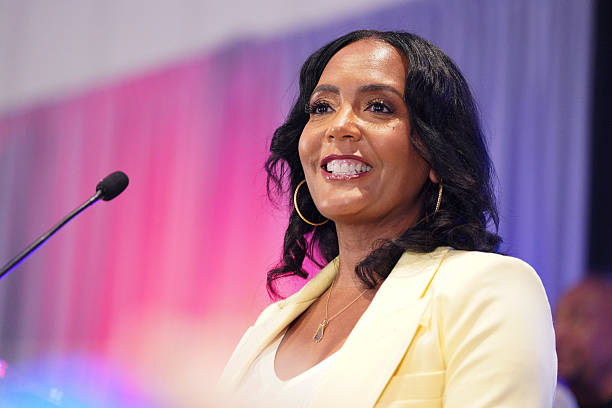
Democrat Keisha Lance Bottoms has made American political history after defeating Republican businessman Rick Jackson in Georgia’s gubernatorial election, becoming the first Black woman ever elected governor of a US state.
The victory, declared on Tuesday, November 3, represents a landmark moment for Black political representation in the United States and a significant electoral setback for the Republican Party, which has controlled Georgia’s governorship for more than two decades.
Bottoms, a former mayor of Atlanta, defeated Jackson, a billionaire healthcare entrepreneur who enjoyed the backing of President Donald Trump and invested more than $200 million of his personal fortune in the campaign.
According to unofficial statewide results reported on Wednesday, Bottoms secured approximately 54.3 per cent of the vote, compared with Jackson’s 45.7 per cent, giving the Democrats a decisive victory in one of America’s most politically competitive states.
Her election will end Republican control of the Georgia governorship, which dates back to 2003, and return the office to Democratic hands for the first time since Roy Barnes left office in 2003, following his 1998 election victory.
The outcome is particularly significant because Georgia has emerged as a crucial battleground in American presidential and congressional elections, with its increasingly diverse electorate and expanding Atlanta metropolitan area reshaping the state’s political landscape.
A historic breakthrough for Black women
Bottoms’ achievement represents a major milestone in American political history. Although Black men have previously served as governors, no Black woman had ever been elected to lead a US state before Tuesday’s election.
Her victory also makes her Georgia’s first female governor, breaking another longstanding political barrier in the southern state.
Bottoms served as Atlanta’s mayor from 2018 to 2022 before joining the Biden administration as a senior adviser and director of the White House Office of Public Engagement.
Her political journey and electoral success have been widely interpreted as evidence of the growing influence of Black women in American electoral politics.
In her victory address to jubilant supporters in Atlanta, Bottoms emphasised that her administration would represent every Georgian, regardless of political affiliation.
“No matter who you voted for tonight, I will be a governor for all of Georgia,” she declared.
She also described the outcome as a message from voters demanding leadership that prioritises the interests of the state and challenges what she characterised as political chaos emanating from Washington.
Her remarks reflected the central message of her campaign, which sought to connect economic concerns at the state level with broader dissatisfaction over policies pursued by the Trump administration.
Republican defeat despite massive financial advantage
Jackson’s defeat represents one of the most consequential Republican setbacks in the 2026 midterm elections.
The Republican businessman entered the contest with considerable financial resources and the political backing of Trump and outgoing Governor Brian Kemp.
Despite spending more than $200 million of his personal wealth on the campaign, Jackson was unable to overcome Bottoms’ coalition of Democratic voters, particularly in metropolitan Atlanta and other increasingly competitive parts of the state.
The result challenges the assumption that enormous campaign expenditure and presidential endorsements can guarantee electoral success, particularly in politically divided states.
Bottoms concentrated her campaign on issues affecting ordinary households, including the rising cost of living, healthcare accessibility, education and employment opportunities.
She also advocated expanding Medicaid, increasing the minimum wage, improving public-sector salaries and addressing Georgia’s abortion restrictions.
Her economic message appeared to resonate with voters concerned about household expenses and the affordability of essential services.
For Republicans, the defeat raises questions about the party’s ability to maintain its influence in Georgia, particularly as demographic changes and shifting voting patterns continue to reshape the electorate.
A setback for Trump’s political influence
The outcome also represents a challenge to Trump’s political influence in a state that has become central to the Republican Party’s national electoral strategy.
Jackson’s association with the president was an important feature of his campaign, while Bottoms positioned herself as a candidate willing to challenge policies coming from the Republican-controlled federal administration.
Her victory therefore carries implications beyond Georgia, offering Democrats an important political success as they seek to rebuild their electoral strength ahead of the next presidential election.
The Republican defeat is especially notable because Georgia had previously resisted Democratic attempts to capture its governorship.
Former Democratic gubernatorial candidate Stacey Abrams lost to Kemp in both 2018 and 2022, despite strong Democratic mobilisation and growing support in metropolitan Atlanta.
Bottoms has now succeeded where previous Democratic candidates struggled, turning the governorship blue after more than two decades of Republican control.
Jackson concedes defeat
Reacting to the outcome, Jackson acknowledged the voters’ decision and accepted his defeat.
“Tonight, the voters spoke … and I respect their decision,” he told supporters.
His concession brought an end to a closely watched campaign that attracted substantial national attention because of Georgia’s political importance and the extraordinary financial resources invested in the contest.
Meanwhile, Bottoms’ victory coincided with another important Democratic success in the state, as Democratic Senator Jon Ossoff secured re-election, continuing his service alongside fellow Democratic Senator Raphael Warnock.
The results further demonstrate the Democrats’ continued competitiveness in Georgia, a state that has increasingly become a major political battleground.
What Bottoms’ victory means for Georgia and America
Beyond its historic significance, Bottoms’ election presents both opportunities and challenges for the Democratic Party.
Her victory provides Democrats with control of the Georgia governorship and an opportunity to pursue a different policy direction after years of Republican leadership.
However, the incoming governor may face resistance from Republican lawmakers, who are expected to retain significant influence in the state legislature.
This could complicate efforts to implement some of her campaign promises, particularly those involving healthcare expansion, taxation and social policy.
Nevertheless, her election sends a powerful message about the changing nature of American politics.
For Black women, it represents the breaking of a barrier that has remained intact throughout the country’s history.
For Democrats, it provides a major breakthrough in a strategically important southern state.
For Republicans, it is a warning that political influence, presidential endorsements and enormous campaign spending may not be enough to overcome an electorate increasingly concerned with economic security, representation and government accountability.
Keisha Lance Bottoms’ victory is therefore more than an individual political achievement. It is a historic moment for American democracy and a significant blow to Republican dominance in Georgia.