
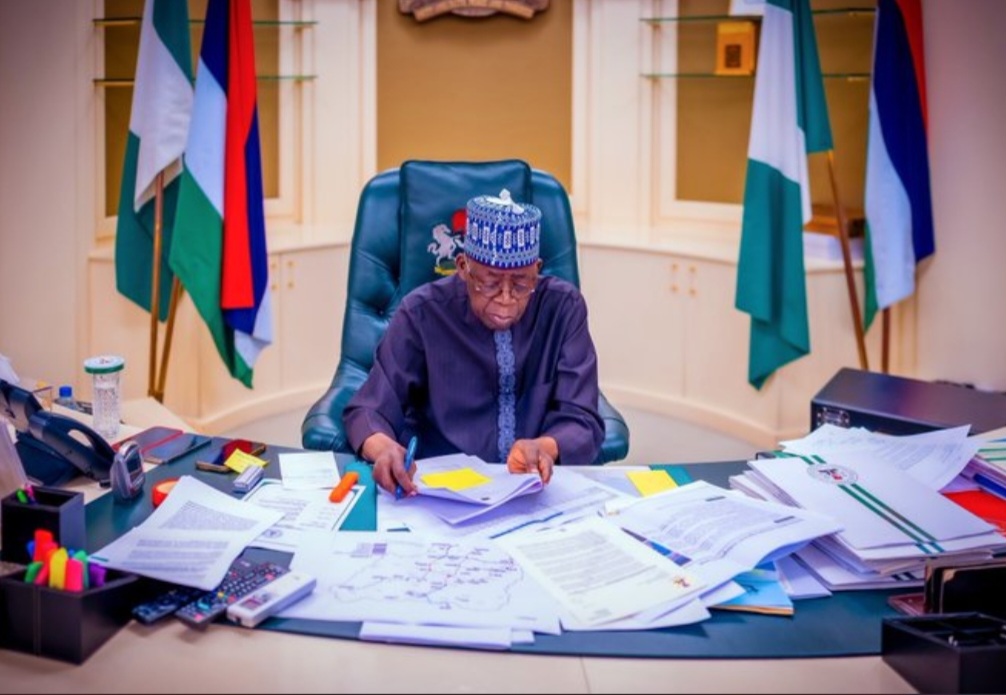
President Bola Ahmed Tinubu has declared that Nigeria is entering a new phase of economic transformation in which government borrowing will increasingly be directed towards productive infrastructure investment rather than financing short-term fiscal deficits.
The President said the strategy was designed to accelerate economic growth, create employment, attract private investment and position Nigeria to achieve its ambition of becoming a $1 trillion economy by 2030.
Tinubu, in a statement titled From Reforms to Delivery: Our Infrastructure Investment and Growth Strategy, said the difficult economic reforms introduced by his administration since 2023 had restored macroeconomic stability, strengthened government revenue and renewed international confidence in the Nigerian economy.
He identified the removal of petrol subsidy, unification of the foreign exchange market, modernisation of the tax framework and coordinated efforts to tackle inflation as critical measures that had laid the foundation for the next phase of economic development.
According to him, the impact of the reforms is becoming evident in key economic indicators, with Nigeria recording 4.43 per cent real Gross Domestic Product growth in the second quarter of 2026, compared with 2.74 per cent in 2023.
He also disclosed that headline inflation declined to 14.63 per cent in September 2026 from 20.98 per cent in September 2025, while external reserves rose to $55.1 billion as of October 9, 2026.
The President noted that the country’s net external reserves stood at approximately $46 billion, describing the development as an 18-year high and an indication of improving external economic stability.
He further said Nigeria’s improved fiscal position and declining country risk premium were creating opportunities for cheaper and longer-term financing for critical infrastructure projects.
Tinubu explained that the administration was deliberately changing the philosophy of public borrowing, insisting that loans should increasingly finance productive assets capable of generating economic returns for decades.
“This is how Nigeria will reach the objective of a USD 1 trillion economy by 2030: not through consumption, but through investment in the infrastructure that makes growth possible,” he stated.
The President stressed that the government would prioritise investments in major highways, electricity infrastructure, railways and commercial ports, alongside healthcare, education and vocational training.
Among the administration’s priority projects are the Lagos-Calabar Coastal Highway, Sokoto-Badagry Superhighway, Trans-Sahara Superhighway, power sector improvements and the modernisation of major commercial ports in Lagos.
He said these projects would connect economic regions, reduce transportation and logistics costs, unlock agricultural and industrial opportunities, improve trade and attract private sector investment.
Providing an update on implementation, Tinubu said work on Lot 2 of the Lagos-Calabar Coastal Highway was reported to be more than 80 per cent complete as of August 2026, while construction on the Calabar-Akwa Ibom section had exceeded 30 per cent.
He added that the Lagos-Calabar Coastal Highway alone was projected to reduce logistics costs along its corridor by between 15 and 20 per cent, potentially contributing up to two per cent to Nigeria’s GDP through industrial development, trade and tourism.
The project is also expected to generate approximately 100,000 direct jobs in construction and engineering, alongside more than 150,000 indirect employment opportunities in logistics, materials supply and related services.
Tinubu maintained that the economic benefits of infrastructure investment would extend beyond the construction phase, creating opportunities for businesses, farmers, manufacturers and communities located along the corridors.
On fiscal sustainability, the President acknowledged that public debt stood at 35.75 per cent of GDP in the second quarter of 2026, while debt servicing accounted for approximately 65 per cent of revenue in the first half of the year.
He said these figures reinforced the need for strict fiscal discipline, adding that the Federal Government’s economic strategy would rule out deficit monetisation and unfunded commitments during the pre-election period.
The President also disclosed that Nigeria’s tax-to-GDP ratio had increased from seven per cent to 12.5 per cent, while net allocations to the three tiers of government through the Federation Account Allocation Committee rose by 44 per cent, from N15.2 trillion in 2024 to N21.9 trillion in 2025.
He further highlighted the country’s N20.1 trillion trade surplus in the first half of 2026, almost double the N10.2 trillion recorded during the corresponding period of 2025.
Tinubu attributed the improving investment climate to positive developments in international financial markets, including rating actions by global agencies, Nigeria’s restoration to FTSE Russell Frontier Market status and its removal from the Financial Action Task Force grey list.
He said these developments, alongside strong demand for Nigeria’s Eurobond issuance, demonstrated renewed confidence in the country’s economic management and prospects.
According to him, the positive international assessments would help Nigeria attract more institutional investors, secure longer-term financing and reduce the cost of capital required for infrastructure development.
The President, however, emphasised that improved international confidence must translate into completed projects and measurable improvements in the lives of Nigerians.
He said the next phase of the administration’s economic agenda would focus on food affordability and energy price stability, fiscal discipline, completion of high-impact infrastructure projects, regulatory efficiency and targeted household support.
“Securing financing is only the beginning. The real achievement lies in completing projects, delivering value for money, and improving Nigerians’ lives,” he said.
Tinubu maintained that every naira borrowed must be justified by the economic value it creates, stressing that infrastructure projects should be assessed by their capacity to stimulate productivity, generate revenue and create sustainable employment.
He said Nigeria could not achieve a $1 trillion economy with infrastructure designed for an economy a fraction of that size, insisting that the country must invest today in assets capable of supporting economic expansion over the next 50 years.
The President concluded that his administration’s ambition was not merely to announce an ambitious infrastructure programme but to build an interconnected national economy in which roads, railways, ports and electricity infrastructure work together to improve productivity and competitiveness.
He added that the success of the economic reforms would ultimately be measured by projects completed, opportunities created and improvements in the standard of living of Nigerians.
Below is the full text of the President’s article:
From reforms to delivery: Our infrastructure investment and growth strategy, By Bola Ahmed Tinubu
Food inflation, while still elevated, stood at 19.59%. Gross external reserves reached USD 55.1 billion as of 9 October 2026, including about USD 46 billion in net reserves, an 18-year high. The NFEM exchange rate stood at ₦1,333/US$, with the market spread below 5%, and public debt remains low compared to peers. Nigeria’s cost of borrowing keeps falling. Confidence has a price, our cost of borrowing is going down, and the country risk premium has drastically decreased.
This changes the purpose of public borrowing. The objective is to increasingly direct new borrowing towards productive capital investment, while maintaining fiscal discipline, reducing refinancing pressures and ensuring that public debt translates into measurable economic value. Nigeria borrows to invest in roads, ports, rail and power that will generate growth, revenue and jobs for decades.
Every Naira and every dollar raised goes to assets that create value, and that value repays the debt. This is how Nigeria will reach the objective of a USD 1 trillion economy by 2030: not through consumption, but through investment in the infrastructure that makes growth possible. This shift is being supported by a stronger fiscal position: tax-to-GDP has risen to 12.5% from 7%, net FAAC increased by 44% from ₦15.2 trillion in 2024 to ₦21.9 trillion in 2025, and Nigeria recorded a ₦20.1 trillion trade surplus in H1 2026, almost double the ₦10.2 trillion recorded in H1 2025.
Borrowing to build, not to bridge, not for consumption:
Nigeria is fundamentally changing the purpose of public borrowing: from financing short-term fiscal pressures to investing in assets that will transform the economy for generations. This shift is taking place with public debt at 35.75% of GDP in Q2 2026 and debt service at about 65% of revenue in H1 2026, underscoring why investment must remain anchored in fiscal discipline.
The Federal Executive Council economic strategy is clear on this point: no deficit monetisation and no unfunded commitments during the pre-election period. At the heart of this disciplined shift towards productive borrowing are our administration’s legacy projects:
The administration is focusing productive borrowing on financing major infrastructure projects, including the Lagos–Calabar Coastal Highway; improvements to the power sector and electricity grid; the Sokoto–Badagry Superhighway; the Trans-Sahara Superhighway; and upgrades to Nigeria’s major commercial ports in Lagos.
Together with other priority projects, the rehabilitation of key hospitals, and investment in education and vocational training, these investments are game-changing. They will connect entire economic regions, unlock agricultural and industrial potential, reduce logistics costs, attract private investment and create hundreds of thousands of direct and indirect employment opportunities over time.
Delivery is already visible on the Lagos-Calabar highway as a major transport infrastructure project as of August 2026. Lot 2 was reported to be over 80% complete, while Calabar–Akwa Ibom works were over 30% complete. This increased emphasis on investment is also evident at the subnational level, where the share of state spending devoted to capital expenditure rose from 46% in 2023 to 61% in 2025.
This is not simply about building infrastructure. It is about reshaping Nigeria’s economic geography, unlocking new sources of growth and creating the productive capacity to achieve a USD 1 trillion economy. The debt is finite; the economic value these assets can generate will endure for generations.
II. Value for money and impact on growth:
The legacy projects are selected and financed on value addition: what they return to the economy for every Naira spent. They connect production to markets, ports to the hinterland and Nigeria to its neighbours. The Lagos–Calabar Coastal Highway alone is expected to reduce logistics costs by 15–20% along the corridor and could add up to 2% to Nigeria’s GDP through new industrial zones, trade and tourism.
These projects are also among the largest job creators in the country. The Coastal Highway is expected to generate around 100,000 direct jobs in construction and engineering and more than 150,000 indirect jobs in logistics, materials and services.
Across the Sokoto–Badagry and Trans-Sahara corridors, the same logic applies to the enhancement of the power grid, ports, rail lines, and social infrastructure: jobs during construction, and lasting employment in the industries, farms, and businesses that grow along the routes once they open.
Lower transport costs mean lower food prices, more competitive exports and stronger revenue for the State. That is value for money: assets that pay back through growth, jobs and revenue, financed over a horizon that matches their life, and each one a step towards the USD 1 trillion economy.
III Long-term commitments for long-term assets:
The structure of Nigeria’s debt now matches the nature of what it finances. The government is extending the maturity profile and shifting from short-term borrowing to long- and very long-term maturities at lower cost. Infrastructure built to last forty years should be financed over a horizon consistent with its life. International investors are willing to commit to Nigeria over ten, fifteen years and beyond, which is the clearest signal of confidence in the country’s trajectory. The broader financing environment is also benefiting from monetary easing: the Monetary Policy Rate was cut by 350 basis points on 22 September 2026, from 26.5% to 23%.
Yet lending rates remain above 30%, reinforcing the need to secure longer-tenor, more competitive financing for productive investment.
IV. Credibility recognised by international markets:
The international financial community has delivered a clear and unprecedented convergence of positive signals on Nigeria. All three major credit rating agencies (S&P, Fitch and Moody’s) have taken positive rating actions, with S&P upgrading Nigeria’s sovereign rating and Fitch and Moody’s raising their outlooks to Positive.
FTSE Russell has restored Nigeria to Frontier Market status, reopening its visibility to global institutional investors, while the FATF has removed Nigeria from its grey list, recognising progress in financial transparency and compliance. Nigeria’s successful Eurobond issuance, attracting strong international demand, further demonstrates renewed investor appetite for Nigerian sovereign risk. The specific rating actions reinforce this convergence: Fitch rates Nigeria B with a Positive outlook as of 9 October 2026; Moody’s rates it B3 with a Positive outlook; and S&P upgraded Nigeria to B on 15 May 2026 with a Stable outlook.
Nigeria’s exit from the FATF Grey List in October 2025 and the EU list in January 2026 further supports improved financial transparency and compliance. These are not political endorsements; they are independent assessments by global rating agencies, index providers, regulators and investors, recognising stronger external reserves, improved macroeconomic management and greater financial credibility. The implications are transformative: broader access to international capital, greater investor participation, and the potential for lower financing costs and longer maturities. Every improvement in Nigeria’s cost of capital creates additional capacity to finance infrastructure, accelerate growth and deliver my government’s economic transformation agenda.
V. What the international community expects:
The message from international investors, global banks and development institutions is unequivocal: Nigeria has undertaken the reforms; now is the time to invest, build and deliver at scale. International capital increasingly sees Nigeria as a major infrastructure investment opportunity, with lenders showing a growing appetite to finance our growth projects (Roads, Railways, Electricity, Water and Agriculture, Transport, and Social Infrastructure) and support the country’s long-term development.
Improving market confidence is creating opportunities for more competitive financing terms and greater access to long-term capital.
Nigeria must seize this window of opportunity. The greatest risk is no longer simply the cost of borrowing, but the economic cost of failing to invest. Every year of delayed infrastructure means lost growth, higher logistics costs, missed investment and jobs that are never created. The international financial community is ready to support credible, bankable projects.
Nigeria must now convert this confidence into capital expenditure, completed infrastructure and lasting economic value. The reforms have opened the door to capital; delivery is what will turn that capital into prosperity. The delivery agenda is reflected in the five priorities FEC identified for the next stage: food affordability and energy price stability; budget harmonisation and fiscal discipline; high-impact project completion and investment in critical infrastructure; an economic policy framework and regulatory efficiency; and targeted household support and investment in human development.
At this point, it must be clearly stated that we did not undertake difficult reforms merely to stabilise the economy. We undertook them to unlock Nigeria’s economic potential and build lasting prosperity. These reforms laid the foundation for economic recovery, while infrastructure investment will drive growth, create jobs and improve living standards. The next phase of Nigeria’s economic transformation must be defined by projects completed on the ground and tangible results for Nigerians, not policy documents alone.
Borrowing and long-term investment
We are moving from borrowing to bridge fiscal gaps to borrowing to build the productive capacity of our nation. The key question is not how much we borrow, but what we build, the value we create and the future we leave behind. Although loans must be repaid, the roads, ports, railways and economic opportunities they finance can serve generations.
We cannot build a $1 trillion economy with infrastructure designed for an economy a fraction of that size. We are investing in infrastructure for the next 50 years, and our financing strategy must reflect that ambition. We must also weigh the cost of borrowing against the cost of inaction because every delayed project means lost opportunities for growth, employment and investment.
Infrastructure and economic impact
We are building more than highways. We are opening economic corridors, connecting markets, supporting industries and reshaping Nigeria’s economic geography. The value of a road extends beyond the completed construction to the farms, factories, businesses and communities it connects.
Every kilometre of infrastructure creates jobs during construction and opens opportunities for decades. Infrastructure provides the foundation for private investment, industrial development, trade and employment. We are therefore building an interconnected national economy in which roads, railways, ports and power infrastructure work together to improve productivity and strengthen Nigeria’s competitiveness in global markets.
International confidence and access to capital
International confidence gives Nigeria an opportunity to secure better financing, accelerate investment and deliver tangible results for its citizens. We must take advantage of our renewed access to international markets by turning investor confidence into productive investment. That investment must translate into economic growth, job creation and improved living standards.
Accountability and delivery
Securing financing is only the beginning. The real achievement lies in completing projects, delivering value for money, and improving Nigerians’ lives. Every Naira borrowed must be justified by the economic value it creates, and we must measure every project by its results.
Our ambition is not simply to announce a large infrastructure programme, but to deliver projects that transform Nigeria’s economy. We must pursue our development goals with urgency while maintaining the discipline required for responsible public financial management.
Building a $1 trillion economy
A $1 trillion economy will not emerge through declarations alone. We must build it through investment, higher productivity, industrialisation and trade. Nigeria’s greatest asset is its economic potential, and we must provide the infrastructure to turn that potential into prosperity. We are not borrowing against our children’s future. We must invest responsibly to expand opportunities available to them.
