

The race for the 2027 National Assembly elections gathered momentum on Monday as the All Progressives Congress (APC) concluded a fresh round of legislative primaries across several states, producing a mix of expected victories, strategic withdrawals and dramatic political signals that are already reshaping calculations ahead of the general election.
At the centre of the unfolding story is former Senate Leader, Ali Ndume, who once again demonstrated his enduring political influence by clinching the APC senatorial ticket for Borno South despite months of perceived tension with the national leadership of the ruling party and his repeated criticisms of the administration of President Bola Ahmed Tinubu.
Ndume emerged through an affirmation process after he was returned unopposed at the APC primary held in Maiduguri, confirming his status as one of the most entrenched political figures in the North-East and placing him firmly on course for a fifth consecutive term in the Senate.
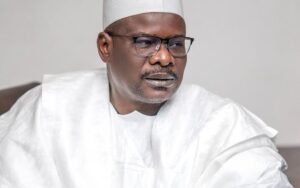
The outcome is widely viewed as one of the biggest political statements from the primaries so far.
For months, Ndume had appeared increasingly isolated within sections of the APC hierarchy following public comments on economic hardship, insecurity and governance issues under the Tinubu administration. His criticisms had fuelled speculation that influential forces within the party might move against his re-election bid.
Instead, the Borno South primary produced the exact opposite outcome.
Party stakeholders in the district rallied behind him, while his major challenger, Abdullahi Askira, Deputy Speaker of the Borno State House of Assembly, eventually stepped down after consultations with party elders and local power brokers.
The consensus arrangement not only avoided a bruising internal contest but also underscored Ndume’s continued dominance in Borno South politics despite turbulence at the national level.
Political observers say the development sends a broader message within the APC: that strong grassroots structures and regional loyalty may still outweigh temporary disagreements with the national leadership.
A Survivor of Many Political Battles
Since entering the Senate in 2011, Ndume has survived multiple political storms, including his removal as Senate Leader during the 8th Senate crisis, clashes with party leadership at various times, and recurring speculation about his future within the APC.
Yet he has repeatedly returned stronger in his constituency.
His latest victory now places him among the small circle of long-serving lawmakers expected to shape the complexion of the next National Assembly if re-elected in 2027.
He also remains one of the most recognisable northern voices in the Senate alongside figures such as Danjuma Goje, another ranking lawmaker who entered the Red Chamber in 2011.
Speaking after his affirmation, Ndume thanked party elders, delegates and supporters for what he described as their continued confidence in his leadership.
“I want to thank our elders in the Borno South Senatorial District for their unwavering support for me,” he said.
“I want to reassure them that I will continue to promote their interest at all times.”
He also praised Askira for stepping down in the interest of party unity.
“I must not fail to commend Honourable Askira, who listened to the persuasions and appeals of the party leaders and took the decision to drop his aspiration. Your loyalty to the party is exemplary,” he added.
What the Primaries Are Revealing
Beyond Ndume’s victory, the ongoing National Assembly primaries are increasingly revealing several emerging trends within the APC and across the broader political landscape.
One major pattern is the return of consensus candidacies in politically sensitive districts where party leaders are keen to avoid internal fractures ahead of the general election.
Another is the growing influence of incumbency.
In many states, sitting senators and House of Representatives members are leveraging existing political structures, constituency projects and long-standing alliances to fend off younger challengers and newcomers.
However, the primaries have also exposed quiet resistance against attempts by national power centres to impose candidates in some constituencies.
Ndume’s emergence is likely to strengthen arguments that local political capital still matters significantly, particularly in states where influential politicians maintain deep grassroots networks independent of Abuja.
Analysts also note that the APC leadership appears determined to minimise high-profile internal conflicts after lessons from previous election cycles where post-primary disputes weakened the party in key battleground states.
That may explain the increasing use of negotiations, withdrawals and elite consensus arrangements in several senatorial districts.
Battle for the Next Senate Begins
With the primaries now producing an early list of likely heavyweights for the 11th National Assembly, attention is gradually shifting to what the next Senate could look like.
If re-elected, Ndume would further consolidate his standing as one of the ranking lawmakers in the chamber and potentially remain influential in debates around leadership positions, committee structures and legislative direction.
His return could also preserve a critical independent voice within the APC caucus at a time many observers believe the ruling party is seeking stronger internal cohesion around the Tinubu presidency.
For now, however, the Borno South result has delivered one unmistakable conclusion: despite political headwinds in Abuja, Ali Ndume still commands formidable authority at home.
And in Nigerian politics, that often remains the most decisive currency of all.
