
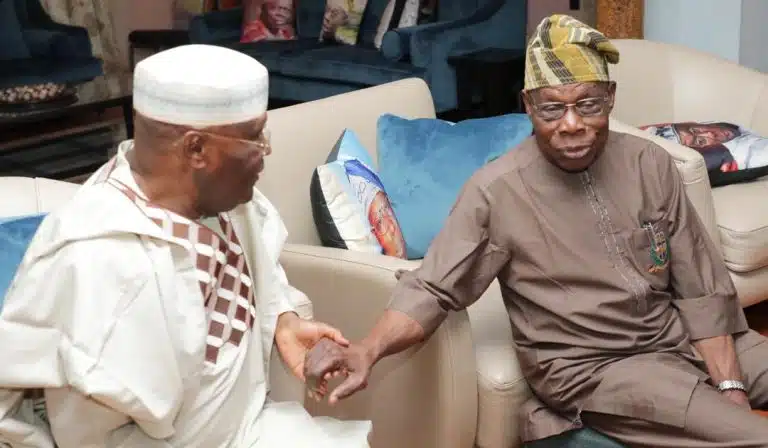
Former President Olusegun Obasanjo has described his decision to pick former Vice-President Atiku Abubakar as his running mate ahead of Nigeria’s landmark 1999 presidential election as the biggest mistake of his presidency, declaring that he would never have selected Atiku had he known then what he later came to learn about him.
Obasanjo made the remarks on Friday during a fireside conversation with veteran entertainer and social activist Charles Oputa, popularly known as Charly Boy, at the public presentation of Charly Boy’s foundation and memoir, 999: A Memoir in Tribute to Late Justice Chukwudifu Oputa, held at the Mike Adenuga Centre, Ikoyi, Lagos. The memoir, for which Obasanjo wrote the foreword, was officially unveiled at the event attended by prominent political, cultural and business leaders.
A video of the conversation, later published by iWitnessLive TV on YouTube, showed the former president reflecting on defining moments of his political career, the role of providence in leadership and the lessons he learned from serving as Nigeria’s democratically elected president between 1999 and 2007.
Speaking about mistakes in public office, Obasanjo said divine intervention had repeatedly saved him from decisions that could have had grave consequences for both himself and the country.
“What I have found in my own life is that mistakes that could have been fatal, God had taken care of them for me,” he said.
When asked by Charly Boy to identify one mistake he made while in office, Obasanjo pointed to his choice of vice-president.
“The man I picked as my running mate, my number two. If I had known him as I came to know him later, I would not have picked him.”
Seeking clarification, Charly Boy asked if he was referring to former Vice-President Atiku Abubakar.
Obasanjo replied: “My vice president. I don’t know what name you want to give him, but my vice president, I mean that.”
The former president said his experiences after assuming office fundamentally altered his opinion of Atiku.
“Of course, what I know about him later… I would not have picked him. Thank God that God did not allow his actions and reactions to overwhelm me, divert my focus from Nigeria or harm Nigeria.”
Despite the criticism, Obasanjo said he bore no personal bitterness toward his former deputy.
“There’s no bitterness because he did what he believed he should do, and God did what God had to do, which enabled me to achieve what I was able to achieve.”
Atiku rejects Obasanjo’s account
Atiku, who is now a leading figure in the African Democratic Congress (ADC) and its presidential candidate for the 2027 election, responded on Saturday through a statement issued by his Senior Special Assistant on Public Communication, Phrank Shaibu, dismissing Obasanjo’s remarks as an attempt to rewrite history.
The former vice-president said he remained proud of opposing the controversial third-term agenda allegedly pursued during the Obasanjo administration, insisting that defending Nigeria’s Constitution was one of the defining moments of his political career.
“I am proud that I stood against the third-term agenda. I am proud that I stood by the Constitution of the Federal Republic of Nigeria. I have no apology whatsoever for frustrating every attempt to subvert our democracy for personal ambition.
“If Chief Obasanjo’s bitterness stems from my refusal to support an unconstitutional third term, then I wear that resentment as a badge of honour. No individual, regardless of his status or accomplishments, is bigger than the Federal Republic of Nigeria. The Constitution is supreme, and I chose Nigeria over personal loyalty.”
According to Atiku, the battle against the proposed constitutional amendment transcended personal disagreements.
“The Nigerian people won that battle. Democracy won that battle. History has already delivered its verdict.”
The former vice-president also sought to remind Nigerians of the political relationship that existed before Obasanjo became president.
He claimed he stood firmly behind Obasanjo during his imprisonment under the late Gen. Sani Abacha, supported his family, worked for his release and later helped rebuild the political coalition that culminated in Obasanjo’s emergence as the PDP presidential candidate in 1999.
“Do I regret helping Chief Obasanjo? Absolutely not. When God gives you the opportunity to lift another human being, you do so without expecting repayment. Acts of kindness are matters of conscience, not commercial transactions.”
Atiku, however, accused the former president of attempting to diminish his contributions to one of Nigeria’s most celebrated economic reform periods, noting that members of the administration’s economic team had publicly acknowledged the role he played.
He argued that, at a time of economic hardship, insecurity and rising unemployment, national leaders should focus on solutions rather than reopening old political battles.
“The 2027 election should be about rebuilding Nigeria, restoring security, reviving the economy and giving hope to the next generation—not reopening old political wounds.”
Atiku concluded by saying history could not be altered through repeated claims.
“Chief Obasanjo is entitled to his opinions. He is entitled to his personal grievances. What he is not entitled to are his own facts.
“History is stubborn. It cannot be rewritten by bitterness, nor erased by repeated falsehoods. In the end, history will render its verdict—and so will the Nigerian people.”
Obasanjo and Atiku emerged as one of Nigeria’s most influential political partnerships after winning the 1999 presidential election on the platform of the Peoples Democratic Party (PDP), marking the country’s return to democratic rule following nearly 16 years of uninterrupted military governance.
Obasanjo, a former military Head of State who had handed power to an elected civilian government in 1979 before returning as an elected president two decades later, selected Atiku, then a former Customs officer and businessman who had established himself as one of the leading political figures from the North-East, as his running mate.
The administration inherited a country grappling with weak institutions, a heavy debt burden, declining public infrastructure and years of international isolation. During its first term, the government embarked on economic and institutional reforms, including telecommunications liberalisation, banking reforms, anti-corruption initiatives, pension reform and public sector restructuring.
The Obasanjo administration also secured a landmark debt relief agreement from the Paris Club in 2005, which resulted in the cancellation of approximately $18 billion of Nigeria’s external debt after negotiations led by the government’s economic team.
Although Obasanjo and Atiku secured a second term in 2003, their relationship deteriorated sharply during the administration’s final years.
Their disagreements centred on succession politics, control of the ruling PDP, allegations of corruption and, most significantly, efforts to amend the Constitution to permit a third presidential term – an initiative that ultimately failed in the National Assembly in 2006 after widespread opposition from lawmakers, civil society organisations and sections of the political establishment.
As tensions deepened, the presidency sought to sideline Atiku politically. The vice-president faced investigations over corruption allegations linked to the Petroleum Technology Development Fund (PTDF), while his allies accused the presidency of orchestrating attempts to remove him from office.
The political rupture culminated in Atiku leaving the PDP to contest the 2007 presidential election under the Action Congress after winning a prolonged legal battle to remain on the ballot.
Since then, both men have remained among Nigeria’s most influential political actors, with their once-close relationship evolving into one characterised by recurring public disagreements over governance, democracy, constitutionalism and national leadership.
The latest exchange is the newest chapter in a political rivalry spanning nearly two decades and comes as political alignments ahead of the 2027 general election continue to gather momentum.