
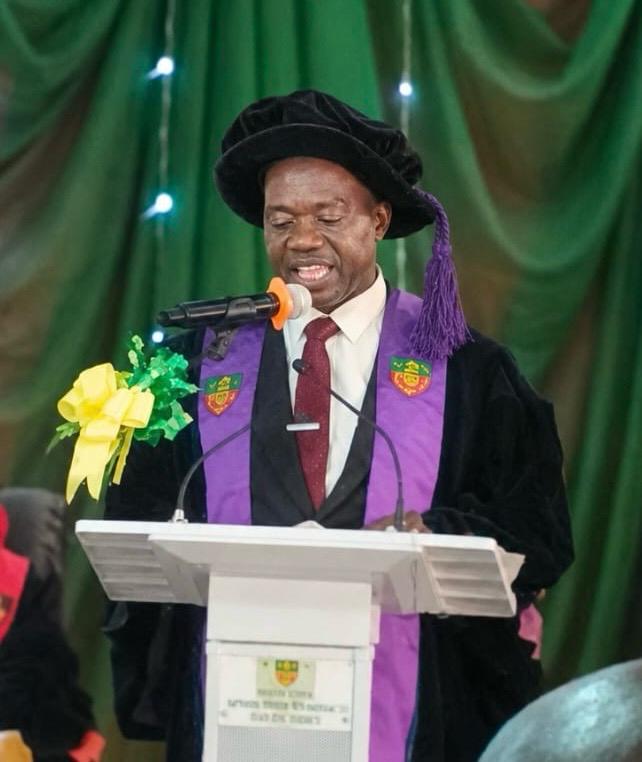
Professor Terzungwe Nyor, Professor of Accounting at the Nigerian Defence Academy (NDA), has called for the introduction of Stewardship Accounting into undergraduate and postgraduate accounting curricula in Nigerian universities and professional accounting programmes, arguing that the initiative would help foster accountability and reduce corruption in Nigeria.
Speaking while delivering the 24th Professional Inaugural Lecture of the Nigerian Defence Academy, Prof. Nyor said the proposed discipline would produce professionals who are faithful, responsible, accountable, and trustworthy managers of public resources.
He said equipping future accountants with the principles of stewardship would help address the persistent abuse of public funds by individuals entrusted with managing the nation’s treasury.
“It is to this end that I am designing and producing materials for the study of Stewardship Accounting as a course for Nigerian universities at the undergraduate level and a programme of study at the postgraduate level,” he said.
The accounting scholar appealed to the Nigerian Defence Academy and the National Universities Commission (NUC) to collaborate in incorporating the programme into Nigeria’s tertiary education curriculum.
Speaking with NIGERIA EVERYDAY shortly after the lecture, Prof. Nyor described corruption as one of Nigeria’s greatest impediments to accountability, good governance, and sustainable development. He urged public office holders to regard themselves as stewards rather than owners of public resources.
“Corruption does nobody any good. Every Nigerian must recognise this and join the fight against it if the country is to make meaningful progress in accountability and development,” he said.
Prof. Nyor criticised the diversion of public funds despite widespread deficiencies in critical infrastructure, including roads, electricity, healthcare facilities, and access to safe drinking water. He also condemned contract inflation, procurement fraud, conflicts of interest, and other unethical practices in the public service.
According to him, corruption extends beyond government institutions and reflects broader societal challenges. He cited the proliferation of counterfeit products, dishonest business practices, sexual exploitation in educational institutions, and breaches of trust by some religious leaders as evidence that accountability must become a shared national value.
While acknowledging reforms introduced by the Federal Government – including the Treasury Single Account (TSA), the Integrated Personnel and Payroll Information System (IPPIS), and the Government Integrated Financial Management Information System (GIFMIS) – Prof. Nyor argued that weak institutions and poor enforcement have undermined their effectiveness.
He further noted that anti-corruption agencies continue to face significant operational constraints, including inadequate funding, shortages of skilled personnel, limited institutional independence, judicial delays, and legal loopholes that often protect influential offenders from prosecution.
“Laws and institutions alone cannot guarantee accountability. Until the rule of law applies equally to everyone, accountability will remain elusive,” he said.
Prof. Nyor described accounting as more than a profession, characterising it as a universal system of stewardship founded on transparency, integrity, faithful record-keeping, and prudent management of entrusted resources.
Although he acknowledged Nigeria’s existing accountability framework – including the 1999 Constitution, the Independent Corrupt Practices and Other Related Offences Commission (ICPC), the Economic and Financial Crimes Commission (EFCC), the Code of Conduct Bureau and Tribunal, the Federal Government’s whistle-blower policy, and Anti-Corruption and Transparency Units (ACTUs) – he maintained that institutional reforms alone would not achieve lasting accountability.
He stressed that meaningful progress would require a transformation in personal values and ethical conduct.
“If people see themselves as stewards rather than owners of what has been entrusted to them, they will act with integrity, earn public trust, and help build a more accountable society,” Prof. Nyor said.