
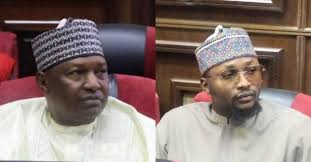
It is the season of forfeiture, again, in Nigeria
The country’s anti-corruption campaign recorded two of its biggest civil asset recovery victories this week after separate courts in Abuja ordered the permanent forfeiture of billions of naira worth of assets linked to businesswoman Aisha Achimugu and former Attorney-General of the Federation and Minister of Justice, Abubakar Malami (SAN).
The combined forfeitures involve luxury jewellery, exotic vehicles, cash, high-value real estate, commercial businesses, educational institutions, factories, hotels and other investments allegedly traced to proceeds of unlawful activities.
The rulings represent major victories for the Economic and Financial Crimes Commission (EFCC), although both proceedings are civil forfeiture actions and do not, on their own, amount to criminal convictions of the affected individuals.
Achimugu loses jewellery, luxury cars, cash worth over N9 billion

In one of the landmark decisions, Justice Jude Onwugbuzie of the FCT High Court sitting in Apo, Abuja, ordered the final forfeiture to the Federal Government of assets linked to prominent businesswoman, Aisha Achimugu.
The order followed an application by the EFCC, which argued that investigations had established that the assets represented proceeds of unlawful activities.
The assets permanently forfeited include:
• Jewellery valued at N4,645,170,294.90
• 11 exotic vehicles valued at N4,293,000,000
• $50,000 cash
• N30 million cash
Altogether, the forfeited assets are valued at well over N9 billion, excluding the dollar component.
Justice Onwugbuzie held that the EFCC successfully established the legal basis for final forfeiture, thereby vesting ownership of the assets in the Federal Government.
Investigation traced transactions through over 136 bank accounts
Court documents indicate that the EFCC’s investigation into Achimugu was triggered by financial intelligence reports which allegedly revealed extensive movements of funds through a complex banking network.
According to the anti-graft agency, investigators uncovered massive inflows and outflows involving more than 136 bank accounts linked to Achimugu, with transactions running into billions of naira and millions of dollars.
The Commission argued that the financial pattern raised sufficient suspicion to justify the forfeiture proceedings under Nigerian law.
Latest order comes after earlier $13 million forfeiture
The latest judgment is not the first forfeiture involving the businesswoman.
Earlier this year, the Federal High Court in Abuja, presided over by Justice Emeka Nwite, ordered the final forfeiture of $13 million linked to Achimugu after finding that the funds constituted proceeds of unlawful activities.
The latest ruling therefore significantly expands the volume of assets permanently transferred to the Federal Government in relation to the ongoing EFCC investigation.
Malami loses 48 properties after court dismisses objections
In another far-reaching judgment delivered on Wednesday, Justice Joyce Abdulmalik of the Federal High Court in Abuja ordered the permanent forfeiture of 48 properties linked to former Attorney-General of the Federation and Minister of Justice, Abubakar Malami.
The ruling came after months of legal contest between the EFCC and Malami, members of his family and several companies claiming ownership of the assets.
Justice Abdulmalik held that the respondents failed to rebut the EFCC’s case that the assets were reasonably suspected to have been acquired through unlawful activities.
“The issue before the court is not who owns the property, but how legitimate are the funds used to acquire the properties,” the judge held.
She further ruled that the respondents failed to dislodge the reasonable suspicion surrounding the source of funds used to acquire the assets.
The court relied principally on Section 17 of the Advance Fee Fraud and Other Fraud Related Offences Act in granting the final forfeiture order.
Court dismisses objections by Malami, wife, son and companies

Before delivering judgment, Justice Abdulmalik dismissed multiple motions, objections and applications filed by:
• Abubakar Malami
• his wife, Nana Hadiza Malami
• his son, Abdulaziz Abubakar Malami
• several companies claiming ownership of the affected assets.
The judge described the applications as lacking merit, holding that the respondents failed to establish that the assets were purchased from legitimate income.
Nine properties spared
While granting the EFCC’s application substantially, the court did not approve forfeiture of every property originally listed.
The judge vacated the interim forfeiture order in respect of nine properties located in Kebbi and Kaduna States after finding that the EFCC failed to establish the required connection between those assets and alleged unlawful activities.
Consequently, 48 of the 57 properties initially targeted by the Commission were finally forfeited.
Properties spread across four states
The forfeited properties are spread across:
• Abuja
• Kano State
• Kebbi State
• Kaduna State
They include a broad portfolio of residential, commercial and institutional assets.
University, factories, hotels among assets forfeited
Among the assets covered by the final forfeiture order are:
• Rayhaan University, including its permanent and temporary campuses
• Vice Chancellor’s residence
• Rayhaan Radio
• Rayhaan Agro Allied Factory
• Azbir Arena
• Hotels
• Filling stations
• Commercial plazas
• Warehouses
• Residential estates
• Luxury duplexes
• Large parcels of land
• Other hospitality and commercial businesses located across northern Nigeria.
EFCC initially targeted N212.8 billion worth of assets
The civil forfeiture proceedings originated from an EFCC application seeking the permanent forfeiture of 57 properties valued at about N212.8 billion allegedly linked to Malami.
An interim forfeiture order was first granted by Justice Emeka Nwite during the Federal High Court’s annual vacation.
The court subsequently directed the EFCC to publish the interim order in national newspapers to enable interested persons to appear and show cause why the properties should not be permanently forfeited.
Following the publication, Malami, his wife, son and associated companies entered appearances and challenged the forfeiture proceedings.
They maintained that the assets were lawfully acquired and argued that the EFCC failed to establish any nexus between the properties and unlawful conduct.
Justice Abdulmalik ultimately rejected those arguments before granting the final order over 48 properties.
Civil forfeiture distinct from criminal prosecution
Although both judgments represent significant victories for the EFCC, the courts’ forfeiture orders are civil proceedings directed at the assets themselves rather than findings of criminal guilt.
In Malami’s case, the former minister, members of his family and others continue to face separate criminal proceedings in which allegations, including money laundering and conspiracy, remain before the courts. Malami has pleaded not guilty. The forfeiture ruling therefore should not be construed as a criminal conviction.
Major boost for Nigeria’s asset recovery efforts
Taken together, the two judgments rank among the most significant asset recovery successes recently secured by the EFCC.
For Achimugu, the Federal Government has now obtained final forfeiture orders covering billions of naira in luxury assets in addition to an earlier $13 million forfeiture.
For Malami, the Federal Government has secured permanent ownership of 48 high-value properties, including educational institutions, factories, hotels, commercial developments and extensive real estate spread across several states, following the court’s finding that the legitimacy of the funds used to acquire the assets had not been established.