
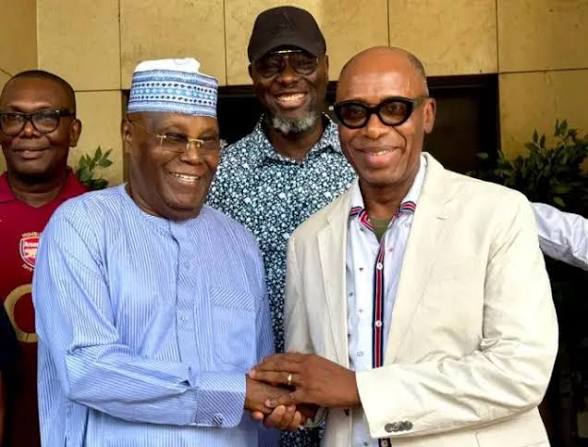
Former Vice President Atiku Abubakar has moved quickly to mend divisions within the African Democratic Congress (ADC) after emerging as the party’s presidential candidate for the 2027 general election, holding a closed-door meeting with former Rivers State governor Rotimi Amaechi in Abuja on Thursday.
A source suggested the rushed visit may have included an unverified offer for the former governor and Minister to be a running mate on the ADC presidential ticket, but will Amaechi accept the offer? The answer hangs in the air.
The meeting came less than 24 hours after Atiku secured a decisive victory in the ADC presidential primary held at the Congress Hall of Transcorp Hilton Abuja. Official results announced by the party’s returning officer, Tunde Ogbeha, showed Atiku polling 1,846,370 votes, defeating Amaechi, who secured 504,117 votes, while former banker Mohammed Hayatu-Deen scored 177,120 votes.
Atiku was accompanied to Amaechi’s residence by former Sokoto State governor Aminu Tambuwal, former ADC National Chairman Ralph Nwosu and other senior party figures, in what observers see as part of an urgent reconciliation effort aimed at stabilising the opposition coalition ahead of 2027.
The ADC had adopted a direct primary system for the nationwide exercise after attempts to produce a consensus candidate reportedly failed. Voting took place across 8,809 wards nationwide, with Atiku recording commanding wins in several states, including Yobe and Imo.
Despite the scale of Atiku’s victory, the exercise exposed deep tensions within the party. Amaechi and Hayatu-Deen reportedly rejected the outcome, alleging irregularities and voter disenfranchisement. Hayatu-Deen was absent during the official announcement of results, while Amaechi described some announced figures as “concocted,” according to reactions circulating after the primary.
In his acceptance speech, Atiku struck a conciliatory tone, insisting there were “no winners and no losers” in the contest. He appealed directly to his rivals and aggrieved party members to unite behind the ADC ahead of the general election.
“I therefore appeal to all those who feel aggrieved to come back to our party and close ranks with the rest of us,” Atiku said.
He specifically invited Amaechi and Hayatu-Deen to join him “in the fight to save Nigeria’s democracy,” promising to work with all stakeholders to strengthen the party and build a broad opposition front capable of challenging the ruling All Progressives Congress (APC).
Atiku also used his victory speech to launch a strong attack on President Bola Tinubu’s administration, accusing the APC government of weaponising anti-corruption agencies and security institutions against opposition politicians.
He cited the reported detention of former Kaduna State governor Nasir El-Rufai despite court orders granting bail, alleging that opposition figures facing investigations often receive relief once they defect to the APC.
“Once a person joins the APC, the harassment ceases and the charges against them magically disappear,” Atiku said, warning against what he described as attempts to intimidate or weaken the ADC through political pressure and institutional interference.
He further warned the Presidency, the judiciary and Independent National Electoral Commission (INEC) against interfering in the affairs of the ADC, saying the opposition would resist any effort to undermine the party.
Outlining his campaign priorities, Atiku pledged that an ADC-led government would focus on national security, education, healthcare, economic revival and restructuring. He promised large-scale recruitment and improved welfare for security agencies, free and compulsory basic education, expanded youth skills development, improved electricity supply and reforms aimed at attracting investment and creating jobs.
On healthcare, he pledged to strengthen primary healthcare and equip specialist centres to reduce medical tourism abroad. He also promised that his government would operate with measurable targets and timelines guided by the ADC manifesto.
“The future of our younger generation is being mortgaged with no accountability,” Atiku said. “That has to change and will change under an ADC government.”
The post-primary developments come amid uncertainty within the opposition coalition. Recent reports indicated cracks within the ADC alliance after prominent opposition figures, including Peter Obi and Rabiu Kwankwaso, reportedly distanced themselves from the coalition over internal disagreements and legal disputes. Watchers suggest those divisions could complicate efforts to build a united front against the APC ahead of 2027.
Still, Atiku’s swift outreach to Amaechi signals recognition within the ADC that party unity will be critical if the opposition hopes to mount a serious challenge in the next presidential election.