
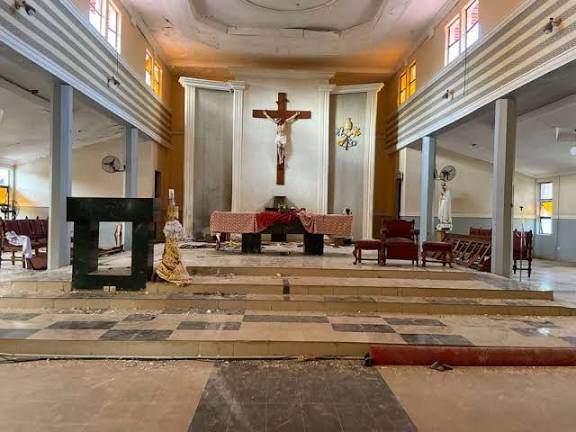
Beneath the solemn arches of the Federal High Court in Abuja on Tuesday, silence settled heavily as Justice Emeka Nwite reserved judgment in one of Nigeria’s most haunting terrorism trials – the prosecution of five men accused of orchestrating the bloody 2022 attack on St. Francis Catholic Church in Owo, Ondo State.
The courtroom, tense with expectation, listened as final legal salvos were exchanged between the Department of State Services (DSS) and defence counsel, bringing months of proceedings to a dramatic pause before judgment.
Justice Nwite announced that the verdict date would be communicated to all parties once the court was ready, hinting that notices could be issued within the next 24 hours.
For many Nigerians, the case is more than a criminal trial. It is a national reckoning.
The June 5, 2022 massacre – carried out during Sunday Mass at St. Francis Catholic Church – sent shockwaves across Nigeria and beyond. Worshippers had gathered in prayer when terror struck, turning a sacred sanctuary into a scene of horror. The attack left grieving families, shattered pews, and a nation demanding answers.
On Tuesday, the DSS urged the court to deliver what it described as the full force of justice.
Lead prosecuting counsel, Ayodeji Adedipe (SAN), delivered a fiery closing argument, insisting that the evidence before the court painted a clear and damning picture of guilt. He urged the judge to impose the maximum punishment under the law – death by hanging – arguing that the scale and cruelty of the attack demanded no less.
According to the prosecution, painstaking investigations and extensive evidence had linked the defendants to one of the deadliest assaults on innocent worshippers in Nigeria’s recent history.
“The law must speak firmly,” Adedipe declared, warning that anything short of decisive punishment could embolden violent extremism.
But the defence pushed back sharply.
Counsel to the accused, Abdullahi Mohammad, urged the court to free his clients, arguing that the prosecution had failed to prove its allegations beyond reasonable doubt. He maintained that suspicion and public outrage could not replace hard evidence in a court of law.
Standing trial are Idris Abdulmalik Omeiza, Al Qasim Idris, Jamiu Abdulmalik, Abdulhaleem Idris, and Momoh Otuho Abubakar.
Outside the courtroom, memories of the Owo tragedy still linger painfully.
The massacre drew worldwide condemnation at the time, with global leaders – including Pope Francis, United Nations Secretary-General António Guterres, the European Union, and the United Kingdom – denouncing the killings. The UN chief and the Archbishop of Canterbury described the assault as “heinous,” while Nigerians across religious and political divides demanded justice.
Then-President Muhammadu Buhari vowed that Nigeria would “never give in to evil and wicked people,” while the late Ondo Governor Rotimi Akerodolu called for relentless pursuit of the perpetrators.
Now, nearly four years after gunfire shattered a Sunday morning in Owo, the nation waits again – this time not for the sound of bullets, but for the sound of judgment.