
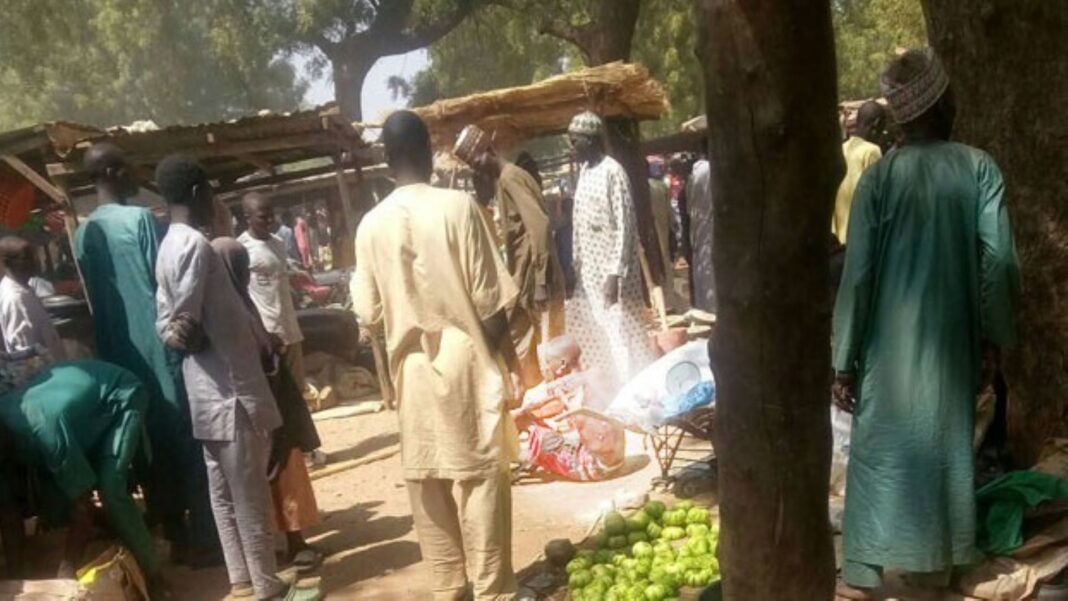
In the dusty heart of the North-West, where market days are usually marked by the clatter of bargaining voices and the scent of roasted grain, Tumfa village awoke this week to grief, confusion, and a nation once again divided over the cost of war from the skies.
What began as an ordinary Sunday market in Zurmi Local Government Area of Zamfara State ended in fire and smoke after an Air Force airstrike tore through the crowded trading ground, leaving behind scenes survivors described as “unimaginable.” Residents say more than 100 people – many of them women traders and children – were killed when bombs struck the bustling market without warning.
“We were buying and selling when the aircraft came,” one villager recounted in Hausa over the phone, his voice trembling. “Most of those who died were women.”
Across hospitals in Zurmi, Kaura Namoda, and nearby Shinkafi, the wounded continue to arrive. Families search for missing relatives while volunteers dig through debris and hastily dug graves. In the village itself, the silence left behind has become louder than the market noise that once filled Tumfa’s open square.
Yet even as mourning spread, official accounts quickly diverged.
The Zamfara State Government insisted the bombed location was no ordinary civilian settlement but a notorious enclave used by armed bandits who have terrorised communities across the region for years. Ahmed Danmanga, special adviser on security to the governor, said authorities were unaware that a functioning market operated there.
“The area is a hideout for bandits,” he maintained.
Defence Headquarters reinforced that position on Tuesday, dismissing reports of mass civilian deaths as “misleading, speculative, and unverified.” According to military authorities, the operation – conducted by troops of Operation FANSAN YAMMA – targeted a gathering of terrorist leaders believed to be coordinating attacks on surrounding communities.
Military officials said intelligence from multiple sources identified the site as a strategic meeting point for armed groups. A subsequent Battle Damage Assessment, they said, confirmed that “several terrorists were neutralised.”
“No credible or independently verified evidence has been established to suggest civilians were affected,” the Defence Headquarters stated, stressing that operations follow strict Rules of Engagement and international humanitarian law. “Civilians are never targets.”
But on the ground, residents tell a very different story.
Human rights organisation Amnesty International accused the military of carrying out an unlawful strike on civilians and called for an immediate independent investigation. According to the group, aircraft were first seen circling overhead around midday before returning nearly two hours later to attack the crowded market.
Amnesty claimed at least 100 civilians died and condemned what it described as a growing pattern of deadly military errors in northern Nigeria.
“This pattern of human rights violation is increasingly becoming the norm,” the organisation said, “with villagers at the receiving end of atrocities by both armed groups and the military.”
The tragedy in Tumfa has revived painful memories across the country. It is the second reported bombing of a crowded market in barely a month, following the April strike on Jilli market in Yobe State where scores of civilians were also feared killed.
For many Nigerians, Tumfa is not an isolated disaster but another chapter in a grim timeline of mistaken airstrikes that stretches back years: from the 2017 bombing of an internally displaced persons camp in Rann, Borno State, to the Tudun Biri tragedy in Kaduna in 2023, and more recent strikes in Sokoto, Nasarawa, and Zamfara itself.
Each incident follows a familiar script – reports of civilian deaths, military denials or investigations, and communities left to bury the dead while questions linger unanswered.
In Tumfa, those questions now hang heavily in the air.
Was the market truly mistaken for a terrorist camp? Were intelligence reports flawed? Or were civilians caught in the blurred line between counterinsurgency and survival in a region where bandits often move among rural populations?
For grieving families, the debate unfolding in Abuja offers little comfort. Their concern is simpler and far more immediate: who will answer for the bodies wrapped in white cloth beneath the scorched earth of Tumfa village?
As the country intensifies its war against insurgents and bandits across the North-West and North-East, the tragedy has once again exposed the painful tension between national security and civilian protection – a tension measured not in official statements, but in lives lost beneath the roar of military aircraft.