
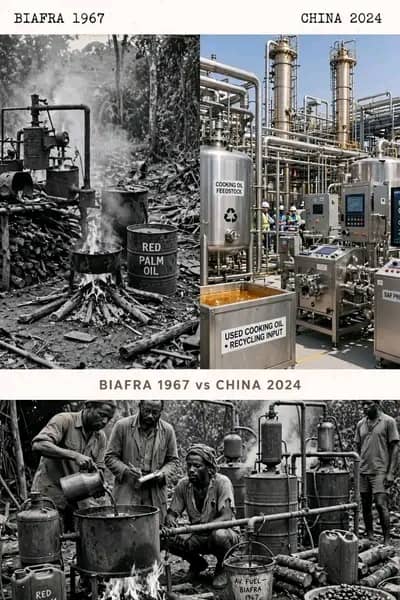
Claims of Biafran palm-oil aviation fuel resurface following China’s sustainable jet-fuel breakthrough
By Phil Timzin
More than five decades after the Nigerian Civil War, renewed attention is being drawn to the scientific and technological achievements of Biafran engineers and researchers, following China’s advances in producing sustainable aviation fuel from used cooking oil.
A claim circulating on social media asserts that Biafran scientists converted red palm oil into jet fuel in 1967, long before China announced its recent advances in sustainable aviation fuel production.
The claim has revived interest in the activities of Biafra’s Research and Production (RAP) organisation, whose engineers and scientists worked under extraordinary wartime conditions to develop locally manufactured weapons, equipment and essential materials.
However, while Biafra’s indigenous industrial and petroleum-refining activities are historically documented, the specific claim that red palm oil was converted into aviation-grade fuel and successfully used to power aircraft remains insufficiently verified by independent technical or flight-test records.
Biafra’s wartime scientific response
The Nigerian Civil War, which lasted from 1967 to 1970, subjected Biafra to a devastating economic and military blockade.
With access to conventional supplies severely restricted, Biafran authorities increasingly depended on local ingenuity to sustain their war effort.
One of the most significant responses was the establishment of the Research and Production organisation, commonly known as RAP.
A 2025 academic study by historian Francis Iwuchukwu Asika, published in the UZU Journal of History and International Studies, documents the emergence and development of RAP and its contribution to Biafra’s wartime industrial activities.
According to Asika, the organisation brought together scientists, engineers, technicians, artisans and other skilled professionals. Its activities included weapons manufacturing, chemical production, mechanical engineering, electronics and petroleum-related research.
The study identifies several prominent figures associated with RAP, including Dr Benjamin Nwosu, William Achukwu, Dr Godian Ezekwe, Edmund Kaine, Dr Edward Chukukere and Professor Mark Chijioke.
It also documents the involvement of Dr Felix Oragwu in the early accounts of Biafran scientific and technological innovations.
The research describes RAP as an important indigenous industrial undertaking established in response to the severe shortages confronting Biafra.
The palm-oil aviation fuel controversy
The renewed social media discussion specifically credits Professor Gordian (Godian) Ezekwe, Dr Felix Oragwu, Engineer Willy Achukwu and other Biafran scientists with developing aviation fuel from locally available red palm oil.
According to the circulating account, the scientists experimented with improvised equipment and locally sourced materials to develop alternative fuel supplies during the blockade.
The account further claims that aircraft operating from Uli airstrip used fuel derived from red palm oil.
These assertions are significant, but they require careful historical examination.
The available academic study confirms the existence of RAP’s petroleum extraction and related research groups, as well as the participation of the named scientists and engineers in various technological projects. It does not, however, establish that red palm oil was successfully converted into certified jet fuel or that Biafran aircraft flew using such fuel.
There is also an important difference between refining crude petroleum into conventional fuels and chemically converting vegetable oil into aviation-grade biofuel. These are different industrial processes.
What historical records say about Biafra’s aviation fuel
A declassified United States diplomatic telegram dated September 16, 1969, provides an important contemporary account of Biafra’s aviation fuel difficulties.
Published in the US State Department’s Foreign Relations of the United States historical archive, the telegram examined sources of aviation gasoline available to the Biafran Air Force.
The American diplomatic report stated that Biafra obtained some aviation gasoline through relief flights operating from São Tomé and Libreville.
It also reported that Biafran engineers distilled low-octane gasoline and mixed it with aviation gasoline for use in motor vehicles.
The document is particularly relevant because it demonstrates that Biafra was undertaking local fuel processing while struggling to obtain sufficient aviation gasoline.
However, it does not identify red palm oil as a source of aircraft fuel.
China and the 2024 sustainable aviation fuel breakthrough
Meanwhile, China has made substantial advances in the production of sustainable aviation fuel (SAF) from waste cooking oil and other renewable feedstocks.
On January 20, 2024, Chinese company Jun Heng Biotechnology received airworthiness approval for its sustainable aviation fuel from the Civil Aviation Administration of China.
According to SGS, the fuel was produced using used cooking oil and other waste-derived materials. Its approval marked an important development in China’s commercial sustainable aviation fuel industry.
In June 2024, China’s state-owned oil giant Sinopec announced a successful trial production of approximately 606 tonnes of bio-aviation kerosene at its Zhenhai Refining and Chemical facility.
The China National Center for Science and Technology Innovation reported that the fuel was produced from renewable resources, including waste cooking oil and animal and plant fats.
The World Economic Forum also highlighted China’s emergence as a major player in sustainable aviation fuel in a December 2024 article examining the country’s use of waste cooking oil.
These developments represent important progress in the global transition towards lower-carbon aviation.
Nevertheless, China’s industrial achievements should not be described as the first-ever conversion of vegetable or waste oil into aviation fuel without considering earlier historical experiments and research.
Was Biafra ahead of its time?
The comparison between Biafra’s reported experiments and China’s modern sustainable aviation fuel industry raises an interesting historical question.
Could Biafran scientists have experimented with converting vegetable oils into aviation fuel during the Nigerian Civil War?
It is a question deserving serious investigation, particularly given the documented existence of RAP’s petroleum, chemical and biochemical research activities.
However, the assertion that Biafra was the first country in the world to manufacture palm-oil-derived jet fuel in 1967, or that its aircraft successfully flew using that fuel, should remain an attributed historical claim until supported by contemporary technical reports, laboratory records, eyewitness documentation or independent flight-test evidence.
Similarly, claims that Frederick Forsyth or the International Committee of the Red Cross independently confirmed the specific palm-oil jet-fuel achievement require identifiable documentary references.
Preserving Biafra’s scientific history
Regardless of the unresolved palm-oil aviation fuel claim, the documented achievements of Biafra’s Research and Production organisation deserve greater recognition.
The 2025 study by Francis Iwuchukwu Asika provides an important contribution to understanding the scientists, engineers and technicians who attempted to build an indigenous industrial capability under exceptionally difficult circumstances.
The story is not simply about military inventions. It is also about scientific improvisation, engineering, resourcefulness and the determination to develop local solutions when conventional supply chains collapsed.
The renewed debate should therefore encourage historians, engineers, surviving RAP members and research institutions to examine archival documents, laboratory notes, personal testimonies and other surviving evidence.
If the palm-oil aviation fuel claim can be substantiated, it would represent an extraordinary chapter in the history of African science and technological innovation.
For now, one historical fact is beyond reasonable dispute: Biafra’s wartime scientists and engineers demonstrated remarkable ingenuity. Whether they also achieved the world’s first palm-oil-derived jet fuel remains an important question awaiting conclusive evidence.