
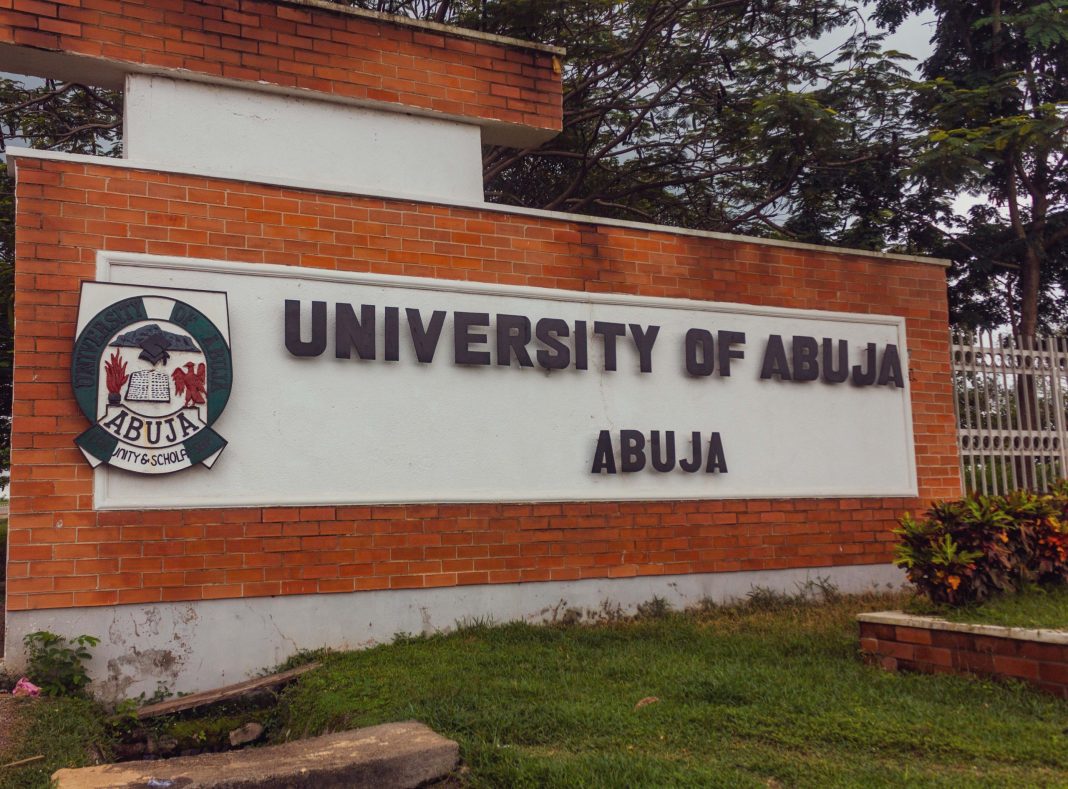
The controversy surrounding the Federal Capital Territory Administration’s (FCTA) decision to withdraw 7,139 hectares of land from the University of Abuja (UNIABUJA) has intensified, following a strong defence of the action by the FCT Minister, Nyesom Wike, and renewed opposition from the university community.
The administration insists that the decision was neither arbitrary nor politically motivated, maintaining that it was based on recommendations made by a joint committee established in 2016 to review the institution’s land allocation.
However, the university’s staff unions, students and alumni have challenged the reduction, arguing that the massive cut could undermine the institution’s long-term expansion plans, academic master plan and future development.
The dispute reached another flashpoint on Monday, November 16, when members of the university’s Joint Action Committee (JAC), comprising the Academic Staff Union of Universities (ASUU), Senior Staff Association of Nigerian Universities (SSANU), Non-Academic Staff Union of Educational and Associated Institutions (NASU), Students’ Union Government and the alumni association, staged a protest against the government’s decision.
Reacting to the demonstration, Lere Olayinka, Senior Special Assistant to the FCT Minister on Public Communications and Social Media, described the protest as misplaced, insisting that Wike merely implemented a recommendation approved by his predecessor, former FCT Minister Mohammed Musa Bello.
How the University Lost 7,139 Hectares
According to Olayinka, the University of Abuja originally received an allocation of 11,824.04 hectares, an area the FCTA now considers excessive in relation to the institution’s development needs and the National Universities Commission’s (NUC) recommended land requirements.
He explained that a 12-member joint committee was inaugurated on November 10, 2016, to examine the university’s land allocation, encroachment by indigenous settlers, illegal developments around its Gwagwalada Mini Campus and the issuance of land titles for its campuses.
Five members of the committee reportedly represented the university. They were Prof. Otaki Alanana, Prof. A. Mallam, Mohamed Kassim, A.E. Ripite and Sadiq O. Shuaibu.
Olayinka said the committee concluded that the institution’s original landholding of more than 11,000 hectares was far beyond the 100 hectares it considered consistent with the NUC’s recommendation.
He added that the committee’s report was approved by Bello before the current administration assumed office.
According to the FCTA spokesman, Wike subsequently approved 4,519.80 hectares for the university, bringing its total retained allocation to approximately 4,685 hectares.
The minister’s aide argued that the current allocation was considerably more generous than the 100 hectares recommended by the committee.
FCTA Questions University’s Expansion Plans
In defending the reduction, Olayinka questioned why an institution established 38 years ago still required more than 11,000 hectares, particularly when substantial portions of its original allocation allegedly remained undeveloped.
He maintained that the retained 4,685 hectares could accommodate more than 80,000 buildings if developed using plots of 500 square metres each.
He further argued that the government was entitled to review the size of land allocated to a public institution, especially where the land was not being put to productive use.
Challenging the protesting unions, Olayinka asked whether the university’s representatives on the 2016 committee had informed other stakeholders about the recommendations contained in its report.
He also questioned whether the reduction would affect lecturers’ salaries, students’ academic activities or the institution’s immediate operations.
The FCTA spokesman challenged the protesters to identify universities elsewhere in the world occupying more than 11,000 hectares and explain why UNIABUJA required such an extensive landholding.
EFCC Land Allocation Raises Fresh Questions
The controversy has taken another dimension following allegations that the university management allocated portions of its land to individuals and corporate organisations without obtaining the necessary approval from the FCTA.
Olayinka specifically alleged that the institution allocated 100 hectares to the Economic and Financial Crimes Commission (EFCC) without recourse to the administration.
The allegation has raised questions about the university’s authority to allocate or transfer portions of government-owned land to third parties and the extent of its control over the original allocation.
However, the allegation remains the FCTA’s account of the matter and requires clarification from the university and the EFCC.
Dispute Goes Beyond Land Allocation
The latest confrontation is part of a wider disagreement over the future of the university’s main campus in the Giri District of the FCT.
The dispute had already attracted public attention in June 2025, when Wike announced plans to recover approximately 7,000 hectares from the university, arguing that such a large allocation could not remain under the institution’s control without corresponding development.
The minister reportedly directed relevant authorities to set aside about 4,000 hectares for the university, with the remaining land earmarked for other developments.
But the university community has maintained that the original allocation was legitimate and necessary for its long-term institutional needs.
One of the arguments raised by the university’s leadership is that the physical character of the remaining land must be considered when determining whether the reduced allocation is adequate.
The university’s Pro-Chancellor, Olanrewaju Tejuoso, reportedly argued that substantial portions of the land left for the institution consist of rocky hills, raising questions about how much of the retained territory is actually suitable for development.
The university’s position also highlights the importance of planning beyond immediate infrastructure needs, particularly as a growing federal institution may require additional space for research facilities, hostels, laboratories, agricultural activities and future academic expansion.
Court Proceedings Add Another Layer
The disagreement has also taken a legal dimension.
According to reports, the university instituted Suit No. FCT/HC/CV/3500/2026 before the High Court of the Federal Capital Territory, challenging aspects of the land dispute.
A reported order issued on August 18, 2026, by Justice F.E. Messiri directed the parties to maintain the status quo ante bellum concerning Plot No. 1, Giri District, pending the determination of the substantive case.
ASUU subsequently accused the FCTA of violating the order through alleged allocations of portions of the disputed land to private individuals and companies on September 26, 2026.
These allegations and the precise scope of the court’s order remain important issues requiring clarification. The existence of a reported interim order does not, by itself, establish that any party has violated it.
The legal proceedings could prove decisive in determining the parties’ respective rights and the extent to which the FCTA can alter the university’s original land allocation.
The Bigger Question: Development or Encroachment?
At the heart of the dispute is a fundamental question about public land management: should a government-owned university retain thousands of hectares for possible future expansion, or should the government recover portions considered unnecessary for its present and projected operations?
For the FCTA, the issue is one of responsible land administration, accountability and the utilisation of public assets.
For the university community, however, the concern goes beyond the number of hectares being withdrawn. It involves institutional autonomy, long-term planning, security of tenure and the protection of land that may be required for future academic and research activities.
The disagreement also raises questions about the transparency of the 2016 committee’s findings, the basis of the NUC’s reported 100-hectare recommendation and whether the university’s present and future development requirements were adequately considered before the revised allocation was approved.
While Olayinka has challenged the unions to explain their interest in the disputed land, the university community’s position deserves to be assessed against its documented master plan, projected student population, infrastructure requirements and the actual developable area of the remaining land.
Ultimately, the controversy should not be reduced to a political confrontation between the FCTA and university unions. It is a matter involving public accountability, the future of higher education and the responsible management of one of the country’s major federal university campuses.
As the legal dispute unfolds, many are watching to see whether the government and the university can resolve the disagreement through transparent negotiations, proper land documentation and respect for the rule of law.
For now, the battle over UNIABUJA’s 7,139 hectares is far from over, and its eventual outcome could have implications for public land administration and the future expansion of federal universities across Nigeria.