
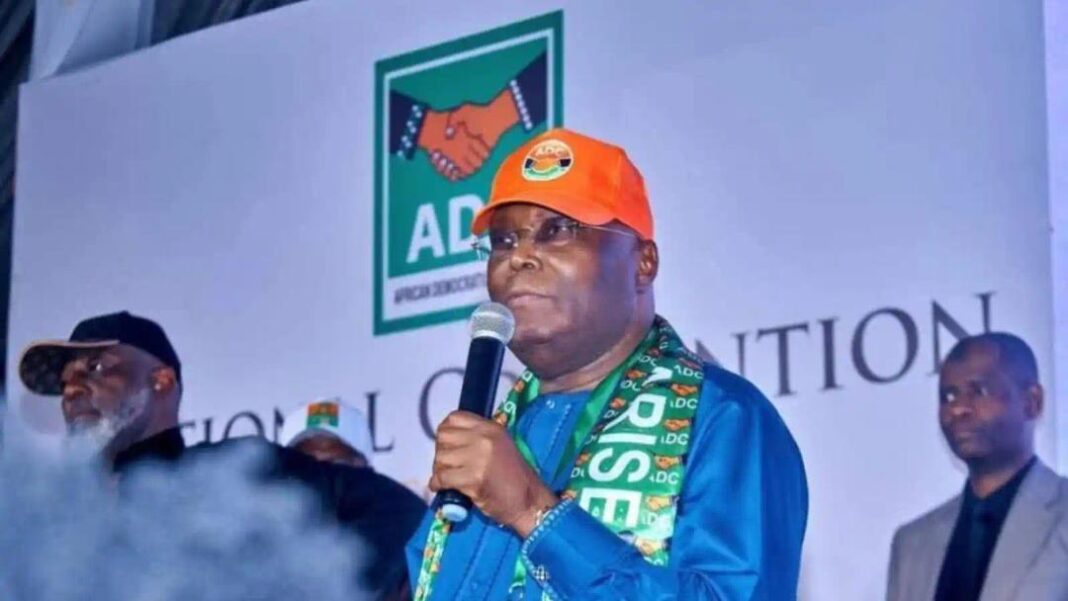
The battle over the African Democratic Congress (ADC) ahead of the 2027 general elections has intensified, with former Vice-President Atiku Abubakar declaring that no court judgment will stop him from contesting the presidency, while Minister of Aviation and Aerospace Development, Festus Keyamo, has dismissed concerns over his possible exclusion from the ballot.

The exchange follows Thursday’s judgment of the Federal High Court in Abuja, which nullified the leadership of the ADC under former Senate President David Mark and invalidated decisions taken by the leadership, including the process that produced Atiku as the party’s presidential candidate.
But Atiku, in a strongly worded statement personally signed on Friday, insisted that he remained in the race, describing the court ruling as an attempt to weaken the opposition and frustrate Nigerians’ democratic choices.
“I am in this race. I am not going anywhere. We will be on the ballot. No threat, blackmail or court manoeuvre will make me abandon you or the cause we share,” he declared.
While Atiku was insisting that the ruling would not end his presidential ambition, Keyamo took a sharply different position, defending the court’s decision and warning politicians against attacking judges whenever judicial pronouncements go against their interests.
In a post on his verified X account on Friday, the minister argued that court judgments should be assessed on the basis of facts, evidence and the law rather than political sentiments or public outrage.
He dismissed suggestions that Atiku’s possible absence from the 2027 ballot would constitute a setback for Nigerian democracy.
“You cannot abuse judges and blackmail the judiciary when it doesn’t go your way. Heavens will not fall if a certain Atiku Abubakar is not on the ballot in 2027,” Keyamo declared.
The former Vice-President maintained that the judgment could not override the political aspirations of Nigerians, insisting that the electorate, rather than judicial manoeuvres, should ultimately determine who governs the country.
He said no court ruling, political pressure or alleged manipulation could erase his place in the 2027 contest or silence the campaign, adding that Nigerians must be allowed to exercise their constitutional right to choose their leaders.
Atiku also accused the ruling All Progressives Congress (APC) of using state institutions and political influence to weaken opposition parties, alleging that the administration was pursuing a strategy capable of pushing Nigeria towards a one-party system.
He questioned why a ruling party that boasts of controlling 32 state governments and frequently celebrates the defection of opposition politicians would be apprehensive about facing its opponents in a competitive election.
According to him, a government confident in its performance should have no reason to undermine rival parties or resort to what he described as courtroom manoeuvres and attempts to compromise the electoral process.
Atiku further criticised President Bola Tinubu’s administration over the economic difficulties confronting Nigerians, citing the removal of fuel subsidy, the depreciation of the naira, rising food prices, business closures and worsening insecurity.
He argued that the hardship experienced by households and businesses should be a central issue in the coming election, urging his supporters not to lose faith despite the latest judicial setback.
“Your vote is your power, and together, we will take our country back,” he told supporters.
In a direct challenge to President Tinubu, Atiku called for a free, fair and credible contest, insisting that the President should face the electorate rather than rely on legal battles to determine the outcome of the political contest.
“Let me say this plainly: Bola cannot use the courts to escape the judgment of Nigerians at the ballot box,” he added.
ADC heads to Appeal Court, seeks suspension of judgment
Beyond Atiku’s declaration, the ADC has moved to challenge the judgment through the appellate process, signalling that the dispute over the party’s leadership and its 2027 political plans is far from settled.
The Federal High Court, presided over by Justice Peter Lifu, delivered its judgment in a suit instituted by Nafiu Bala Gombe, a former Deputy National Chairman of the ADC, who challenged the emergence of the Mark-led leadership.
The court declared the Mark-led caretaker committee illegal, holding that it emerged through an improper process. It consequently nullified the committee’s actions and recognised Bala’s position in the party’s leadership dispute.
The ruling affected not only Atiku’s presidential nomination but also other decisions taken by the disputed leadership, raising questions about the status of the party’s candidates and preparations for the 2027 elections.
However, in a significant development on Friday, the Mark-led faction approached the Court of Appeal, filing a notice of appeal and seeking a stay of execution of the judgment pending the determination of the appeal.
The party also notified the Independent National Electoral Commission (INEC) of the legal action and urged the commission not to take steps that could pre-empt the outcome of the appellate proceedings.
The ADC has rejected the judgment, describing it as politically motivated and alleging that the ruling party is interested in destabilising the opposition ahead of the elections.
Its National Publicity Secretary, Bolaji Abdullahi, said the party would explore every available legal avenue to defend its rights and preserve its participation in the electoral process.
The party also questioned the timing of the judgment, which came shortly after its presidential campaign rally in Sokoto State.
Keyamo also argued that the ADC remained an existing political party, insisting that its original leaders and members had legitimate rights that should not be disregarded in the ongoing leadership dispute.
He maintained that the party had not been proscribed and that the emergence of a different leadership through the court process should not automatically be interpreted as an attempt to destroy opposition politics.
To reinforce his argument, Keyamo recalled two previous Supreme Court decisions that went against the APC.
He cited the 2019 Zamfara State judgment, which nullified the electoral victories of APC candidates across the state and declared their PDP opponents winners because of irregularities in the party’s nomination process.
He also referred to the February 2020 Bayelsa judgment, which nullified the election of APC governorship candidate David Lyon over the running mate’s disqualification, paving the way for PDP candidate Douye Diri to become governor.
Keyamo argued that the APC accepted those decisions without resorting to attacks on the judiciary and insisted that opposition politicians should demonstrate the same respect for judicial pronouncements.
His position has added another dimension to the controversy, shifting the debate beyond the immediate fate of Atiku’s candidacy to the broader question of how political parties respond to unfavourable court judgments.
APC denies involvement in ADC crisis
Meanwhile, the APC has rejected allegations that it is behind the ADC’s internal crisis, maintaining that the opposition party should resolve its leadership disagreements rather than blame the ruling party for the court’s decision.
The ruling party described the judgment as a consequence of the ADC’s internal problems and urged its leaders to put their house in order.
The dispute has also generated competing demands over compliance with the court’s decision. While the Mark-led faction is pursuing an appeal and seeking a stay of execution, members of the ADC aligned with Bala have called for the judgment to be respected and implemented.
This has placed INEC in a delicate position as it navigates the competing legal claims and the implications for the recognition of the party’s leadership and candidates.
A fresh legal and political battle ahead of 2027
The unfolding crisis represents another major challenge for the opposition as political parties intensify preparations for the 2027 presidential election.
Atiku, who was the PDP’s presidential candidate in the 2023 election and finished second behind Tinubu, secured the ADC presidential ticket in May after opposition figures rallied around the party as a platform for a political coalition.
His emergence was widely seen as a major development in efforts to consolidate opposition forces ahead of the next election.
However, the latest judgment has thrown the arrangement into uncertainty, with the ADC now facing a legal battle over its leadership, internal processes and the validity of decisions taken under the Mark-led executive.
The central question is no longer simply whether Atiku intends to contest the presidency, but whether the ADC can successfully overturn the judgment and establish a legally recognised leadership capable of presenting candidates for the election.
For now, Atiku remains defiant, Keyamo remains unapologetic in his defence of the court’s decision, and the ADC is banking on the Court of Appeal to reverse the ruling.
With the 2027 elections approaching, the outcome of the legal battle could have significant implications for the opposition’s political strategy and the shape of the presidential contest.
Until the appellate courts determine the matter, the final status of the ADC leadership and the party’s presidential ticket remains a subject of legal uncertainty.