
For weeks, families in Ngoshe, a quiet community tucked inside Gwoza Local Government Area of Borno State, have lived with a haunting question: Are our loved ones still alive?
On Thursday, that question was answered – at least in part.
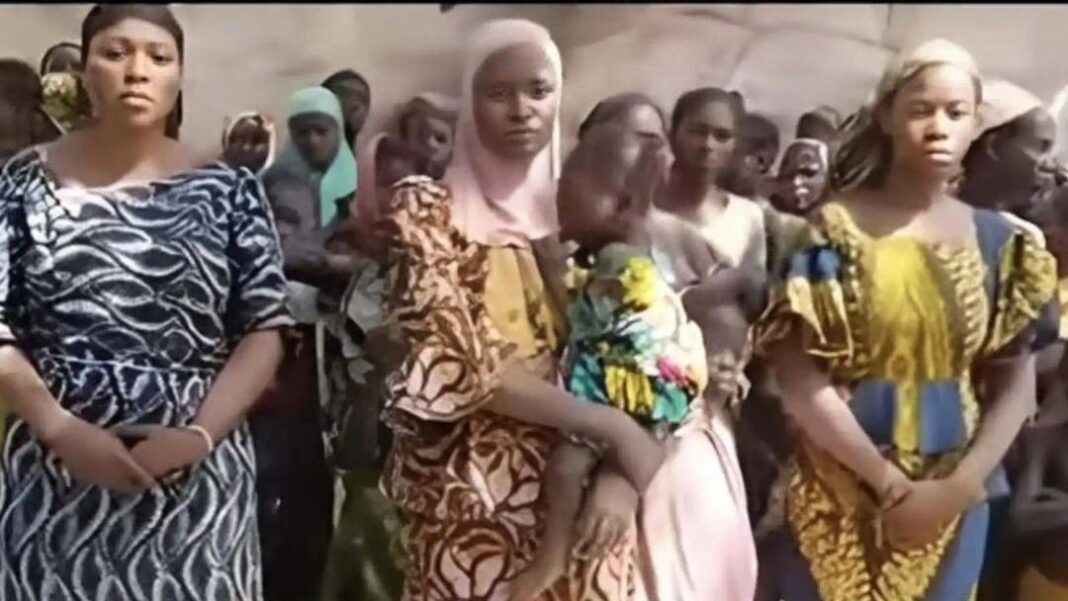
A faction of Boko Haram released a video showing what it claims are 416 abducted residents of the town. The footage, lasting just under seven minutes, offers the first glimpse into the lives of those taken during a recent attack. Most of those seen are women and children. A few men sit among them, their faces drawn but attentive.
The video appears carefully staged. A spokesperson for the insurgent group addresses the camera, insisting the captives are safe and have not been abused. He says the recording was made in response to appeals from the Borno South Youths Alliance, a group that has quietly tried to open lines of communication since the abductions.
But beyond the spokesman’s claims, it is the voice of one woman – calm, composed, yet heavy with longing – that lingers.
“We are alive,” she says simply.
Speaking on behalf of the group, she explains that they have been given food, clothing, and medical care. Some who fell ill, she adds, received treatment. Children who arrived without proper clothing were provided with what they needed.
On the surface, it is a message meant to reassure.
Yet beneath her words lies something harder to ignore.
“We are restless,” she admits. “We are worried about our families.”
Her voice does not rise, but the weight of uncertainty is unmistakable. She speaks of relatives left behind—some killed, others scattered by violence, many unaware whether those taken are dead or alive.
For the families watching from afar, this video may bring a fragile sense of relief. But it also sharpens the pain of separation.
The woman’s message turns into a plea – direct, urgent, and deeply human. She calls on Nigeria’s leaders to act, naming them one by one, asking for intervention that could bring them home.
“We are not used to staying away from our homes,” she says. “It is very difficult to remain here.”
Meanwhile, the Borno South Youths Alliance has confirmed the figure shown in the video: 416 people still in captivity. The group says the number emerged after days of dialogue and humanitarian appeals.
Its president, Samaila Kaigama, insists their role is not political, nor does it signal support for insurgents. Instead, he describes it as a necessary step – giving a voice to those who cannot speak freely and pushing for solutions in a region long scarred by insecurity.
He also points to other parts of northern Nigeria where mediation efforts have led to the release of abducted civilians, urging authorities to act with the same urgency for Ngoshe.
For now, the people in the video remain where they are – alive, visible, but not free.
And back in Ngoshe, families who have seen their loved ones for the first time in weeks are left holding on to a new, more complicated hope: not just that they survived, but that they will return.
Also, a chilling video, now circulating widely, has cast a harsh spotlight on the deepening insecurity in Kwara State – its frames filled not with chaos, but with something far more haunting: quiet desperation.
Inside what appears to be a remote hideout, dozens of women and children huddle together, their faces worn by fear, fatigue, and uncertainty. They are among the 176 people abducted during the deadly raid on Woro community in Kaiama Local Government Area earlier this year. Again, since their capture, their voices are being heard.
But not freely.
The footage opens with a member of the armed group, calm and deliberate, introducing the captives as though presenting a case study rather than human lives. He claims the victims have undergone “religious indoctrination,” asserting they are being taught Islamic principles – an unsettling attempt to describe captivity as conversion.
Before any plea is made, the captives are prompted to recite religious teachings in unison. Their voices rise together – mechanical, rehearsed – answering questions about faith under watchful eyes.
Then, a shift.
A young woman leans forward. Her voice trembles, but her words are clear – urgent, human.
“We are the people who were kidnapped from Woro… Please, this is the last opportunity they gave us.”
Her appeal stretches beyond religion, beyond politics – it is a cry for survival.
She speaks of pregnant women, of sick children, of bodies weakening in captivity. Her words paint a stark contrast to the captors’ narrative: whatever “teachings” are being given, the reality remains one of suffering.
Another voice follows, this time in Yoruba, echoing the same fear and urgency. She calls on leaders in Kwara and neighboring Oyo State to act – quickly, decisively.
Across languages and tones, the message is unified: help us.
A Community Still Reeling
The video revives painful memories of the February 2026 attack on Woro – a once-quiet rural community that became the scene of one of the region’s most brutal assaults in recent years.
Gunmen descended without warning.
Homes were burned. Lives were cut short. Among the dead were respected community figures – members of the Emir’s family, the Chief Imam, educators, and students. In the aftermath, more than a hundred women and children vanished into the surrounding wilderness.
Weeks later, their fate remains uncertain.
Between Narrative and Reality
What makes the video particularly disturbing is not just the condition of the captives, but the narrative imposed upon them. The captors’ insistence on “indoctrination” raises troubling questions about coercion, identity, and the psychological toll of prolonged captivity.
Yet, even within that controlled setting, the victims reclaim a sliver of agency – using the brief window they are given to send a message that cuts through the rhetoric.
This is not about ideology.
It is about survival.
A Growing Sense of Urgency
As the footage spreads, so does public concern. Security analysts warn that such videos are often strategic – designed to pressure authorities, provoke fear, or reshape public perception.
But beyond strategy lies a more immediate reality: lives hanging in the balance.
For the families of those taken, the video is both a relief and a torment – proof that their loved ones are alive, and a painful reminder of the danger they still face.
“Hear Us”
The final moments of the video linger – not on the captors, but on the captives themselves.
Their eyes do not leave the camera.
Their message is simple, repeated across voices, languages, and trembling breaths:
This is our last chance.
And now, the question hangs heavy in the air:
Who is listening?