
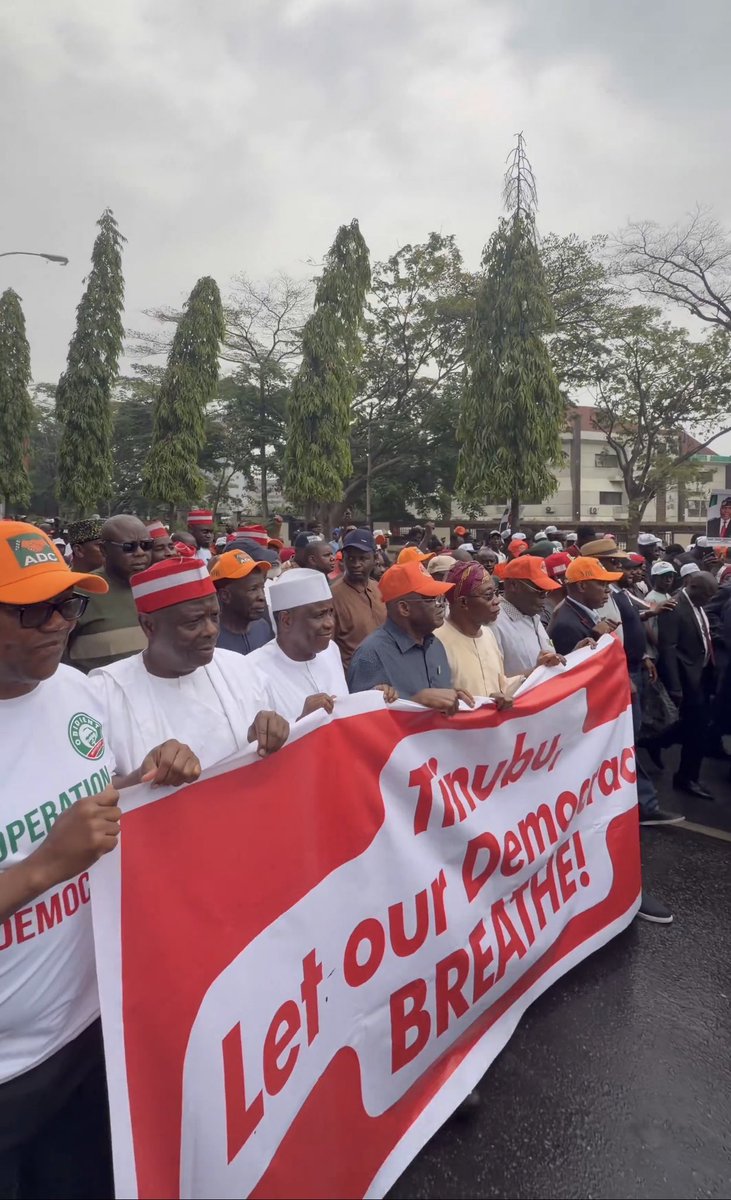
Abuja witnessed a political earthquake on Wednesday as some of Nigeria’s most formidable opposition figures – former Vice President Atiku Abubakar former Senate President David Mark, former House of Representatives Speaker and governor Aminu Tambuwal, former Governors Rauf Aregbesola, Rabiu Musa Kwankwaso, and Peter Obi – led a charged procession to the headquarters of Independent National Electoral Commission (INEC), transforming simmering tensions into a full-blown confrontation that could reshape Nigeria’s political landscape ahead of 2027.
In what is being described as a battle over the soul of Nigeria’s democracy, the rallying cry of #OccupyINEC, the protest – though peaceful – throbbed with urgency, anger, and unmistakable political symbolism. What began months ago as an internal leadership tussle within the African Democratic Congress (ADC) has now exploded into a national standoff, pitting opposition forces against the very institution tasked with safeguarding democracy.
“Disgraceful and Unbecoming”
Standing shoulder-to-shoulder with party leaders, ADC National Chairman Mark delivered a blistering rebuke of INEC’s leadership, accusing its chairman, Joash Amupitan, of dragging the electoral body into partisan waters.
“Your recent media interview was not only disgraceful and unbecoming of the high office you occupy,” the party declared, “but it also exposed a troubling willingness to descend into partisan controversy.”
At the heart of the outrage lies a constitutional flashpoint: the ADC insists that INEC has overstepped its bounds by interpreting court rulings – an act it says belongs solely to the judiciary.
“The interpretation of court judgments is the exclusive preserve of the judiciary,” the party thundered. “For the Chairman of INEC to publicly assume that role amounts to a serious constitutional breach.”
A Crisis of Confidence
What makes this confrontation particularly combustible is the ADC’s claim that INEC had previously validated its leadership processes – only to now reverse course under alleged pressure.
According to party officials, multiple National Executive Committee meetings in 2025 produced the current leadership, with INEC representatives present and affirming the outcomes. The Commission even backed this position in a sworn affidavit before the Federal High Court.
Now, the party alleges, there are “efforts being made to recant testimonies” – a move it describes as “unconscionable” and dangerous for democratic stability.
“This is not only improper; it is dangerous for the credibility of our electoral system,” the ADC warned, raising fears that Nigeria’s electoral umpire may be losing its neutrality at a critical political moment.
Opposition Unites: “We Will Resist”
The protest drew in opposition firepower, including former Vice President Atiku Abubakar, who described the demonstration as a resistance movement against creeping authoritarianism.
“This protest sends a clear signal that any attempt to weaken our democracy will be resisted,” Atiku declared, urging the international community to pay close attention.
Kwankwaso echoed the sentiment, calling the gathering a “unified stand” against what he termed INEC’s “compromised neutrality.”
“Today, I joined fellow coalition leaders and committed democrats to condemn the clear partisanship,” he said, warning that Nigerians would not tolerate actions capable of undermining the democratic process.
The 72-Hour Ultimatum
Behind the rhetoric lies a ticking clock.
ADC Youth Leader Balarabe Rufai issued a 72-hour ultimatum to INEC: restore the Mark-led National Working Committee on its official portal – or face nationwide civic resistance.
“If INEC fails to comply,” he warned, “we will initiate nationwide, peaceful and lawful civic action across all 36 states and the Federal Capital Territory… and sustain resistance until full restoration of democratic order.”
The demands are sweeping and uncompromising:
• Immediate resignation or removal of the INEC chairman
• Withdrawal of “offensive” correspondence to the ADC
• A formal public apology
• A binding commitment to non-interference in party affairs
A Deeper Political Fault Line
The crisis traces back to a disputed leadership battle within the ADC following the resignation of its former executives and the emergence of Mark as chairman – moves tied to the party’s adoption as a coalition platform for 2027.
But the situation escalated when INEC withdrew recognition of the Mark-led leadership, citing a Court of Appeal order to maintain the previous state of affairs. The ADC insists that the “last uncontested position” clearly favors Mark’s leadership.
“What changed?” Rufai asked pointedly. “Power, pressure and political interference.”
“A One-Party State Will Not Stand”
Civil society voices are now joining the fray. Activist Ibrahim Garba Wala warned of an agenda to weaken opposition politics in Nigeria.
“The attempt to make Nigeria a one-party state will not stand,” he said. “It will be rejected by the people.”
With legal fireworks looming, mass protests threatened, and political alliances hardening, the road to 2027 is already shaping up to be one of the most fiercely contested in the nation’s history.
And at the center of it all stands a question that could define the republic: Who guards the guardians of the vote?