
By The Political Desk
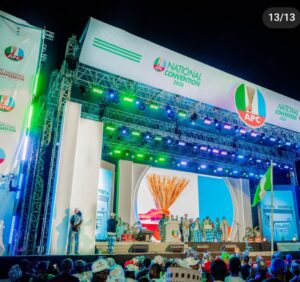
At first glance, it was a familiar scene: party flags waving under Abuja’s dry-season sky, delegates chanting slogans, and political heavyweights exchanging carefully choreographed smiles at Eagle Square.
But beneath the spectacle, the 2026 convention of the country’s ruling party unfolded as something far more consequential – a carefully managed consolidation of power, a warning to dissenters, and a soft launch of the 2027 presidential race.
And then, almost absurdly, there was a stolen iPhone.
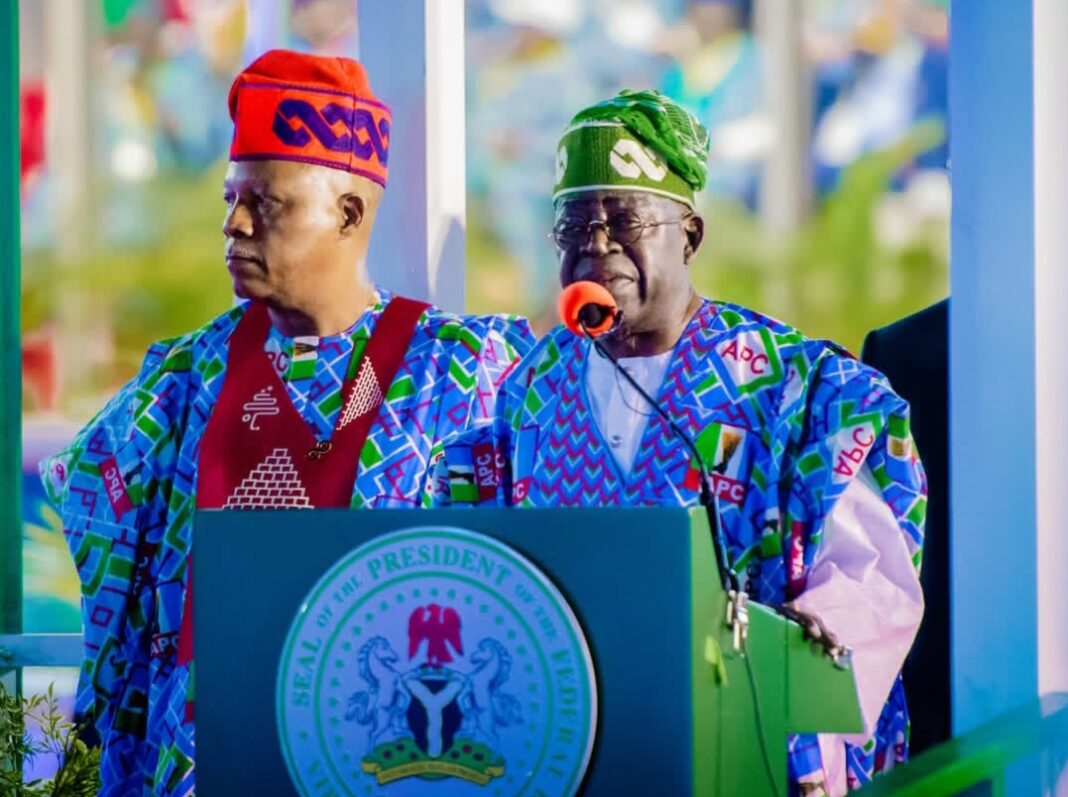
When Bola Ahmed Tinubu stepped up to address party faithful, the message was unmistakable: fall in line or fall out of relevance.
He spoke of unity, discipline, and the dangers of internal division. But between the lines, it was a speech about control.
He defended his administration’s economic reforms- policies that have drawn so much pain from so many across the country – arguing that recovery was underway and patience was required.
Nigerians used to the patience story simply scoffed, and many living in Abuja could not wonder why the party that has caused so heartaches and pain should worsen it by the gridlock in traffic as witnessed during the convention.
The loud complaints from the majority notwithstanding, there are few, mainly direct beneficiaries and government ‘yes-men’ who applaud Tinubu’s policies.
Yet the most telling parts of the president’s speech were not about the economy or opposition parties. They were about APC itself.
The greatest threat to APC is not the opposition—it is APC.
For a party that has historically battled internal fractures, Tinubu’s emphasis on unity was less a plea and more a directive.
The Rise of Yilwatda
The emergence of Nentawe Yilwatda as national chairman—through consensus rather than contest—perfectly captured the spirit of the convention.
There were no dramatic floor fights.
No surprise upsets.
No visible fractures.
Instead, there was agreement – carefully negotiated and tightly managed.
Yilwatda, a technocrat with roots in governance and administration, represents a new archetype of party leadership: less populist, more managerial, and crucially, aligned with the presidential center.
In Nigerian political terms, consensus does not mean absence of conflict.
It means conflict has already been settled behind closed doors.
And in this case, it signals one thing clearly: The party structure is now firmly under Tinubu’s influence.
Despite the show of unity, APC remains a coalition of competing interests—each recalibrating after the convention.
The Presidential Bloc (In Control)
At the center is Tinubu’s political machine:
Loyal governors
Key ministers
Party leadership
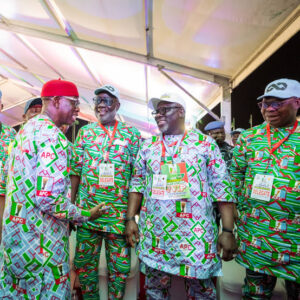
This bloc now controls both government and party architecture—a powerful combination heading into an election cycle.
The Northern Establishment (Watching Closely)
Figures like Abdullahi Ganduje represent a northern bloc that remains influential but cautious.
With power currently in the South, their focus is strategic:
Maintain relevance
Position for future transitions
Their loyalty is real—but not unconditional.
The Governors (Silent Kingmakers)
Nigeria’s governors remain the most potent political actors after the president.
Their influence:
Control of state party structures
Ability to mobilise votes
Power to destabilise or stabilise
If aligned, they guarantee victory.
If fractured, they can unravel everything.
The Opposition: Fragmented, But Not Finished
While APC projected unity, the opposition faces a more complicated reality.
PDP: Structure Without Harmony
Rudderless and fractured, the party retains national reach but struggles with internal cohesion.
Its challenge is simple:
It cannot defeat APC if it cannot first unite itself.
Labour Party: Energy Without Machinery
Previously driven by Peter Obi, who has now moved to the African Democratic Congress (ADC), the party appears to have lost its youth enthusiasm with the departure of Obi.
Even then, enthusiasm is not structure.
Without grassroots consolidation, Labour risks remaining a movement without electoral depth.
The Coalition Question
Other platforms like African Democratic Congress could become vehicles for alliances.
Because the truth is stark: No single opposition party, as currently constituted, can defeat APC alone.
2027: Three Possible Futures
From the signals at the convention, three electoral paths are emerging:
APC Dominance
If unity holds and economic conditions stabilise, Tinubu enters 2027 as clear favourite.
A Competitive Coalition
If opposition parties unite behind a single candidate, Nigeria could see its most competitive election since 2015.
Internal Rupture
If APC’s internal balance collapses – particularly between regional blocs – the party’s greatest threat may come from within.
The iPhone That Stole the Moment
Amid speeches about unity and national progress, a quieter story broke through the noise: A phone – reportedly belonging to an aide of a top official—was stolen at the venue.
It was later recovered. A suspect was reportedly apprehended.
But by then, the moment had already taken on a life of its own.
Why it mattered:
▪︎It punctured the aura of elite control
▪︎It mirrored everyday insecurity Nigerians face
▪︎It became, on social media, a metaphor
▪︎In a single incident, the gap between political messaging and lived reality was laid bare.
The Deeper Story
The APC convention was not chaotic. It was not dramatic. It was not unpredictable.
And that is precisely why it matters.
It revealed a party that is:
▪︎Disciplined, but tightly controlled
▪︎ United, but carefully managed
▪︎Confident, but aware of its internal fault lines
For Bola Ahmed Tinubu, the convention achieved its immediate goals:
▪︎Consolidate authority
▪︎Align party structure
▪︎Begin the long march to 2027
But it also exposed the terrain ahead:
▪︎A restless electorate.
▪︎A fragmented opposition.
▪︎And a ruling party whose greatest test may not come from outside—but from within.
In the end, the APC convention told two stories.
One was deliberate:
A party united under a leader, preparing confidently for re-election.
The other was accidental:
A stolen phone, a fleeting moment, and a reminder that power – no matter how carefully organised – exists within a country still grappling with deeper realities.
Between those two stories lies the real contest for 2027.