
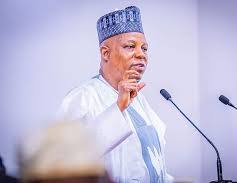
An Open Letter To His Excellency, Senator Kashim Shettima, GCON
BY Emman Usman Shehu
Your Excellency,
In the shadow of Zamfara’s endless funerals, where grief has become as routine as the harmattan wind, your impending arrival on March 24, 2026, feels less like a gesture of solidarity than a stark emblem of national priorities gone tragically awry. You come not to console the bereaved or to confront the architects of terror, but to preside over a ceremonial “decamping”—the formal welcome of Governor Dauda Lawal from the Peoples Democratic Party into the All Progressives Congress. Red carpets will be rolled out in Gusau; flags will wave; speeches will proclaim party unity and political triumph.
Yet the true red that defines Zamfara today is not partisan bunting. It is the blood that soaks the soil of Maru, Tsafe, Anka, Maradun (my ancestral home), countless communities and hamlets where bandits—armed, audacious, and seemingly untouchable—continue to dictate the terms of existence.
Consider the calendar of horror that has shadowed this state in the first twelve weeks of 2026. Just over a week ago, on March 14, gunmen stormed a gold mining site near Arafa village in Maru Local Government Area, abducting five foreign nationals from Burkina Faso in broad daylight. Their fate remains unknown, another entry in the ledger of ransoms and disappearances.
Earlier this year, attacks in Anka claimed dozens of lives—some reports say 50 or more—with women and children hauled away into the forests. Abba, the NYSC member, and indigene of the state- after his brutalisation by bandits went viral globally, remains in captivity despite the payment of a handsome ransom fee. Villages burn; farmers pay exorbitant “protection taxes” to till their own land; students sleep with one eye open, fearing their hostels will become the next viral tragedy.
Your Excellency, these are not isolated incidents but symptoms of a collapsed social contract. Zamfara has long served as Nigeria’s grim laboratory for state failure: where the monopoly on violence has been ceded to non-state actors, where life is cheap and impunity absolute. Families of kidnapped citizens, youth-corpers, teachers, miners—do not debate party manifestos; they count the days since last contact, praying their loved ones still draw breath. A senior staff member at the College of Education was recently murdered even after ransom was paid—a bitter reminder that in Zamfara, payment no longer buys freedom; at best, it buys the right to a grave.
The deepest wound, however, is not merely the violence itself but the selectivity of Abuja’s attention. For years, the people of Zamfara—and the wider North West—have waited for a visit rooted in empathy rather than expediency. No presidential pilgrimage to the scorched farmlands; no vice-presidential vigil with displaced widows; no high-level declaration that every Nigerian life, regardless of postcode or polling unit, carries equal weight. Yet when a governor crosses the aisle, betraying a core election principle and by extension the populace—when a political arithmetic shifts in favor of the ruling party—the machinery of state mobilises swiftly. The optics are unmistakable: a governor’s defection merits the full apparatus of the Presidency; the mass abduction or murder of citizens does not.
This is more than insensitivity; it borders on a moral inversion. In pursuing the chimera of a dominant one-party landscape, the administration risks signaling that the capture of votes outweighs the rescue of the governed. When power is measured in defections rather than lives preserved, the republic itself begins to hollow out. Zamfara’s tragedy is not merely local—it is a national indictment, exposing how security has been subordinated to political housekeeping.
Governor Lawal’s right to realign is unquestioned in a democracy. Political mobility is a feature, not a bug. But the decision to transform that realignment into a celebratory festival—complete with the Vice President as master of ceremonies—on soil still warm from fresh atrocities is a choice that demands reflection. As you step onto that podium, flanked by protocol and applause, look beyond the hired crowds and scripted cheers. Meet the eyes of the ordinary Zamfara indigene: hollowed by loss, hardened by abandonment, yet still clinging to the faint hope that Abuja remembers them beyond election cycles.
We do not ask for miracles. We ask only for proportion—for the flag of the Federal Republic to stand, at last, for something more enduring than party colors. Safety over symbolism. Justice over jamboree. The sanctity of life over the scoreboard of defections.
Your Excellency, let March 24 not be remembered as the day Zamfara was briefly important to the Presidency because a governor changed jerseys. Let it mark a pivot: a moment when power paused its pursuit of dominance long enough to reckon with the human cost of its indifference.
Yours in shared sorrow and stubborn hope,
A Concerned Son of Zamfara.
● Dr Shehu is an Abuja-based writer, activist and educator.