
By Chinedu Agu
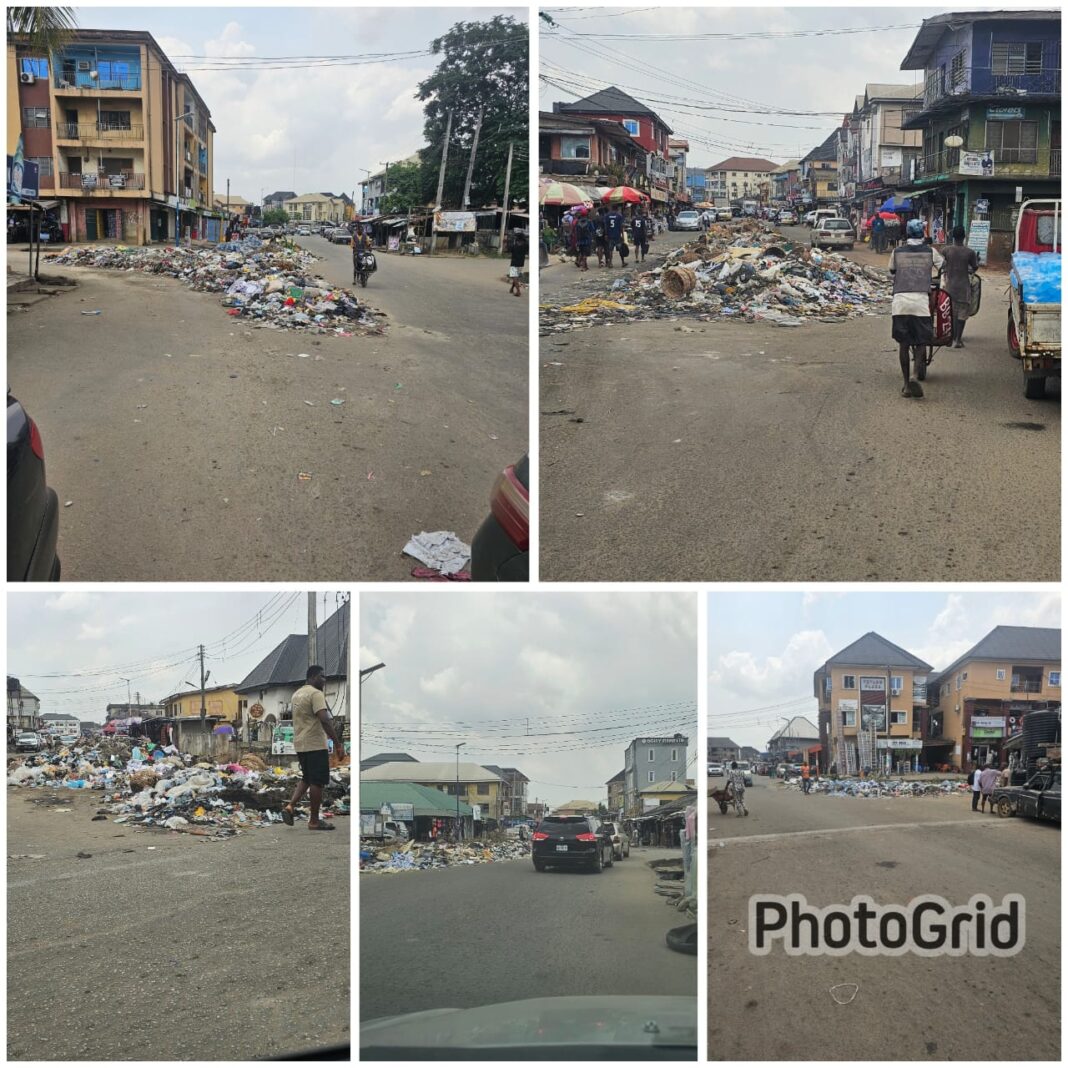
These pictures, taken between 12:15 p.m. and 12:35 p.m. today, Monday, 2 March 2026, show today’s Owerri, once the cleanest city in Nigeria.
The first frame captures the junction of School Road and Njiribeako Street, otherwise referenced as School Road Njiribeako.
The second frame shows the intersection of Tetlow Road and Ajoku Street, commonly described as Tetlow by Ajoku.
The third is the convergence of Tetlow Road and School Road.
The fourth depicts Tetlow Road at Christ Church Street, alas, my own Christ!
The fifth is the junction between Tetlow Road and Lagos Street [Lagos will be so ashamed now, I guess].
For those unfamiliar with the urban geography of Owerri, Tetlow Road is not a peripheral access lane tucked away in obscurity. It lies less than two kilometres from the Imo State Government House, placing it squarely within the administrative and commercial core of the capital. By longitudinal stretch, it is the longest arterial corridor in Owerri.
After Douglas Road, Tetlow is arguably the busiest and most commercially active spine in the metropolis. It is densely tenanted by markets, law offices, retail shops, hospitality outfits, the popular old stadium, and clusters of small and medium enterprises.
Functionally, Tetlow operates as a primary distributor road, interlinking Bank Road, Njemanze Street, Lagos Street, School Road, Christ Church Street, Ajoku Street, Osuji Street, Wetheral Road, Douglas Road, Mere Street, Uratta Street and extending connectivity toward Mbaise Road. It is not merely a road. It is an urban circulatory system. And yet, 48 to 72 hours, sometimes longer, after every celebrated clean up exercise in Owerri, this critical transport corridor routinely degenerates into a linear arrangement of refuse mounds positioned at nodal intersections and carriageway shoulders.
As stated earlier, the images above were taken between 12:15 p.m. and 12:25 p.m. today, Monday, 2 March 2026. High noon; peak of vehicular and pedestrian flow.
At traffic convergence points, heaps of waste sat squarely within driver sightlines, narrowing effective carriage width, obstructing turning radii, and converting strategic junctions into unsightly temporary dump sites. This is not an isolated lapse, it is a recurring post sanitation phenomenon recently.
Last Saturday, 28 February 2026, movements were restricted. Security operatives mounted checkpoints. The monthly sanitation ritual was observed with familiar seriousness. By Monday afternoon, Tetlow Road had resumed its predictable post ritual state.
It is not the first time. In January, refuse gathered during the clean up exercise remained on the roadsides until Tuesday.
Two days after the so called sanitation. We are not cleaning up. We are messing up and relocating dirt. A system that gathers waste and leaves it at intersections for days is not sanitation but putrefaction.
In functioning jurisdictions, clean streets are not achieved by shutting down cities. They are achieved by logistics.
In the United Kingdom, for instance, refuse management is handled by councils [Local Governments] as a routine municipal function. Collection schedules are structured. Households bag waste properly. Trucks evacuate on fixed weekly days. There is no ceremonial shutdown. There are no armed patrols enforcing cleanliness. Every day is sanitation day because sanitation is embedded in daily administration.
Here, however, sanitation is transformed into a special observance and performance. Movement is criminalised for hours. Yet the waste, once swept into piles, remains on major corridors as if mocking the entire exercise.
When clean up requires roadblocks but fails to require refuse trucks in real time, something fundamental is wrong.
Even more troubling is the continued restriction of movement during sanitation exercises, despite judicial pronouncements that blanket restrictions without clear statutory basis offend the constitutional right to freedom of movement.
Last year September, I experienced this personally. Travelling from my village to Owerri on sanitation day, I was stopped by police officers at Orlu [in front of Orlu Local Government Headquarters]. They demanded “morning.” I declined, especially having in August 2025, marked my ten years anniversary of not giving any police officer on the road any form of inducement [my own little way of protesting against roadblocks and extortion]. I was not about to end that discipline. I explained that any directive preventing lawful movement must conform with constitutional guarantees and that administrative convenience can not override fundamental rights. They regarded me like a man speaking Swahili [and indeed, talking law to a policeman in Nigeria is talking Swahili]. They were unmoved. Rather than break my discipline, I opted to remain detained by the roadside from 8:20 a.m to 10 a.m.
At 10:04 a.m., I was asked to _”carry your wahalla dey go.”_ _Nah today?_ Of course that wahalla was refusing to be extorted. Driving away, I was happy I did not blink.
Who has noticed the uncharacteristic keenesss with which law enforcement agents enforce the illegal “no movement order” during mess up, sorry, clean up exercises? Sorry, I am about to digress now.
Under the 1999 Constitution of the Federal Republic of Nigeria, refuse disposal and environmental sanitation fall within the functions of Local Government Councils as outlined in the Fourth Schedule. So one must ask: If waste management is constitutionally a local government responsibility, why does the State Government dominate its execution? Why do state governmemts make pronouncement about “no movement?” Why are local governments financially constrained and administratively subdued, yet the State presides ceremonially over sanitation exercises?
If local governments were properly empowered, properly funded [rather than gift them paltry sum after signing to have collected huge sums], and allowed operational autonomy, Tetlow Road would not convert into a refuse corridor every month.
Let us return to the most basic question. Why are refuse heaps not evacuated simultaneously as they are gathered? If waste is swept at Tetlow by Ajoku at 7 a.m. on Saturday, why is it still there at noon on Monday? Why must drivers weave through trash piles at signalised junctions? Why must pedestrians navigate through decomposing waste at commercial nodes less than two kilometres from Government House?
A gathered heap left on a carriageway shoulder beyond a few hours is not sanitation. It is evidence of broken waste logistics. When strategic urban corridors resemble transfer stations days after a clean up, the issue is not dirt, the issue is systems design.
If we truly desire a state that is clean both literally and figuratively, the solution is neither dramatic enforcement nor monthly ritual. It is structure.
1. Restore Local Government Autonomy. Sanitation funds must be directly managed by Local Governments, as constitutionally envisaged. Ring fenced allocations should be dedicated to waste logistics, not ceremonies.
2. Institutionalise Weekly Street Based Collection. Adopt structured, street by street collection schedules. Waste must be bagged at source and evacuated on predictable weekly cycles.
3. Real Time Evacuation Protocol. Sanitation teams should operate with trailing compactor trucks. No refuse mound should remain roadside beyond one hour after sanitation exercise.
4. End Blanket Movement Restrictions. Environmental order can not come at the expense of constitutional liberty. Clean streets do not require suspended rights.
5. Transparent Contracting and Monitoring. Digitise waste reporting. Publish response times. Track contractor performance publicly. Governance improves when sunlight shines on expenditure.
6. Make Tetlow a Showcase Corridor. Given its proximity to Government House and its status as a principal arterial distributor, Tetlow should be designated a model sanitation corridor, maintained daily, inspected weekly and benchmarked for performance.
Filth is rarely about garbage alone. When refuse decorates Tetlow by Lagos Street. When Tetlow by Christ Church becomes an afterthought. When School Road by Njiribeako turns into a holding bay for waste. When police extort in the name of sanitation. The conversation is no longer about sweeping. It is about governance philosophy. Imo does not need more monthly announcements. Imo needs daily administrative discipline.
Imo does not need checkpoints. Imo needs compactor trucks. Until cleanliness becomes routine rather than ritual, we will continue to sweep on Saturdays and drive through trash on Mondays.
Clean up should never mean mess up.

● Agu, a lawyer and activist, writes from Owerri and can be reached on ezeomeaku@gmail.com.