
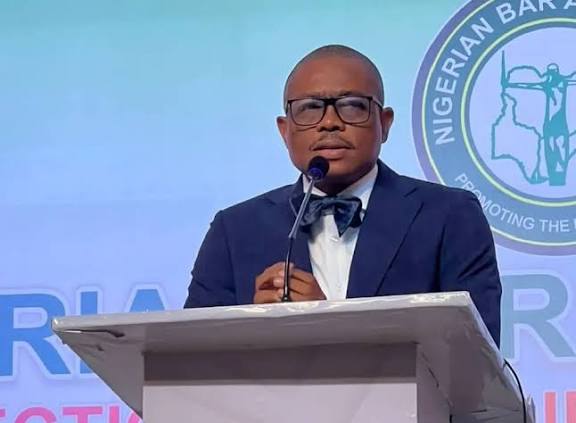
Mazi Afam Osigwe, SAN, President of the Nigerian Bar Association (NBA), has delivered a scathing indictment of corruption within Nigeria’s judiciary and legal profession, branding judges and lawyers among “the most corrupt Nigerians.” He warned that the integrity of the justice system is increasingly compromised, with judgments often swayed more by the “fatness of envelopes” than by the strength of evidence.
Osigwe made these remarks on Friday, February 6, 2026, at the Ralph Opara Memorial Lecture organised by the National Association of Seadogs (NAS) in Enugu. The lecture, themed “Judicial Corruption in Nigeria: A Menace to Democracy and Social Justice,” drew legal practitioners, civil society advocates and public commentators. NAS describes itself as a socio-political group committed to ethical ideals and societal improvement.
Describing the situation as a “moral crisis and a democratic emergency,” Osigwe lamented the erosion of public confidence in the judiciary, once seen as the last hope of the common man. He said that citizens now perceive courtrooms as marketplaces where justice is “auctioned to the highest bidder.”
To substantiate his claims, Osigwe referenced recent surveys showing deepening corruption trends in public institutions:
• A 2024 report by the United Nations Office on Drugs and Crime (UNODC) together with the National Bureau of Statistics (NBS) indicated that public officials in Nigeria received about ₦721 billion in cash bribes in 2023, with judges among the prominent recipients.
• An Independent Corrupt Practices and Other Related Offences Commission (ICPC) survey revealed that approximately ₦9.4 billion flowed through the justice sector via bribes between 2018 and 2020, with lawyers and litigants identified as major bribe-givers.
• Transparency International’s 2024 Corruption Perceptions Index ranked Nigeria 140th out of 180 countries, underscoring persistent transparency challenges.
These figures align with other findings from the Nigeria Corruption Index, which also showed that significant bribe offers and payments are reported across the judiciary and legal profession, particularly in politically sensitive cases like election disputes.
Osigwe emphasized the global consequences of domestic judicial failures, citing prominent cases where litigants sought justice outside Nigeria due to perceived systemic flaws:
• Okpabi v. Royal Dutch Shell – Niger Delta communities took their grievances to UK courts, reflecting frustration with domestic legal avenues.
• P&ID Arbitration Saga – A historic multi-billion-dollar arbitration award against Nigeria was only set aside in London after a UK judge found that the award had been obtained through corrupt practices and fraud. This case is widely seen as a stark rebuke of procedural weaknesses in Nigeria’s dispute resolution environment.
Osigwe described these outcomes as a “global vote of no confidence” in Nigeria’s justice system, with serious implications for foreign investment and the country’s reputation as a rule-of-law jurisdiction.
In response to the crisis, Osigwe proposed a broad set of reforms intended to restore trust and strengthen judicial integrity:
• Merit-based judicial appointments to reduce patronage and favoritism.
• Establishment of state-level judicial academies for continuous professional education and ethical training.
• Removal of the Chief Justice of Nigeria as chair of the National Judicial Council (NJC) to curb concentration of power in judicial governance.
• Implementation of automated case assignment systems to minimise human interference in case allocations.
• Mandatory suspension of judges under credible investigation and strict enforcement of judicial financial autonomy to shield courts from political and financial pressures.
Osigwe also urged religious and traditional institutions to refrain from honouring individuals whose wealth stems from questionable means, stressing that cultural respect should align with ethical conduct.
His comments come amid other NBA actions under his leadership, such as calling out judicial interference in specific cases — for example, giving the Enugu State Chief Judge a two-week ultimatum to reassign a stalled appeal in the case of a detained lawmaker, vowing a boycott of that court if no action was taken. This underscores the association’s readiness to confront corruption not only in rhetoric but in targeted interventions.
Osigwe concluded by warning that the survival of Nigeria’s democracy depends on an incorruptible judiciary — one that commands respect both at home and abroad. He reiterated that the fight against corruption requires a united effort by the Bar, the Bench, civil society, and everyday citizens to ensure justice truly prevails over money.