
By Frank Tietie
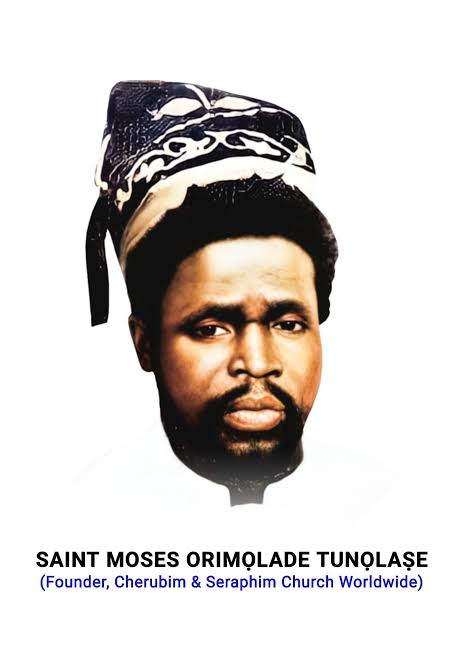
Today, in a moment of childlike curiosity, I found myself reading about a historical figure, Moses Orimolade, the founder of the Cherubim & Seraphim Church. What emerged was the portrait of a life rich in experience, wonder, and accounts of the miraculous, defining cosmic encounters between a mysteriously born Christian prophet and an entrenched community of idol worshippers in a place called Ikare, in what is now South West Nigeria.
From those beginnings, the Cherubim and Seraphim Church movement took root. It spread across the country, carrying with it an air of mystery typical of African spiritual churches with worshippers wearing white garments and characterised by highly rhythmic and gyrating music, spirited dancing, blaring trumpets, and, at times, trance-like prophetic expressions in church services that looked like makeshift concerts mounted for the Creator of heaven and earth, Himself.
As a child shaped by the Sunday School routines of a small-town Anglican church, this world of white-garment-wearing Christians once felt far too enigmatic for my pristine sense to embrace. Still, the spark for today’s reflection came from an old question on my mind, which I finally decided to answer concerning the meaning of the opening chant in the classic song “No More Wars” by Sonny Okosuns, with its repeated refrain, “Orimolade, Orimolade, Orimolade.”
Since 1982, when I first heard the song on a black-and-white broadcast of the NTA Benin, that word, “Orimolade “, had remained a mystery to me. However, today, I now understand that the chant was no accident. It was either a tribute to a man whose ministry was associated with extraordinary spiritual power, so much so that Okosuns’ own family reportedly became members of the Cherubim and Seraphim church, or it was an invocation of that power by which Orimolade operated as a prophet, and, therefore it would be fitting to use it to open a song that dared to pray for what seemed impossible: An Africa without war.
“We don’t want to fight wars no more;
We don’t want to shed blood no more;
We won’t fight no more wars.”
No doubt that Okosuns in the above lines longed for a better Nigeria and a better African continent. In the lyrics, he further prayed against military coups and for the reign of democracy across Africa.
What fascinates me now, after I solved the “Orimolade” mystery, is that, unlike many modern Pentecostal movements, members of the Cherubim and Seraphim Church have not been especially vocal about the richness of their origins. Has the modern church transition in Nigeria, which was often suspicious of white garment-wearing Christians and considered them to be “too trado-spiritual”, made the members of the Cherubim and Seraphim Church mute their historical memory? Has the esteem that they have for their founder faded?
As someone with modest familiarity with Nigeria’s cultural and religious shifts over the past fifty years, I knew of the exploits of Joseph Ayo Babalola of the Apostolic Church, Samuel Bilewu Oshoffa of the Celestial Church of Christ, and Josiah Olufemi Akindayomi, whose work later became the Redeemed Christian Church of God. How, then, had I not truly encountered Moses Orimolade?
Was Okosuns prescient in sensing a future silence around this great man, and so became quite determined to immortalise his name, “Orimolade”, through one of his greatest songs? Frankly, without that refrain, I might never have paused to discover Orimolade and his exploits.
African spiritual churches, particularly those of the white-garment tradition, ought to be more assertive about what they believe and what informs their distinctive modes of worship. One widespread mistake we make, especially in Africa, is the failure to realise that the Church of Jesus Christ was never meant to adopt a single cultural form of worship. It was meant to adapt to every culture without losing its essence. The flood of Romanised, Anglicised, and later Americanised patterns that came to define Christianity in Africa has often hindered its reception among traditional communities.
While I commend the early men and women of Yoruba ancestry who received and spread the liberating gospel of Jesus Christ across Nigeria, those who inherited the faith in whatever form should not be ashamed to proclaim it with the same fidelity with which they received it. They should not fear criticism or shrink before newer waves of Christianity that do not understand them. No small damage has been done by the satire, ‘Trials of Brother Jero’, by the genius, Wole Soyinka. He didn’t help the push back on Western influence as he did well in The Lion and the Jewel’.
For stirring these reflections on “Orimolade,” I invite everyone to listen again to Sonny Okosuns’ No More Wars on YouTube and, in doing so, to honour both the Okosuns family and one of Christianity’s enduring prophets, Moses Orimolade. Find a Yoruba speaker as I did with my colleague, Favour Ogunkolo, to interpret the lyrics, and savour their richness alongside the classic pop arrangement. As I suggested earlier, Okosuns may not have known he was creating a timeless classic before he crossed into the other dimension.
● Tietie, lawyer, media personality, and an enthusiast of the humanities, writes from Abuja.